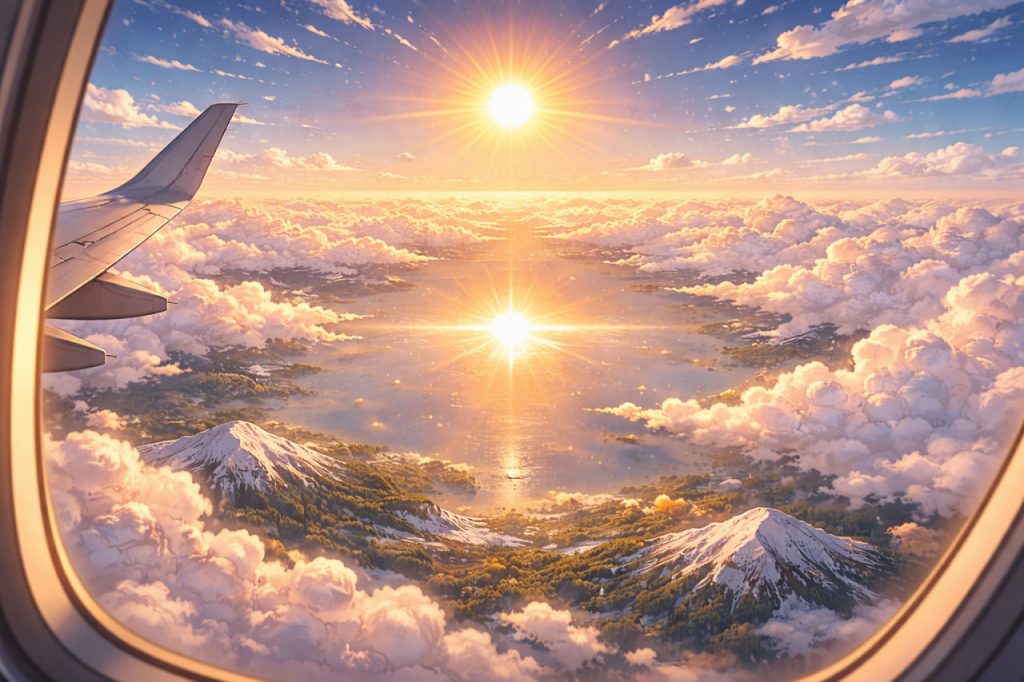
A subsun is a rare and striking atmospheric optical phenomenon that looks like a bright reflection of the Sun appearing below the real Sun. At first glance, it may resemble a second sun shining beneath the horizon or clouds, creating a surreal and almost otherworldly view. Despite its dramatic appearance, the subsun is not a second light source and has nothing to do with astronomy. It is entirely an atmospheric effect, formed under very specific conditions involving ice crystals high in the atmosphere. Understanding the subsun reveals how light, geometry, and nature combine to create one of the most beautiful optical illusions in the sky.
What a Subsun Actually Is
A subsun is an optical reflection of sunlight caused by flat, plate-shaped ice crystals suspended in the atmosphere. These crystals act like tiny mirrors, reflecting sunlight downward. When an observer is positioned above the reflecting layer—such as in an airplane or on a high mountain—the reflected light becomes visible as a bright spot directly below the Sun. The subsun always appears aligned with the real Sun and never exists independently.
How a Subsun Forms
The key requirement for a subsun is a layer of horizontally oriented ice crystals, usually found in cirrus clouds. These crystals float with their flat faces nearly parallel to the ground. When sunlight hits them at the correct angle, it reflects just like light off a mirror. If the observer is above this layer, the reflection becomes visible below the Sun. Without altitude, the phenomenon cannot be seen, which is why subsuns are most often observed from aircraft.
“A subsun is essentially a mirror image of the Sun,
created by millions of ice crystals acting in unison,”
explains atmospheric physicist Dr. Les Cowley.
Why Subsun Is So Rare
Although ice crystals are common in the upper atmosphere, the precise alignment needed for a subsun is uncommon. The crystals must be flat, stable, and uniformly oriented. The Sun’s position, the observer’s height, and cloud structure all must align perfectly. Even slight turbulence can disrupt the effect. This is why many frequent flyers never see a subsun, while some are lucky enough to witness it once or twice in a lifetime.
How Subsun Differs From Sundogs and Halos
Subsun is often confused with other atmospheric phenomena such as sundogs or halos. However, there is a clear distinction. Sundogs appear to the sides of the Sun and are caused by refraction, not reflection. Halos form circular patterns around the Sun or Moon. A subsun, by contrast, is a pure reflection, appears directly below the Sun, and requires the observer to be above the reflective layer. This makes it visually unique among optical sky phenomena.
Where and When Subsun Can Be Seen
Subsun sightings are most common during flights above cold cloud layers, particularly near polar or high-latitude regions. They can also appear above snow-covered landscapes or ice fields under the right conditions. The phenomenon usually occurs when the Sun is relatively low in the sky, enhancing the reflection angle. Winter months increase the likelihood due to greater ice crystal formation.
“Subsun observations remind us that
many atmospheric phenomena depend on viewpoint, not rarity of light,”
notes meteorologist Dr. Raymond Lee.
Scientific and Aesthetic Value
While subsuns do not affect weather or climate, they are scientifically valuable for studying ice crystal behavior in clouds. They also serve as a powerful reminder of how perception depends on perspective. Visually, subsuns are considered among the most beautiful optical effects in nature, often described as ethereal or surreal by those who witness them.
Why Subsun Is Often Misinterpreted
Because it looks like a second Sun, subsun images are sometimes misinterpreted as astronomical anomalies or edited photographs. In reality, the physics behind the phenomenon is well understood. The illusion disappears as soon as the viewing angle changes or the aircraft descends, reinforcing the idea that it is entirely dependent on observer position.
Interesting Facts
- Subsun can only be seen from above the reflecting ice layer.
- It is caused by reflection, not refraction.
- Flat ice crystals act like tiny mirrors.
- Subsun always appears directly below the real Sun.
- Most documented sightings come from airplane windows.
Glossary
- Subsun — an atmospheric optical phenomenon where sunlight is reflected below the Sun.
- Ice Crystals — microscopic frozen particles in high-altitude clouds.
- Cirrus Clouds — thin, high clouds composed mainly of ice crystals.
- Reflection — the bouncing of light off a surface.
- Optical Phenomenon — a visual effect caused by light interaction in the atmosphere.