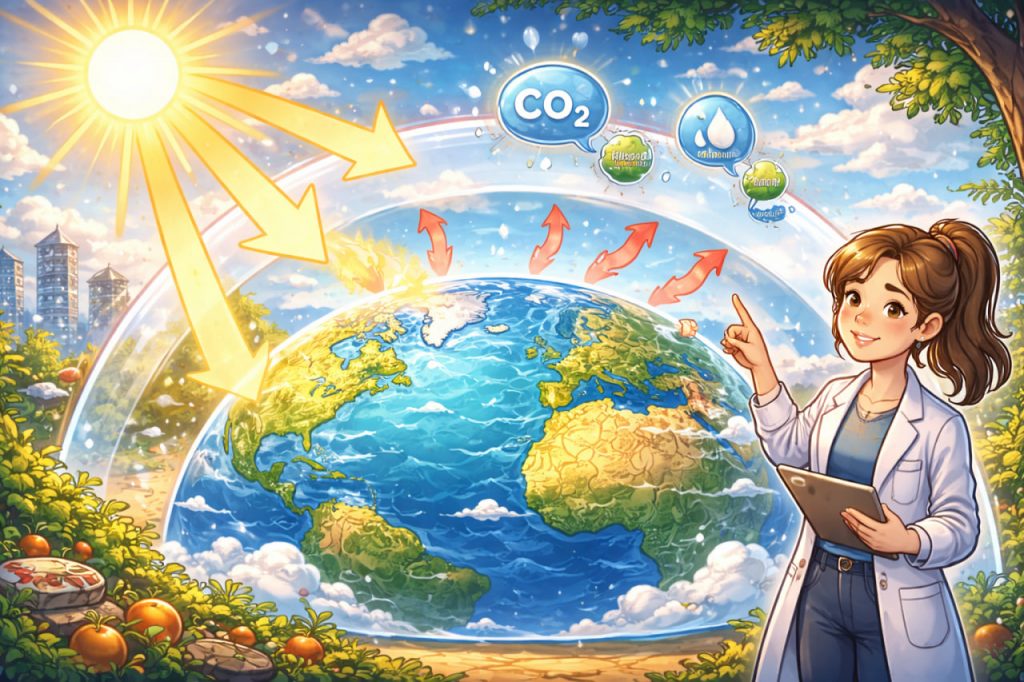
The greenhouse effect is a natural process that allows life to exist on Earth, yet it is often misunderstood or oversimplified. In basic terms, it describes how heat is retained in the atmosphere, preventing our planet from becoming too cold. Without it, Earth would resemble a frozen world rather than a living ecosystem. However, when this process intensifies beyond natural levels, it leads to global warming and climate instability. Understanding the greenhouse effect in simple terms helps explain both its necessity and its risks.
How the Greenhouse Effect Works
The Sun sends energy to Earth mainly as visible light. This energy passes through the atmosphere and warms the planet’s surface. The warmed surface then emits heat back toward space in the form of infrared radiation. Greenhouse gases absorb part of this heat and re-emit it in all directions, including back toward the surface. This creates a warming effect similar to a thermal blanket around the planet.
“Greenhouse gases act like a temperature regulator.
They don’t create heat, but they slow its escape,”
explains climate physicist Dr. Michael Oppenheimer.
This balance is what keeps Earth’s average temperature stable enough for life.
Why It Is Called the Greenhouse Effect
The term comes from a comparison with greenhouses used in agriculture. Sunlight enters easily, but heat escapes slowly, keeping the interior warm. While the physical mechanisms differ, the analogy helps people visualize the concept. Earth’s atmosphere works in a similar way—transparent to sunlight, but partially restrictive to outgoing heat.
The Natural Greenhouse Effect
The natural greenhouse effect has existed for millions of years. Water vapor, carbon dioxide, methane, and other gases are naturally present in the atmosphere and play a crucial role in maintaining climate stability. This process allowed oceans to form and ecosystems to develop. For most of human history, this system remained relatively balanced.
“Without the natural greenhouse effect,
Earth’s surface would be too cold for liquid water,”
notes climatologist Dr. Katharine Hayhoe.
In this sense, the greenhouse effect itself is not harmful—it is essential.
What Happens When the Effect Becomes Stronger
Problems arise when human activity adds large amounts of greenhouse gases to the atmosphere. Burning fossil fuels, deforestation, and industrial processes increase gas concentrations, trapping more heat than the natural system can balance. This leads to a gradual rise in global temperatures. The result is not just warming, but disruption of weather patterns, melting ice, rising sea levels, and increased frequency of extreme events.
Why Small Temperature Changes Have Big Effects
Climate systems are highly sensitive. Even a small average temperature increase can shift rainfall patterns, affect agriculture, and stress ecosystems. Ice and snow loss reduces the planet’s ability to reflect sunlight, amplifying warming further. These feedback loops explain why scientists focus on fractions of degrees rather than dramatic temperature jumps.
Common Misunderstandings
One widespread misconception is that the greenhouse effect and the ozone hole are the same phenomenon—they are not. Another is believing the greenhouse effect is entirely negative. In reality, the issue is excessive amplification, not the process itself. Clear understanding helps replace fear with informed discussion.
Why Understanding This Process Matters
Understanding the greenhouse effect helps people make sense of climate science, policy discussions, and environmental responsibility. It explains why reducing emissions, preserving forests, and improving energy efficiency matter. Awareness empowers informed choices rather than passive concern.
Interesting Facts
- Without the greenhouse effect, Earth would be about 33°C colder.
- Water vapor is the most influential natural greenhouse gas.
- Carbon dioxide can remain in the atmosphere for hundreds of years.
- Even small temperature increases can disrupt entire ecosystems.
- The greenhouse effect is natural.
Glossary
- Greenhouse Effect — the process by which atmospheric gases trap heat.
- Greenhouse Gases — gases that absorb and re-emit infrared radiation.
- Global Warming — long-term rise in Earth’s average temperature.
- Atmosphere — the layer of gases surrounding Earth.
- Climate Feedback — a process that amplifies or reduces climate change.