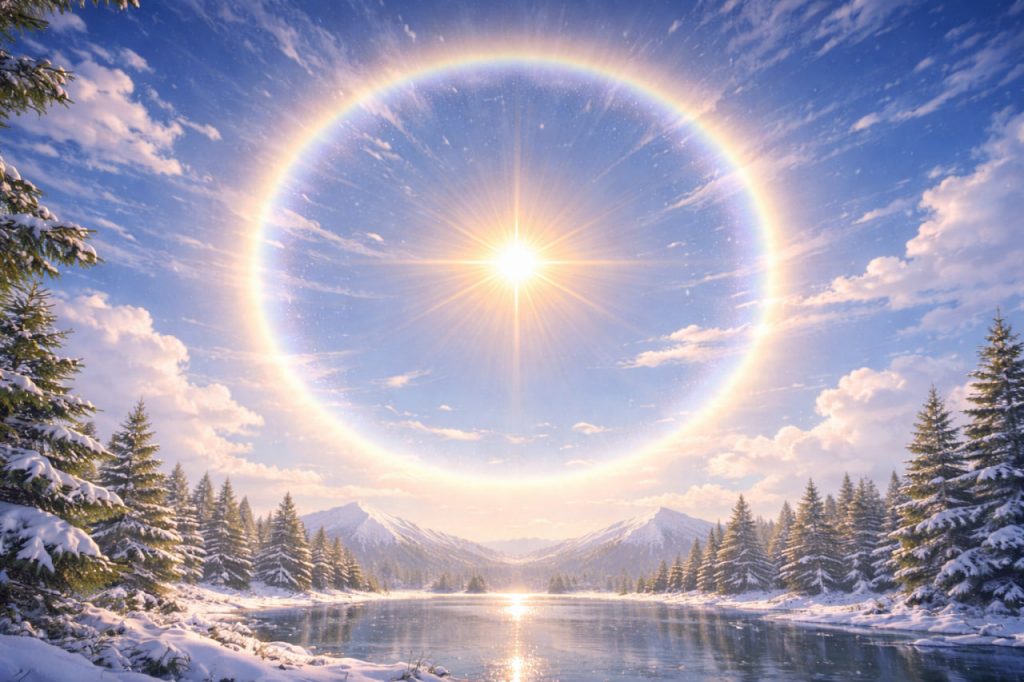
A halo is a beautiful and sometimes mysterious atmospheric phenomenon that appears as a bright ring or arc of light around the Sun or the Moon. For many people, seeing a halo feels unusual or even symbolic, yet it is a well-understood optical effect explained by physics and atmospheric science. Halos form when light interacts with ice crystals high in the atmosphere, creating precise geometric patterns in the sky. Although they look delicate and rare, halos are more common than most people realize—they are simply often unnoticed. Understanding how halos form reveals the hidden structure of clouds and the behavior of light in Earth’s atmosphere.
What a Halo Actually Is
A halo is an optical phenomenon caused by the refraction and reflection of light through tiny ice crystals suspended in high-altitude clouds. These clouds, usually cirrus or cirrostratus, are composed almost entirely of ice rather than water droplets. When sunlight or moonlight passes through the crystals, it bends at specific angles, producing rings, arcs, or spots of light. The most common halo appears as a nearly perfect circle with a radius of about 22 degrees around the Sun or Moon.
How Ice Crystals Create Halos
The key to halo formation lies in the shape and orientation of ice crystals. Most atmospheric ice crystals are hexagonal in structure. When light enters one face of the crystal and exits through another, it bends at a consistent angle. Millions of crystals acting together create a continuous ring of light. Unlike subsuns, which rely on reflection, halos are primarily the result of refraction—light bending as it passes through ice.
“Halos are nature’s demonstration of geometry in the sky,
created by countless ice crystals acting as tiny prisms,”
explains atmospheric scientist Dr. Les Cowley.
Different Types of Halos
Not all halos look the same. The most common is the 22-degree halo, visible as a bright circle around the Sun or Moon. Less common are 46-degree halos, which appear larger and fainter. Other related phenomena include light arcs, tangent arcs, and bright spots sometimes mistaken for extra suns or moons. Each form depends on crystal shape, orientation, and the observer’s position.
Why Halos Appear Around the Sun and the Moon
Halos can form around both the Sun and the Moon because both act as strong light sources. Solar halos are easier to see due to brightness but require eye protection. Lunar halos are dimmer and usually visible at night around a full or nearly full Moon. The physics behind both is the same—the only difference is the light source intensity.
Do Halos Predict Weather Changes
Historically, halos were used as weather signs, especially by sailors and farmers. This belief has some scientific basis. Cirrostratus clouds often appear ahead of large weather systems, meaning a halo can indicate incoming precipitation within the next day or so. However, halos do not guarantee rain or snow—they simply suggest high-altitude ice clouds are present.
“A halo doesn’t cause weather,
but it can signal that atmospheric conditions are changing,”
notes meteorologist Dr. Raymond Lee.
Why Halos Are Often Misunderstood
Because halos are visually striking, they are sometimes interpreted as supernatural or symbolic events. In reality, they are purely physical phenomena governed by optics. Their apparent rarity is largely due to people not looking up or mistaking thin clouds for clear sky. Once you know what to look for, halos become easier to spot.
Scientific and Aesthetic Value
Halos provide scientists with information about cloud composition and atmospheric conditions. For observers, they offer a reminder that complex physical processes are constantly happening above us, often unnoticed. Halos combine scientific precision with natural beauty, making them one of the most elegant sky phenomena.
Interesting Facts
- The most common halo has a radius of 22 degrees.
- Halos are caused by refraction, not reflection.
- They can appear around both the Sun and the Moon.
- Ice crystals, not water droplets, are essential for halo formation.
- Halos are more common than most people think.
Glossary
- Halo — an optical ring or arc of light around the Sun or Moon.
- Ice Crystals — microscopic frozen particles in high clouds.
- Refraction — bending of light as it passes through a material.
- Cirrostratus Clouds — high, thin clouds often linked to halos.
- Optical Phenomenon — a visual effect caused by light interactions.