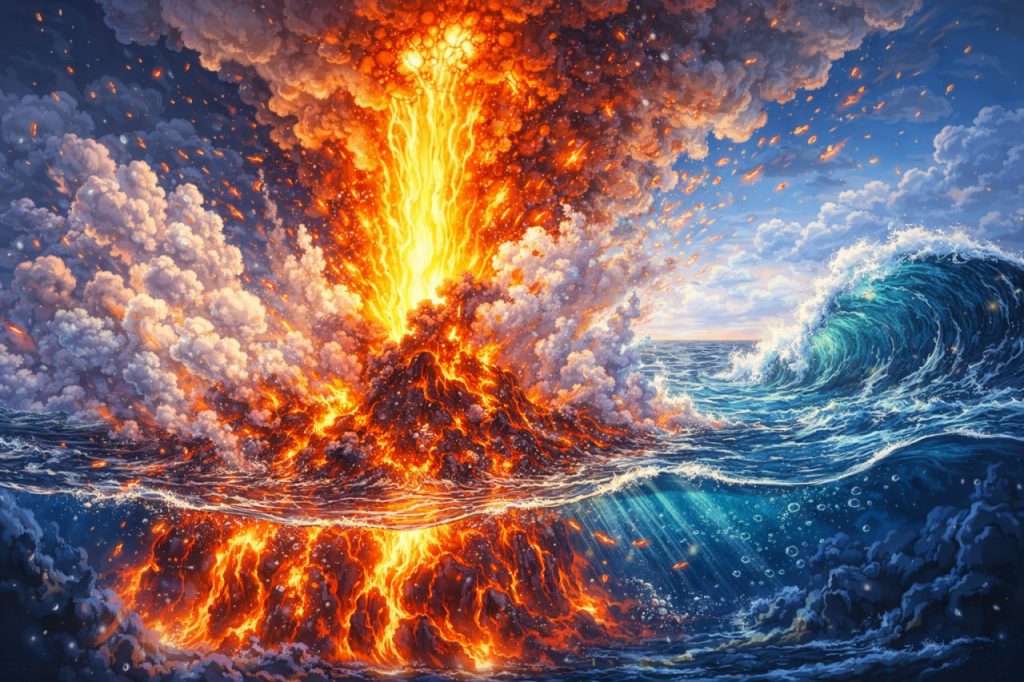
The idea of lava from Earth’s outer core coming into contact with the waters of the global ocean is a dramatic and intriguing scenario. However, in reality, this situation is extremely unlikely because the outer core is located thousands of kilometers beneath the surface. Between the core and the ocean lie the mantle and crust, which act as massive barriers. Still, imagining such an event helps scientists and thinkers explore the limits of geological processes and their potential consequences. If such a phenomenon were possible, it would involve enormous amounts of energy and lead to global-scale effects. Understanding this hypothetical scenario allows us to better appreciate the structure and stability of our planet. It also highlights how extreme conditions inside Earth differ from those at the surface.
Why This Scenario Is Nearly Impossible
The outer core is separated from the surface by layers of solid and semi-solid rock that are thousands of kilometers thick. For material from the outer core to reach the ocean, it would have to pass through the mantle and crust, which would require energy far beyond natural geological processes. Even the most powerful volcanic eruptions originate in the mantle, not the core. Geophysicist Dr. Alan Murray explains:
“There is no known mechanism that allows material
from the outer core to directly reach the surface.”
This means that such an event remains purely theoretical. The structure of Earth is stable enough to prevent this kind of interaction. The layers of the planet act as protective barriers that maintain internal balance.
What If It Somehow Happened
If, hypothetically, extremely hot material from deep within the Earth reached the ocean, the results would be catastrophic. The temperature difference between molten material and ocean water would cause instant vaporization of water. This would produce massive explosions driven by rapid steam formation. These explosions could generate powerful shockwaves and eject large amounts of material into the atmosphere. The interaction would also create enormous plumes of steam and ash. The scale of such events would far exceed typical volcanic eruptions. It would likely affect large regions of the planet.
Impact on Oceans and Atmosphere
The sudden release of heat into the ocean would cause widespread disruption. Large volumes of water could be rapidly heated, potentially leading to massive steam clouds and atmospheric disturbances. This could affect weather patterns and create temporary climate changes. The release of gases and particles into the atmosphere would also impact air quality and sunlight penetration. Ocean ecosystems would be severely affected due to temperature changes and chemical imbalances. Marine life would struggle to survive in such extreme conditions. The event would demonstrate how sensitive Earth systems are to sudden changes.
Potential Tsunamis and Geological Effects
Such a powerful interaction could also trigger massive tsunamis. Rapid displacement of water combined with explosive energy would generate waves capable of traveling across entire oceans. Coastal regions would face severe destruction. Additionally, the event could destabilize surrounding geological structures, potentially causing earthquakes or further volcanic activity. The combination of oceanic and geological disturbances would make the event extremely destructive. These effects would extend far beyond the initial point of contact. The global impact would be significant.
Why This Scenario Matters
Although this scenario is not realistic, it helps scientists understand the limits of Earth’s internal processes. Studying extreme possibilities allows researchers to refine models of planetary structure and behavior. It also helps explain why Earth remains stable despite its dynamic interior. The separation of layers prevents catastrophic interactions between deep and surface environments. This stability is one of the reasons life can exist on Earth. Exploring such ideas encourages deeper understanding of geology and planetary science. It shows how even hypothetical scenarios can provide valuable insights.
P.S. I saw on the Internet the work of volunteers who warned about a possible similar event in the Mariana Trench no later than 2036. To be honest, I didn’t believe it at the time, but after writing this article and what happened to the Hungo Tonga Hapai volcano, I feel uneasy.
Interesting Facts
- The outer core is located about 3,000 kilometers below the surface
- Temperatures in the core can exceed 5,000°C
- Most volcanic activity originates in the mantle, not the core
- Water expands rapidly when turned into steam, causing explosions
- Earth’s layered structure protects the surface from extreme internal processes
Glossary
- Outer Core — liquid layer of Earth composed mainly of iron and nickel
- Mantle — thick layer between the crust and core
- Steam Explosion — explosion caused by rapid vaporization of water
- Shockwave — pressure wave produced by a powerful event
- Tsunami — large ocean wave caused by sudden displacement of water