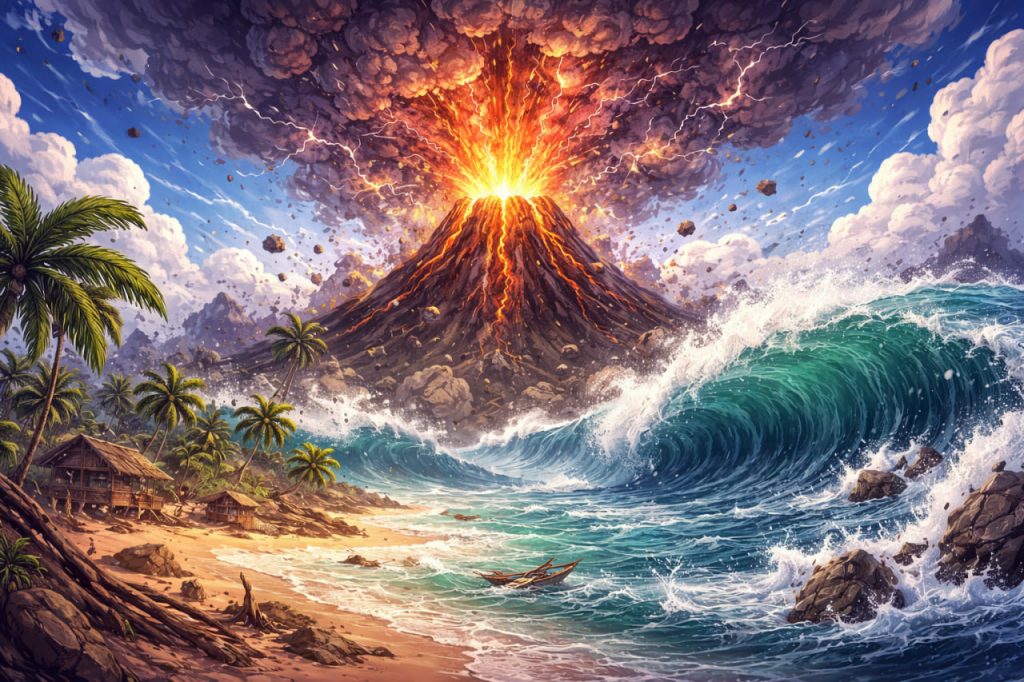
The eruption of Hunga Tonga–Hunga Haʻapai in January 2022 became one of the most remarkable volcanic events in modern history. It occurred in the South Pacific Ocean near the Kingdom of Tonga and was powerful enough to be detected across the entire planet. The explosion sent shockwaves through the atmosphere that circled the Earth multiple times, something rarely observed in recorded history. Massive amounts of ash, gas, and water vapor were released high into the stratosphere, reaching altitudes of over 50 kilometers. This made it one of the most energetic eruptions since the famous eruption of Krakatoa in 1883. The event also demonstrated how underwater volcanoes can produce global-scale atmospheric effects. Scientists continue to study this eruption to better understand extreme geological processes and their impact on the planet.
What Happened During the Eruption
The eruption was driven by a powerful interaction between magma and seawater, which created an explosive reaction known as a phreatomagmatic eruption. This type of eruption occurs when hot magma comes into direct contact with water, causing rapid vaporization and extreme pressure buildup. The resulting explosion was so strong that it generated a massive plume of ash and steam that spread across the Pacific region. The eruption destroyed much of the volcanic island itself, dramatically altering its shape and structure. Satellite images showed that large portions of land were completely erased within hours. The force of the blast also produced a powerful atmospheric pressure wave that was recorded worldwide. This demonstrated the enormous energy stored within Earth’s geological systems.
Tsunamis and Global Impact
One of the most significant consequences of the eruption was the generation of tsunamis that affected not only Tonga but also distant coastlines. Waves were observed across the Pacific Ocean, reaching countries such as Japan, the United States, and Chile. Although many of these waves were relatively small, their global reach was extraordinary. In Tonga itself, the tsunami caused damage to infrastructure, homes, and communication systems. The eruption also disrupted undersea communication cables, temporarily isolating the country from the rest of the world. In addition to oceanic effects, the atmospheric shockwave created unusual pressure changes recorded by instruments worldwide. This event showed how a single eruption can influence multiple systems—oceanic, atmospheric, and geological—at the same time.
Atmospheric and Climate Effects
Unlike many volcanic eruptions, Hunga Tonga released an unusually large amount of water vapor into the atmosphere rather than primarily sulfur dioxide. This is significant because water vapor is a greenhouse gas that can influence climate in different ways. The eruption injected this vapor directly into the stratosphere, where it can remain for extended periods. Some scientists believe this may have a temporary warming effect, unlike eruptions that cause cooling through ash and aerosols. The event also created spectacular atmospheric phenomena, including unusual cloud formations and vivid sunsets observed around the world. These visual effects were a direct result of particles and gases spreading through the upper atmosphere. The eruption provided a rare opportunity to study how volcanic emissions interact with climate systems.
Scientific Importance of the Event
The Hunga Tonga eruption has become a key case study for scientists studying extreme volcanic activity. It provided valuable data on how underwater eruptions behave differently from those on land. The combination of satellite observations, atmospheric measurements, and ocean data allowed researchers to analyze the event in unprecedented detail. Scientists are particularly interested in how the eruption affected atmospheric circulation and wave propagation. The global detection of the pressure wave helped improve models used to understand large-scale explosions. This knowledge can also contribute to better monitoring and early warning systems for future events. The eruption highlighted the importance of international cooperation in studying global natural phenomena.
Why This Eruption Matters
This event is important not only because of its power but also because of its wide-ranging effects on Earth systems. It demonstrated how interconnected the planet is, with a single eruption influencing oceans, atmosphere, and human infrastructure. The eruption also reminded scientists and policymakers of the potential risks posed by rare but extreme natural events. Understanding such eruptions helps improve disaster preparedness and global monitoring systems. It also provides insight into how similar events in the past may have affected Earth’s climate and ecosystems. As research continues, the Hunga Tonga eruption will remain one of the most studied geological events of the 21st century. Its legacy lies in the knowledge it provides for understanding our dynamic planet.
Interesting Facts
- The eruption’s shockwave circled the Earth multiple times
- The plume reached over 50 kilometers into the atmosphere
- It was one of the most powerful eruptions since Krakatoa (1883)
- Tsunamis were detected across the entire Pacific Ocean
- It released an unusually high amount of water vapor
Glossary
- Phreatomagmatic Eruption — an explosion caused by interaction between magma and water
- Stratosphere — upper layer of Earth’s atmosphere above weather systems
- Tsunami — large ocean wave caused by underwater disturbances
- Shockwave — powerful wave of pressure created by an explosion
- Magma — molten rock beneath Earth’s surface