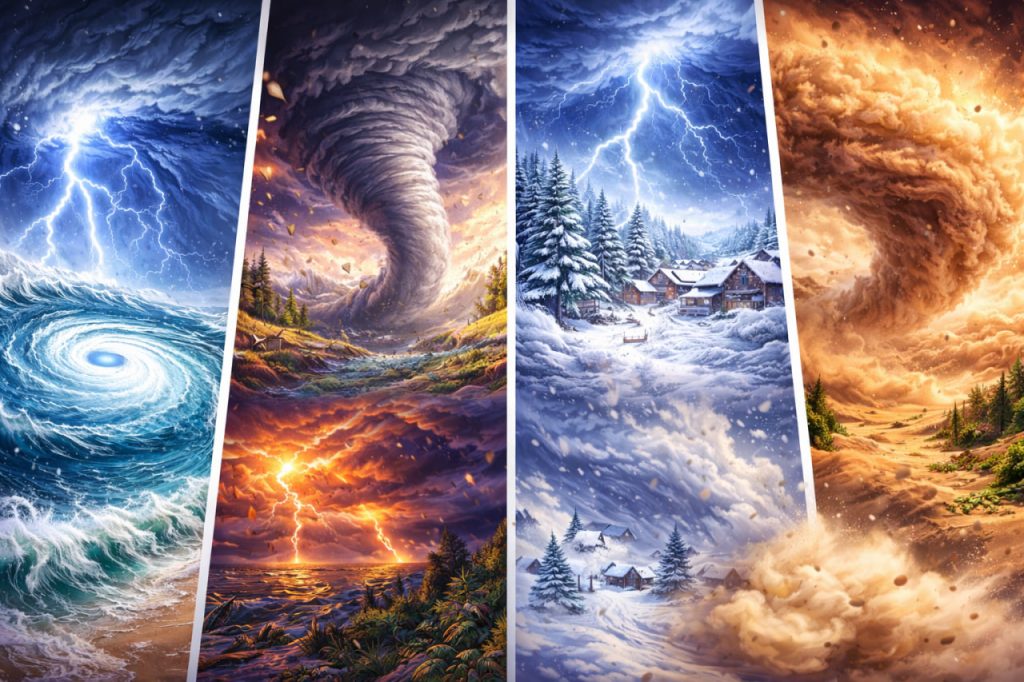
Storms are among the most dynamic and powerful natural events on Earth, forming when atmospheric conditions become unstable and energy is rapidly released. They can develop over oceans, land, or both, and vary greatly in size, intensity, and impact. While some storms bring beneficial rainfall, others cause severe damage through strong winds, flooding, lightning, and extreme pressure changes. Storms are driven by interactions between temperature differences, moisture, and air movement, which together create the conditions for turbulence in the atmosphere. Understanding the different types of storms helps scientists improve forecasting, reduce risks, and better prepare communities for extreme weather events. Despite their differences, all storms share a common origin in the imbalance of atmospheric energy.
Thunderstorms
Thunderstorms are the most common type of storm and can occur almost anywhere in the world. They form when warm, moist air rises rapidly and cools, creating towering clouds known as cumulonimbus. These storms are characterized by lightning, thunder, heavy rain, and sometimes hail. In stronger cases, thunderstorms can produce damaging winds or even spawn tornadoes. Although many thunderstorms are short-lived, they can still cause flash floods and localized destruction. Their intensity depends on how much energy is available in the atmosphere and how quickly air rises.
Tropical Storms and Hurricanes
Tropical storms, including hurricanes, typhoons, and cyclones, form over warm ocean waters where heat and moisture fuel their growth. These systems are large, organized, and can last for days or even weeks. As they strengthen, they develop a well-defined structure with an eye, surrounding eyewall, and spiral rainbands. Strong winds, heavy rainfall, and storm surges make them especially dangerous for coastal regions. Their classification depends on wind speed, with hurricanes representing the most intense stage. These storms can impact vast areas and cause widespread damage.
Tornadoes
Tornadoes are among the most violent and unpredictable storms, characterized by rapidly rotating columns of air that extend from a thunderstorm to the ground. They are typically short-lived but extremely powerful, with winds that can exceed 300 km/h. Tornadoes form when there is a combination of wind shear, instability, and strong updrafts within thunderstorms. Their paths are usually narrow, but the destruction within those paths can be severe. Because they develop quickly, early warning systems are critical for safety.
Blizzards
A blizzard is a severe winter storm defined by strong winds, heavy snowfall, and reduced visibility. Unlike regular snowstorms, blizzards create whiteout conditions that can last for hours or even days. These storms are especially dangerous due to freezing temperatures and wind chill, which can threaten human survival. Transportation systems are often disrupted, and infrastructure can be damaged by ice accumulation. Blizzards are common in polar and temperate regions during winter months.
Sandstorms and Dust Storms
Sandstorms and dust storms occur in dry, arid regions where strong winds lift large amounts of sand and dust into the atmosphere. These storms reduce visibility dramatically and can travel long distances, affecting air quality and human health. Fine particles carried by the wind can damage machinery, contaminate water supplies, and disrupt transportation. Although they may seem less intense than other storms, their impact on ecosystems and infrastructure can be significant, especially in desert regions.
Interesting Facts
- The largest storms on Earth, tropical cyclones, can span over 1,000 kilometers in diameter.
- Lightning from thunderstorms can heat the air to five times hotter than the surface of the Sun for a brief moment.
- Tornadoes can form and dissipate in just a few minutes, making them extremely difficult to predict.
- Some hurricanes release more energy in a day than all human power generation combined.
- Dust from major sandstorms can travel across continents and even reach other oceans.
Glossary
- Cumulonimbus — a tall, dense cloud associated with thunderstorms and severe weather.
- Storm Surge — a rise in sea level caused by strong winds pushing water toward the coast.
- Wind Shear — a change in wind speed or direction with height that can influence storm formation.
- Eyewall — the most intense part of a hurricane surrounding the calm center (eye).
- Whiteout — a condition in which visibility is severely reduced due to snow and wind.