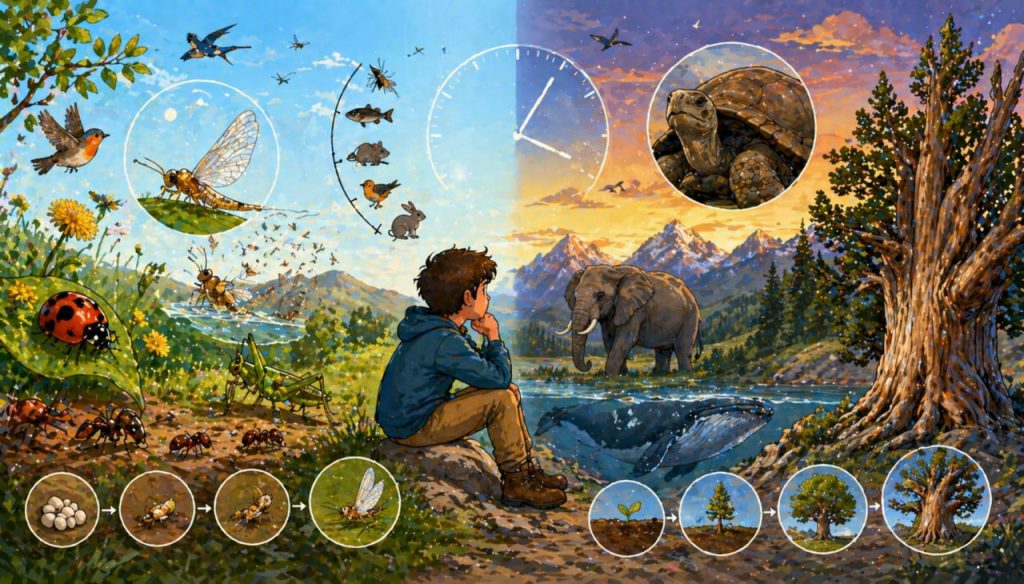
The “speed of life” describes how fast an organism goes through its life processes. These include growth, reproduction, and aging. Some species live fast, reproducing quickly and dying young, while others develop slowly and live for decades or even centuries.
This variation is not random. It reflects evolutionary strategies that help species survive in specific environments. Fast-living organisms often thrive in unstable conditions, while slow-living species tend to dominate in more stable ecosystems.
Metabolism: The Engine Behind Life’s Pace
At the core of life speed is metabolism, the set of chemical processes that keep organisms alive. Metabolism determines how quickly energy is used within the body.
Animals with high metabolic rates use energy rapidly. This often leads to:
- Faster growth
- Higher activity levels
- Shorter lifespans
For example, small mammals like mice have rapid metabolisms and short lives, while larger animals like elephants have slower metabolisms and live much longer.
Biologist Max Kleiber, known for his work on metabolic scaling, observed:
“The metabolic rate of animals is not proportional to their size, but follows a predictable pattern that influences lifespan and biological processes.”
This relationship, often called Kleiber’s law, helps explain why life speed varies so dramatically across species.
Time Perception Across Species
Although we cannot directly measure how animals experience time, research suggests that different species may perceive time at different rates.
Animals with faster metabolisms often process information more quickly. This means they may experience more “moments” within the same period compared to slower organisms.
For instance:
- Flies can react to movement extremely quickly
- Birds perceive rapid changes in their environment
- Humans experience time at a moderate pace
This difference in perception may give fast-living animals an advantage in avoiding predators or capturing prey.
Fast Life vs Slow Life Strategies
In ecology, species are often grouped by their life strategies:
Fast-life species:
- Short lifespan
- Rapid reproduction
- High population turnover
Examples include insects, small rodents, and many fish.
Slow-life species:
- Long lifespan
- Delayed reproduction
- Fewer offspring
Examples include elephants, whales, and large trees.
Each strategy has advantages. Fast-life species can quickly adapt to changing conditions, while slow-life species invest more in survival and stability.
Environmental Influence on Life Speed
The environment plays a major role in determining how fast organisms live.
In unstable or harsh environments:
- Life tends to be faster
- Organisms reproduce quickly
- Lifespans are shorter
In stable environments:
- Life tends to slow down
- Organisms grow more gradually
- Lifespans increase
For example, desert plants often grow quickly after rainfall, while rainforest trees grow slowly over many years.
The Role of Temperature
Temperature strongly affects biological processes. In general, higher temperatures increase metabolic activity, speeding up life processes.
This is why:
- Cold-blooded animals become more active in warm conditions
- Organisms in colder environments often have slower life cycles
Temperature-driven changes in metabolism can influence everything from growth rates to lifespan.
Longevity and Energy Trade-Offs
Living longer often requires a different allocation of energy. Organisms must balance energy between growth, reproduction, and maintenance.
Fast-living species invest heavily in reproduction, often at the cost of longevity. Slow-living species invest more in repair and maintenance, allowing them to live longer.
This trade-off is a key principle in evolutionary biology and helps explain why no species can maximize all aspects of life at once.
Human Perspective on Life Speed
Humans occupy a middle ground in the spectrum of life speed. Compared to many animals, we live relatively long lives and reproduce slowly.
However, modern lifestyles have altered how we experience time. Technology, work schedules, and urban environments often accelerate our perception of life, even though our biological pace remains unchanged.
Understanding the natural variability of life speed can encourage a more balanced perspective, reminding us that slower rhythms are just as natural as fast ones.
Why the Relativity of Life Speed Matters
Recognizing that life unfolds at different speeds across species provides deeper insight into biodiversity and ecological balance.
It helps scientists:
- Predict how species respond to environmental changes
- Understand population dynamics
- Study aging and longevity
It also offers a philosophical perspective, showing that time is not experienced uniformly across life on Earth.
Interesting Facts
- Some insects complete their entire life cycle in less than 24 hours.
- Greenland sharks can live for over 400 years, making them among the longest-living vertebrates.
- Hummingbirds have extremely fast metabolisms, requiring constant feeding.
- Trees like bristlecone pines can live for thousands of years.
- Animals with faster metabolisms often perceive motion more sharply than humans.
Glossary
- Metabolism — The chemical processes that provide energy for life.
- Lifespan — The length of time an organism lives.
- Ecology — The study of how organisms interact with their environment.
- Metabolic Rate — The speed at which an organism uses energy.
- Longevity — The ability to live a long life.