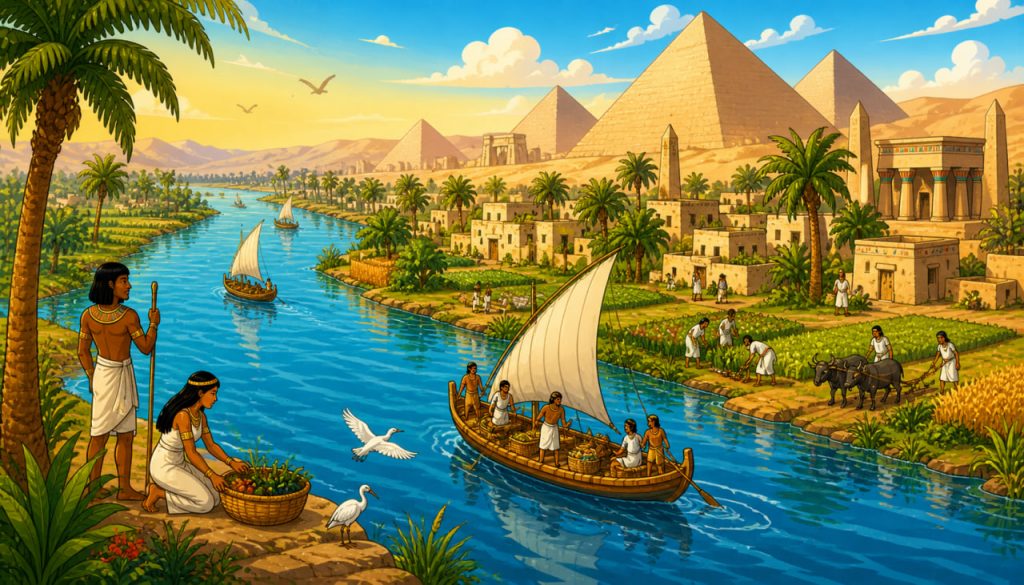
The Nile River is one of the most famous and historically significant rivers in the world. Flowing through northeastern Africa, it has supported human civilization for thousands of years. Often called the “lifeblood of Egypt,” the Nile has shaped cultures, economies, and ecosystems. Understanding this river reveals how geography can influence the rise of entire civilizations.
What Is the Nile River?
The Nile is a major north-flowing river in Africa, widely considered one of the longest rivers in the world, stretching approximately 6,650 kilometers (4,130 miles).
It flows through multiple countries, including:
- Uganda
- Sudan
- Egypt
The river empties into the Mediterranean Sea.
Its vast length and reach make it one of the most important rivers on Earth.
Sources of the Nile
The Nile has two main tributaries:
The White Nile
- Originates from Lake Victoria
- Provides a steady flow of water
The Blue Nile
- Begins in Ethiopia
- Supplies most of the river’s water and fertile sediment
These two rivers meet in Sudan and form the main Nile.
The Role of the Nile in Ancient Egypt
The Nile was central to the development of ancient Egyptian civilization.
It provided:
- Water for drinking and irrigation
- Fertile soil for agriculture
- Transportation routes
The annual flooding of the Nile deposited nutrient-rich silt along its banks.
This natural cycle made farming possible in an otherwise desert environment.
Agriculture and the Flood Cycle
Ancient Egyptians depended on the Nile’s predictable flooding.
Each year:
- The river overflowed its banks
- Fields were covered with fertile mud
- Crops could be planted afterward
This cycle supported crops like:
- Wheat
- Barley
- Flax
Without the Nile, ancient Egypt could not have thrived.
Economic and Cultural Importance
The Nile was not just a source of food—it was a foundation for culture and trade.
It enabled:
- Trade between regions
- Movement of goods and people
- Cultural exchange
Cities and temples were built along its banks.
Expert Insight
Historian Herodotus, often called the “Father of History,” famously said:
“Egypt is the gift of the Nile.”
This statement reflects how essential the river was to the development of one of the world’s greatest civilizations.
The Nile in Modern Times
Today, the Nile continues to play a vital role.
It supports:
- Millions of people
- Agriculture and industry
- Hydroelectric power
Countries rely on it for water resources and economic activity.
The Aswan High Dam
One of the most important modern developments is the Aswan High Dam in Egypt.
It was built to:
- Control flooding
- Store water
- Generate electricity
While beneficial, it also changed natural sediment flow.
Environmental Importance
The Nile supports diverse ecosystems.
It provides habitats for:
- Fish species
- Birds
- Crocodiles and other wildlife
However, modern challenges include:
- Pollution
- Water overuse
- Climate change
Protecting the Nile is essential for future sustainability.
Why the Nile Flows North
Unlike most major rivers, the Nile flows northward.
This is due to:
- Elevation differences
- The slope of the land
It begins in higher southern regions and moves toward lower northern areas.
The Nile and Human Survival
For thousands of years, the Nile has supported life in one of the harshest environments on Earth.
It:
- Transforms desert into fertile land
- Provides water in dry regions
- Sustains large populations
It remains one of the most important natural resources in Africa.
Interesting Facts
- The Nile is one of the longest rivers in the world.
- It flows north instead of south.
- Ancient Egyptians relied on its flooding cycle.
- It passes through multiple countries.
- The river has been used for over 5,000 years.
Glossary
- Tributary — A smaller river that flows into a larger one.
- Irrigation — Supplying water to land for agriculture.
- Sediment — Material carried and deposited by water.
- Delta — Land formed at the mouth of a river.
- Hydroelectric Power — Electricity generated from flowing water.