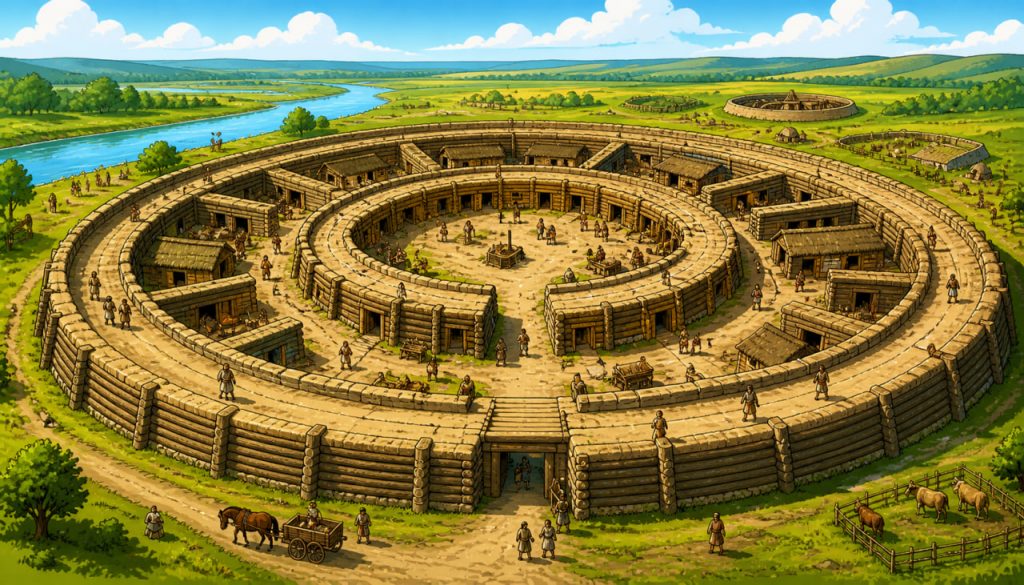
Arkaim is one of the most remarkable archaeological discoveries of the late 20th century. Located in the southern Ural region of Russia, this ancient settlement has attracted scientists, historians, and enthusiasts from around the world. Often described as a “mysterious city,” Arkaim provides valuable insight into early human societies. Its unique structure and advanced design suggest that ancient civilizations were far more complex and organized than previously believed.
What Is Arkaim?
Arkaim is an ancient fortified settlement dating back to approximately the 17th–16th centuries BCE. It belongs to the Sintashta culture, which is associated with early Indo-European populations.
Key characteristics include:
- A circular layout
- Defensive walls
- Organized residential structures
- Central open space
Its precise planning makes it stand out among Bronze Age settlements.
Discovery of Arkaim
Arkaim was discovered in 1987 during a survey before the construction of a reservoir.
Archaeologists quickly realized:
- The site was historically significant
- It needed to be preserved
- It represented a rare type of settlement
The construction project was halted, and Arkaim was saved from flooding.
Unique Architecture
One of the most striking features of Arkaim is its design.
The settlement includes:
- Two concentric circular walls
- Radial streets leading to the center
- Uniform houses arranged in a ring
Each house had:
- Access to a shared drainage system
- A hearth
- Storage areas
This level of planning suggests a highly organized society.
Defensive and Strategic Design
Arkaim was built with defense in mind.
Features include:
- Thick walls made of wood and earth
- Limited entrances for protection
- Elevated structures for surveillance
The circular layout may have helped:
- Improve defense efficiency
- Control movement within the city
Daily Life in Arkaim
Archaeological findings provide clues about life in the settlement.
Residents were likely engaged in:
- Metallurgy (especially bronze production)
- Agriculture and animal husbandry
- Craftsmanship
Artifacts such as tools, ceramics, and weapons have been found.
Arkaim and Early Technology
The people of Arkaim demonstrated advanced knowledge for their time.
They:
- Produced bronze tools and weapons
- Used complex construction techniques
- Developed water management systems
These achievements indicate technological sophistication in the Bronze Age.
Possible Astronomical Significance
Some researchers believe Arkaim had astronomical functions.
Evidence suggests:
- Alignment with solar events
- Possible use as an observatory
- Structured orientation of buildings
Although debated, this idea adds to the site’s intrigue.
Expert Insight
Archaeologist Gennady Zdanovich, who played a key role in studying Arkaim, stated:
“Arkaim represents a unique example of a well-planned settlement that reflects both social organization and technological development of its time.”
His work helped establish Arkaim as a major archaeological site.
Cultural and Historical Importance
Arkaim is part of a larger group of settlements sometimes referred to as the “Country of Cities.”
This region:
- Contains multiple similar sites
- Reflects a shared cultural system
- Provides insight into early Indo-European societies
It is a key piece in understanding ancient human development.
Myths and Speculations
Arkaim has also attracted various speculative theories.
Some claim:
- It had mystical or spiritual significance
- It was an advanced lost civilization
While these ideas are popular, scientific evidence focuses on its historical and cultural value.
Why Arkaim Matters Today
Arkaim challenges earlier assumptions about ancient societies.
It shows that:
- Complex urban planning existed earlier than expected
- Early cultures were highly organized
- Technological development was more advanced than assumed
It reshapes our understanding of human history.
Interesting Facts
- Arkaim is over 3,500 years old.
- It was nearly destroyed before being preserved.
- The site is circular, which is rare for its time.
- It is part of a network of similar settlements.
- It attracts both scientists and tourists today.
Glossary
- Archaeology — The study of ancient human history through remains.
- Bronze Age — A period characterized by the use of bronze tools.
- Fortified Settlement — A protected living area with defensive structures.
- Metallurgy — The process of working with metals.
- Indo-European — A group of ancient cultures and languages.