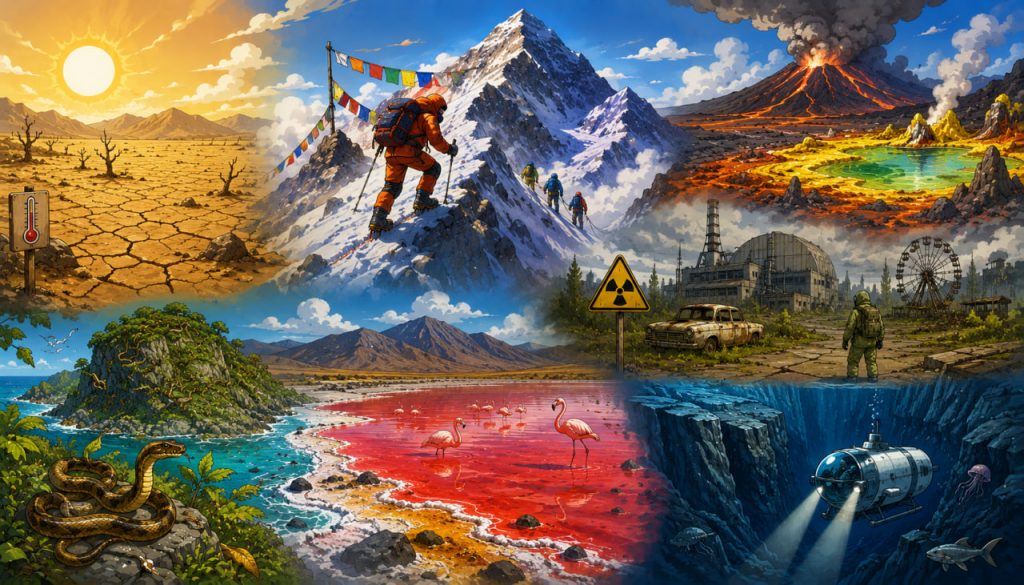
Planet Earth is filled with extraordinary landscapes, but some locations are so extreme and hazardous that they pose serious threats to human life. From volcanic zones and radioactive regions to deserts and deep oceans, these dangerous places reveal the immense power of nature and the limits of human survival. Studying them helps scientists better understand geology, climate, biology, and environmental risks. These locations demonstrate how fragile human life can be in the face of extreme natural and technological conditions.
What Makes a Place Dangerous?
A location becomes dangerous when it contains conditions that threaten human safety or survival.
These dangers may include:
- Extreme temperatures
- Toxic gases
- Radiation
- Volcanic activity
- Lack of oxygen
- Dangerous wildlife
Some places are dangerous because of natural forces, while others became hazardous due to human activity.
Death Valley, USA
Death Valley is one of the hottest places on Earth.
Temperatures can exceed:
- 56°C (133°F)
The region is dangerous because of:
- Extreme heat
- Severe dehydration risk
- Harsh desert conditions
Despite the danger, scientists study its unique climate and geology.
Mount Everest, Nepal and Tibet
Mount Everest is the highest mountain on Earth.
At high altitudes:
- Oxygen levels are extremely low
- Temperatures become deadly
- Avalanches and storms are common
The “death zone” above 8,000 meters is especially dangerous because the human body cannot adapt well to such low oxygen conditions.
The Danakil Depression, Ethiopia
The Danakil Depression is one of the hottest and most hostile places on Earth.
It contains:
- Acid pools
- Toxic gases
- Active volcanic regions
Temperatures often remain extremely high year-round.
Scientists compare parts of this region to conditions on other planets.
Chernobyl Exclusion Zone, Ukraine
The Chernobyl disaster in 1986 created one of the most radioactive places on Earth.
Although radiation levels have decreased:
- Some areas remain hazardous
- Long-term exposure can damage health
The zone became an important site for studying the effects of radiation on ecosystems.
Snake Island, Brazil
Snake Island is famous for its extremely high concentration of venomous snakes.
It is home to:
- Golden lancehead vipers
- Highly venomous reptiles found nowhere else
The island is restricted to protect both humans and wildlife.
Lake Natron, Tanzania
Lake Natron contains highly alkaline water.
The environment is dangerous because:
- Water chemistry can burn skin and eyes
- Temperatures are high
However, some specialized organisms thrive there.
The Mariana Trench, Pacific Ocean
The Mariana Trench is the deepest known part of Earth’s oceans.
Conditions include:
- Crushing pressure
- Complete darkness
- Extreme cold
The pressure is so intense that ordinary equipment would collapse instantly.
Expert Insight
Explorer and oceanographer Jacques Cousteau once stated:
“The sea, once it casts its spell, holds one in its net of wonder forever.”
His exploration work demonstrated both the beauty and danger of extreme environments.
Volcanoes and Active Geological Zones
Some of the world’s most dangerous places are volcanic regions.
Examples include:
- Yellowstone Caldera
- Mount Vesuvius
- Mount Merapi
Hazards involve:
- Lava flows
- Ash clouds
- Toxic gases
- Explosive eruptions
Why Scientists Study Dangerous Places
Extreme environments help researchers:
- Understand Earth systems
- Study climate adaptation
- Explore possible extraterrestrial conditions
These locations also improve disaster preparedness and survival technologies.
Human Curiosity and Risk
Despite the dangers, humans continue exploring extreme places.
Reasons include:
- Scientific discovery
- Adventure
- Environmental research
Human curiosity often pushes people into the most hostile environments on Earth.
Why Dangerous Places Matter
Studying hazardous regions teaches us:
- How nature operates
- The limits of human survival
- The importance of environmental safety
These places remind us of Earth’s immense power and complexity.
Interesting Facts
- Death Valley once recorded one of Earth’s highest temperatures.
- The Mariana Trench is deeper than Mount Everest is tall.
- Some radioactive zones are slowly being reclaimed by nature.
- Snake Island is closed to most visitors.
- Certain extreme environments resemble conditions on Mars.
Glossary
- Radiation — Energy emitted from unstable atoms.
- Alkaline — Having a high pH level.
- Exclusion Zone — Restricted area due to danger.
- Volcanic Activity — Movement of magma and eruption processes.
- Pressure — Force exerted on an object or surface.