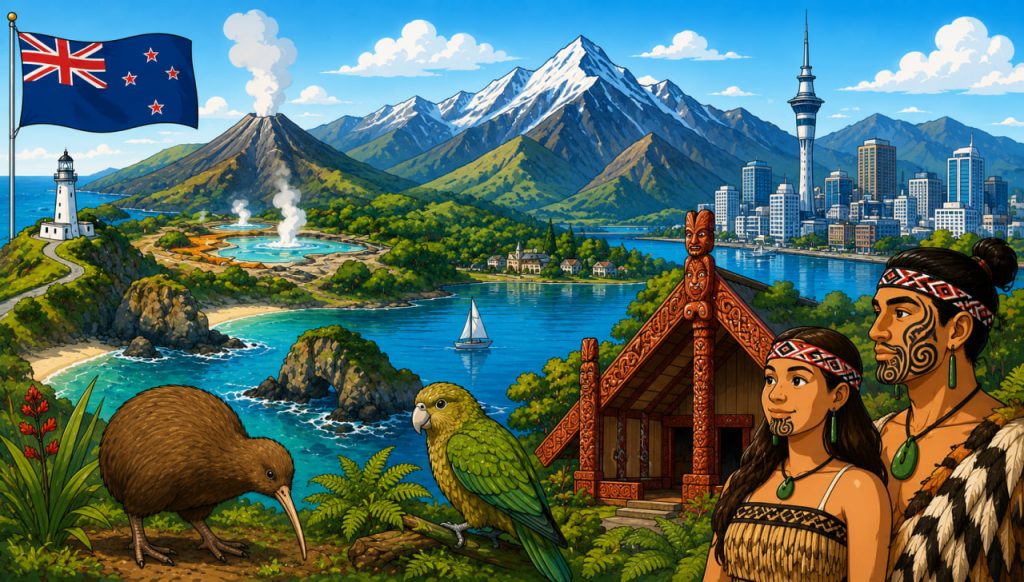
New Zealand is one of the most fascinating countries in the world. Located in the southwestern Pacific Ocean, it is known for breathtaking landscapes, rich Maori heritage, advanced environmental policies, and a high quality of life. Despite its relatively small population, New Zealand has had a significant cultural and scientific impact globally. Understanding this country reveals how geography, culture, and innovation can shape a modern nation.
Where Is New Zealand?
New Zealand is an island country located southeast of Australia.
It consists mainly of:
- The North Island
- The South Island
- Smaller surrounding islands
Its remote location has contributed to:
- Unique ecosystems
- Distinct wildlife
- Cultural independence
Isolation played a major role in shaping New Zealand’s environment and identity.
Geography and Natural Beauty
New Zealand is famous for its dramatic landscapes.
The country features:
- Mountains
- Volcanoes
- Forests
- Lakes
- Fjords
- Beaches
The South Island contains the Southern Alps mountain range, while the North Island is known for geothermal activity and volcanic regions.
Climate and Environment
The climate varies by region.
New Zealand experiences:
- Mild coastal temperatures
- Snow in mountainous areas
- Frequent rainfall in some regions
Its environment supports rich biodiversity.
Many species are unique to New Zealand because of long geographic isolation.
Unique Wildlife
New Zealand is home to unusual animals found nowhere else.
Examples include:
- Kiwi birds
- Kakapo parrots
- Tuatara reptiles
Unlike many countries:
- Native land mammals are very limited
Birds evolved to fill ecological roles often occupied by mammals elsewhere.
Maori Culture and Heritage
The Maori are the indigenous people of New Zealand.
They arrived centuries ago from Polynesia and developed a rich culture with:
- Language
- Traditions
- Art
- Navigation skills
Today, Maori culture remains an important part of national identity.
Modern Society and Economy
New Zealand is considered one of the world’s most developed countries.
Its economy includes:
- Agriculture
- Tourism
- Technology
- Renewable energy
The country is also known for:
- Political stability
- Education quality
- Environmental awareness
Expert Insight
Environmental scientist David Attenborough once described New Zealand as:
“One of the last great wildernesses where nature still dominates the landscape.”
This reflects the country’s extraordinary natural preservation.
Renewable Energy and Sustainability
New Zealand produces a large portion of its electricity from renewable sources.
Major energy sources include:
- Hydroelectric power
- Geothermal energy
- Wind energy
The country actively promotes sustainable development and conservation.
Tourism and Global Popularity
Millions of tourists visit New Zealand every year.
Popular attractions include:
- Milford Sound
- Hobbiton movie set
- Tongariro National Park
- Queenstown
The country gained additional fame through films such as The Lord of the Rings.
Volcanic Activity and Earthquakes
New Zealand lies on the Pacific Ring of Fire.
This means:
- Earthquakes are common
- Volcanoes remain active in some areas
The country has developed strong engineering and disaster preparedness systems.
Education and Innovation
New Zealand places strong emphasis on education and scientific research.
It contributes to fields such as:
- Environmental science
- Agriculture
- Medicine
The country consistently ranks highly in global quality-of-life indexes.
Why New Zealand Is Unique
New Zealand combines:
- Advanced modern society
- Indigenous heritage
- Exceptional natural landscapes
Few countries balance technological progress and environmental preservation so effectively.
Interesting Facts
- New Zealand was one of the last major landmasses settled by humans.
- There are more sheep than people in the country.
- The kiwi bird cannot fly.
- Wellington is one of the southernmost capitals in the world.
- New Zealand has active volcanoes and geothermal areas.
Glossary
- Biodiversity — Variety of living organisms in an ecosystem.
- Geothermal Energy — Energy generated from Earth’s internal heat.
- Maori — Indigenous Polynesian people of New Zealand.
- Fjord — Long, narrow sea inlet formed by glaciers.
- Pacific Ring of Fire — Region with high volcanic and earthquake activity.