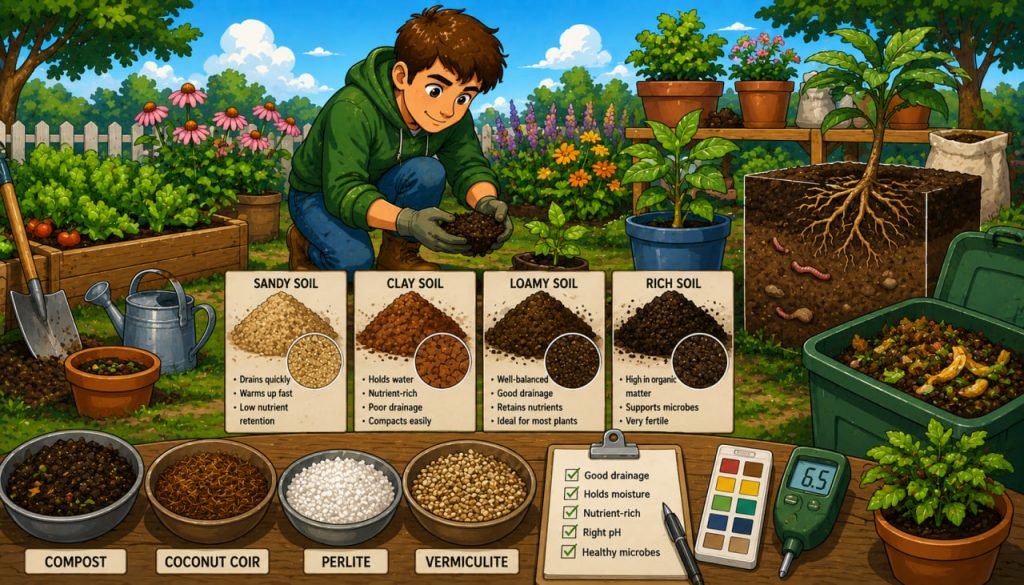
Healthy plants begin with healthy soil. Whether growing vegetables, flowers, herbs, or indoor plants, soil plays a critical role in supplying nutrients, water, oxygen, and structural support. Many beginner gardeners focus only on watering and sunlight, but experienced growers know that choosing the correct soil is one of the most important factors for successful plant growth.
Different plants require different soil conditions, and understanding soil composition can dramatically improve plant health and productivity.
Why Soil Is So Important
Soil is much more than dirt.
Good soil provides:
- Nutrients
- Moisture retention
- Air circulation
- Root stability
- Beneficial microorganisms
Healthy soil acts as a complete ecosystem supporting plant life.
Main Components of Soil
Most soils contain different proportions of:
- Sand
- Silt
- Clay
- Organic matter
The balance between these materials affects how soil behaves.
Sandy Soil
Sandy soil contains larger particles.
Characteristics:
- Drains water quickly
- Warms up fast
- Contains less nutrient retention
Advantages:
- Good aeration
- Suitable for some drought-tolerant plants
Disadvantages:
- Dries out quickly
- Requires frequent watering
Clay Soil
Clay soil contains very small particles.
Characteristics:
- Holds water strongly
- Retains nutrients well
- Becomes compact easily
Advantages:
- Nutrient-rich
Disadvantages:
- Poor drainage
- Limited airflow to roots
Too much clay can suffocate plant roots.
Loamy Soil
Loam is often considered ideal garden soil.
It contains a balanced mixture of:
- Sand
- Silt
- Clay
- Organic matter
Benefits include:
- Good drainage
- Nutrient retention
- Healthy root development
Many plants grow best in loamy soil.
Organic Matter and Compost
Organic matter improves soil quality significantly.
Examples include:
- Compost
- Decomposed leaves
- Manure
Organic material helps:
- Retain moisture
- Feed microorganisms
- Improve soil structure
Rich organic soil supports long-term plant health.
Expert Insight
Soil scientist Elaine Ingham has explained:
“Healthy soil is alive, and the biology within it plays a critical role in plant growth and ecosystem balance.”
Her work emphasizes the importance of soil microorganisms.
Soil pH and Plant Growth
Soil acidity or alkalinity affects nutrient absorption.
pH scale:
0≤pH≤140 \leq pH \leq 140≤pH≤14
- Below 7 = acidic
- Above 7 = alkaline
- Around 6–7 is ideal for many plants
Different species prefer different pH levels.
Choosing Soil for Indoor Plants
Indoor plants often require specialized potting mixes.
Good indoor soil should:
- Drain well
- Resist compaction
- Prevent root rot
Potting soil usually contains:
- Peat moss
- Coconut coir
- Perlite
- Vermiculite
Soil for Vegetables
Vegetables generally require:
- Nutrient-rich soil
- Good drainage
- High organic content
Adding compost regularly helps maintain productivity.
Soil Drainage Matters
Poor drainage can damage roots.
Excess water may:
- Cause fungal diseases
- Reduce oxygen availability
- Lead to root rot
Healthy roots require both water and air.
Fertilizers and Soil Nutrition
Even good soil may eventually lose nutrients.
Plants commonly need:
- Nitrogen (N)
- Phosphorus (P)
- Potassium (K)
Balanced fertilization supports growth, flowering, and fruit production.
Common Soil Mistakes
Beginner gardeners often:
- Overwater
- Use compacted soil
- Ignore drainage
- Choose soil unsuitable for specific plants
Learning basic soil science prevents many plant problems.
Sustainable Soil Practices
Healthy soil should be protected.
Good practices include:
- Composting
- Mulching
- Crop rotation
- Avoiding excessive chemicals
These methods improve long-term soil fertility.
Why Soil Choice Matters
Choosing the right soil affects:
- Plant growth
- Disease resistance
- Water efficiency
- Crop yield
Strong plants begin below the surface—with healthy roots and living soil.
Interesting Facts
- A teaspoon of healthy soil may contain billions of microorganisms.
- Earthworms improve soil aeration naturally.
- Different plants prefer different pH levels.
- Compost can improve nearly all soil types.
- Soil forms extremely slowly in nature.
Glossary
- Loam — Balanced soil mixture ideal for many plants.
- pH — Measure of acidity or alkalinity.
- Compost — Decomposed organic material used to enrich soil.
- Drainage — Ability of soil to remove excess water.
- Root Rot — Disease caused by excessive moisture around roots.