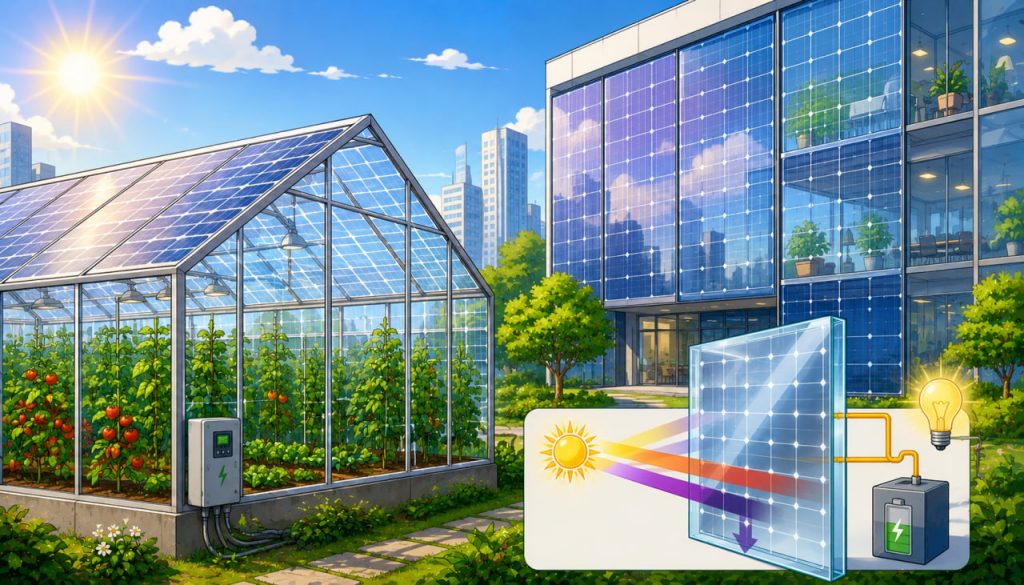
For decades, solar panels were associated with large dark panels installed on rooftops or solar farms. While highly effective, traditional photovoltaic systems often require dedicated space and visibly alter building design. Today, however, scientists and engineers are developing a new generation of solar technology that may fundamentally transform architecture and urban energy systems: transparent solar panels.
Transparent photovoltaics can generate electricity while still allowing light to pass through glass surfaces. This innovation opens the possibility of turning:
- Windows
- Skyscrapers
- Greenhouses
- Building facades
- Vehicle glass
into energy-producing surfaces.
Although the technology is still developing, transparent solar systems may become one of the most important future directions in renewable energy and sustainable architecture.
What Are Transparent Solar Panels?
Transparent solar panels are photovoltaic materials capable of generating electricity while remaining partially transparent.
Unlike traditional solar panels, these systems allow visible light to pass through while capturing other parts of the solar spectrum.
Most transparent photovoltaic systems focus on absorbing:
- Ultraviolet light
- Infrared radiation
while letting much of visible light remain visible to the human eye.
This allows windows and glass surfaces to function simultaneously as:
- Transparent structures
- Energy generators
How Photovoltaic Technology Works
Photovoltaic systems convert sunlight into electricity using semiconductor materials.
When photons strike the material:
- Electrons become energized
- Electrical current is generated
Traditional panels maximize energy capture by absorbing most sunlight.
Transparent systems must balance:
- Light transmission
- Energy efficiency
- Visual clarity
This creates significant engineering challenges.
Why Transparent Solar Panels Matter
Modern cities contain enormous amounts of glass.
Skyscrapers alone may have thousands of square meters of window surfaces exposed to sunlight.
Researchers realized these surfaces represent huge untapped energy potential.
Transparent photovoltaics could help:
- Reduce building energy consumption
- Generate local electricity
- Improve sustainability
- Lower carbon emissions
Energy researcher Richard Lunt, one of the pioneers of transparent solar technology, explained:
“Every window or sheet of glass could potentially become a solar panel.”
This idea could dramatically expand renewable energy integration into daily life.
Transparent Solar Windows in Buildings
One of the most promising applications involves building-integrated photovoltaics (BIPV).
Future buildings may incorporate transparent solar glass directly into:
- Windows
- Facades
- Roof structures
This transforms buildings into partially self-powered systems.
Advantages may include:
- Reduced electricity demand
- Improved energy efficiency
- Better urban sustainability
Large commercial buildings especially consume enormous amounts of energy, making integrated solar systems highly attractive.
Solar Greenhouses and Agriculture
Transparent photovoltaics may also revolutionize agriculture.
Greenhouses require sunlight for plant growth, but they also consume significant electricity for:
- Lighting
- Ventilation
- Climate control
Transparent solar panels may help greenhouses generate energy while still allowing plants to receive sufficient light.
Scientists carefully study which light wavelengths are most important for photosynthesis.
Plants mainly use:
- Red light
- Blue light
Some transparent solar systems attempt to harvest wavelengths less critical for plant growth.
Different Types of Transparent Solar Technology
Researchers are exploring multiple approaches.
Organic Solar Cells
Use carbon-based materials that may offer flexibility and transparency.
Perovskite Solar Cells
Highly promising materials with rapidly improving efficiency.
Luminescent Solar Concentrators
Transparent materials that redirect light toward solar cells at window edges.
Each approach involves trade-offs between:
- Transparency
- Cost
- Durability
- Efficiency
The Efficiency Challenge
One major limitation remains energy efficiency.
Traditional opaque solar panels still produce more electricity because they absorb more sunlight.
Transparent systems sacrifice some efficiency to maintain visibility.
Scientists continue working to improve:
- Conversion rates
- Material stability
- Manufacturing scalability
Rapid progress over the last decade suggests major future improvements are possible.
Urban Energy and Smart Cities
Transparent photovoltaics fit naturally into future smart city concepts.
Future urban systems may combine:
- Solar windows
- Smart grids
- Battery storage
- AI-controlled energy systems
Buildings themselves may become active energy producers rather than passive consumers.
This could reduce pressure on centralized electrical infrastructure.
Environmental Benefits
Transparent solar technology may support cleaner urban development by:
- Reducing fossil fuel use
- Lowering carbon emissions
- Increasing renewable generation capacity
- Improving energy decentralization
Unlike large solar farms, transparent photovoltaics utilize surfaces already present in cities.
This improves land-use efficiency.
Challenges and Limitations
Despite its promise, several obstacles remain.
Current challenges include:
- Manufacturing cost
- Long-term durability
- Lower efficiency
- Scaling production
Researchers also study:
- Weather resistance
- UV degradation
- Thermal performance
Commercial adoption will depend heavily on cost reductions and improved reliability.
Could Entire Cities Generate Power Through Windows?
Some futurists imagine cities where:
- Skyscrapers generate electricity
- Greenhouses become energy-neutral
- Vehicle windows contribute power
- Homes partially power themselves
While full implementation remains distant, transparent photovoltaics may become an important component of future sustainable architecture.
The Future of Transparent Solar Panels
Future research may lead to:
- More efficient transparent materials
- Flexible solar films
- Self-cleaning solar glass
- AI-optimized energy systems
As renewable energy demand continues growing, integrating power generation directly into everyday surfaces may become increasingly important.
Why This Technology Matters
Transparent solar panels represent a fascinating fusion of:
- Physics
- Materials science
- Architecture
- Renewable energy engineering
Instead of requiring separate solar infrastructure, future buildings themselves may quietly harvest energy from sunlight every day.
What once sounded futuristic is gradually moving toward practical reality.
Interesting Facts
- Transparent solar panels can absorb invisible parts of sunlight.
- Modern cities contain enormous amounts of glass surface area.
- Some greenhouse solar systems are designed to preserve plant growth efficiency.
- Perovskite materials are among the most promising new photovoltaic technologies.
- Future skyscrapers may partially function as giant vertical power plants.
Glossary
- Photovoltaic — Technology that converts sunlight into electricity.
- Semiconductor — A material capable of conducting electricity under certain conditions.
- Perovskite — A promising material used in advanced solar cell research.
- BIPV (Building-Integrated Photovoltaics) — Solar systems integrated directly into building materials.
- Photosynthesis — The process plants use to convert sunlight into chemical energy.