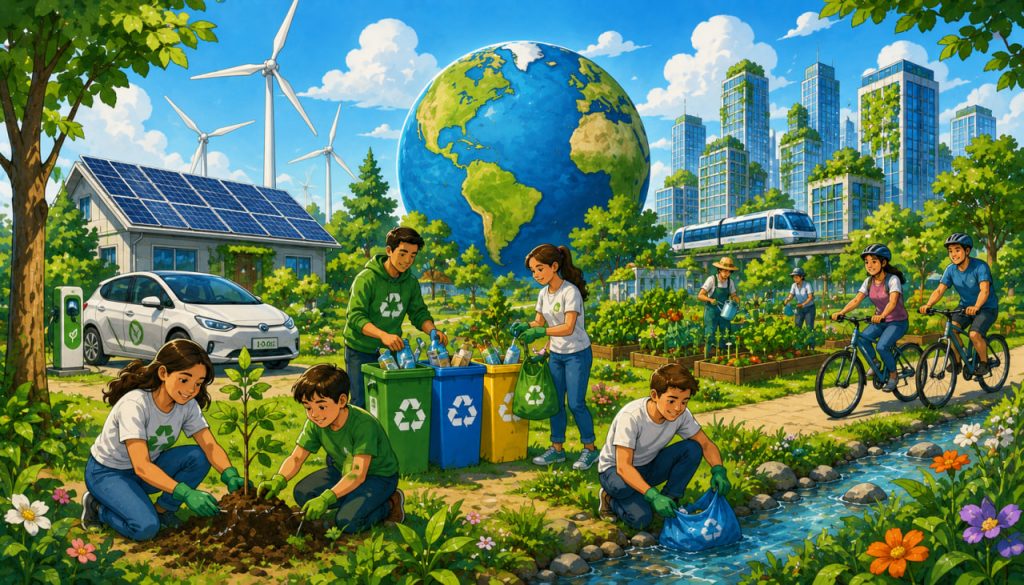
Human civilization achieved extraordinary technological progress over the last two centuries. Industrialization, global transportation, agriculture, digital technologies, and urban development transformed modern life dramatically. However, this rapid growth also created serious environmental challenges affecting nearly every ecosystem on Earth.
Today humanity faces:
- Climate change
- Air pollution
- Ocean contamination
- Deforestation
- Biodiversity loss
- Soil degradation
- Plastic waste accumulation
Scientists increasingly warn that ecological stability is deeply connected to economic stability, food systems, public health, and long-term human survival.
Despite these challenges, many researchers believe ecological recovery is still possible if governments, industries, scientists, and societies cooperate on large-scale sustainable solutions.
Restoring Earth’s ecology will likely require not one single invention, but a combination of:
- Technological innovation
- Political action
- Sustainable economics
- Cultural change
- Scientific cooperation
The coming decades may become one of the most important periods in environmental history.
Why Ecology Matters
Ecology refers to the relationships between living organisms and their environment.
Healthy ecosystems support:
- Clean water
- Stable climate
- Fertile soil
- Biodiversity
- Pollination
- Food production
Modern civilization depends heavily on ecological systems, even though many people rarely notice these connections directly.
Environmental scientist Jane Goodall once explained:
“What you do makes a difference, and you have to decide what kind of difference you want to make.”
This idea reflects how human actions collectively shape planetary systems.
Reducing Pollution
One of the most urgent environmental priorities involves reducing pollution.
Major sources include:
- Fossil fuel combustion
- Industrial emissions
- Plastic waste
- Agricultural chemicals
- Untreated wastewater
Air pollution alone contributes to millions of premature deaths globally each year.
Solutions may include:
- Cleaner energy systems
- Better waste management
- Stricter industrial standards
- Sustainable manufacturing
Reducing pollution often improves both environmental and public health simultaneously.
Transitioning to Renewable Energy
Energy systems strongly influence global ecology.
Burning fossil fuels releases greenhouse gases contributing to climate change.
Many countries are expanding:
- Solar energy
- Wind power
- Hydroelectric systems
- Geothermal energy
- Energy storage technologies
Renewable energy may help reduce:
- Carbon emissions
- Air pollution
- Dependence on finite resources
Scientists increasingly view clean energy transition as one of the central environmental goals of the 21st century.
Protecting Forests and Biodiversity
Forests are among Earth’s most important ecosystems.
They help:
- Store carbon
- Regulate climate
- Protect water cycles
- Support biodiversity
Deforestation continues threatening many regions, especially tropical rainforests.
Protecting ecosystems requires:
- Conservation programs
- Sustainable forestry
- Reforestation efforts
- Habitat protection
Biodiversity loss is also a major concern because ecosystems become less stable when species disappear.
Healthy ecosystems depend on complex biological interactions developed over millions of years.
Solving the Plastic Waste Problem
Plastic pollution became one of the defining environmental issues of modern civilization.
Millions of tons of plastic enter oceans and ecosystems annually.
Scientists are working on:
- Recycling technologies
- Biodegradable materials
- Circular economy systems
- Waste reduction strategies
Some countries now restrict certain single-use plastics.
However, long-term solutions likely require changes in:
- Manufacturing
- Packaging
- Consumer behavior
- Waste infrastructure
Sustainable Agriculture
Agriculture strongly affects:
- Soil health
- Water resources
- Biodiversity
- Climate systems
Modern industrial farming can contribute to:
- Soil erosion
- Chemical pollution
- Habitat destruction
Sustainable agriculture focuses on:
- Soil conservation
- Efficient irrigation
- Reduced chemical use
- Crop diversity
- Regenerative farming methods
Scientists increasingly emphasize the importance of protecting soil because healthy soil supports food security and ecosystem stability.
Restoring Oceans and Water Systems
Oceans regulate climate and support enormous biodiversity.
However, marine ecosystems face:
- Plastic pollution
- Overfishing
- Coral reef decline
- Ocean acidification
Protecting oceans may involve:
- Marine protected areas
- Sustainable fishing practices
- Pollution reduction
- Coastal restoration
Freshwater systems also require careful management as population growth increases water demand worldwide.
Smart Cities and Sustainable Infrastructure
Cities produce large portions of global emissions and waste.
Future sustainable cities may rely on:
- Public transportation
- Renewable energy
- Green architecture
- Smart waste systems
- Efficient water management
Urban planning increasingly combines:
- Ecology
- Engineering
- Digital technology
to improve environmental efficiency.
Smart cities may reduce ecological pressure while improving quality of life.
The Role of Technology
Technology itself is not inherently destructive or beneficial.
Modern innovation may help ecology through:
- AI environmental monitoring
- Satellite climate tracking
- Carbon capture systems
- Cleaner manufacturing
- Precision agriculture
Scientists now monitor ecosystems globally using advanced digital tools.
Environmental technology is becoming one of the fastest-growing scientific fields.
Education and Public Awareness
Long-term environmental improvement also depends on public understanding.
People increasingly recognize the importance of:
- Recycling
- Energy conservation
- Sustainable consumption
- Environmental responsibility
Education helps societies make more informed decisions about environmental policies and lifestyles.
Cultural attitudes may become just as important as technology itself.
International Cooperation
Ecological systems do not follow political borders.
Climate, oceans, forests, and pollution affect the entire planet.
This means environmental protection often requires:
- International agreements
- Scientific collaboration
- Shared technological development
Global environmental problems are difficult for any country to solve alone.
Can Humanity Really Restore the Planet?
Many scientists remain cautiously optimistic.
Humanity possesses:
- Advanced technology
- Scientific knowledge
- Global communication systems
- Growing environmental awareness
However, solving ecological challenges requires long-term thinking and coordinated action.
The future of Earth’s ecosystems will largely depend on decisions made during the next few decades.
Why Ecological Restoration Matters
Ecology is not separate from civilization — it supports civilization itself.
Human health, economies, agriculture, and social stability all depend on functioning natural systems.
Restoring ecological balance may become one of the greatest collective projects in human history.
The challenge is enormous, but so is humanity’s growing scientific and technological capability.
Interesting Facts
- Forests help regulate global climate and rainfall systems.
- Oceans absorb large amounts of atmospheric heat and carbon dioxide.
- Renewable energy technologies are expanding rapidly worldwide.
- Soil contains vast ecosystems of microorganisms essential for agriculture.
- Some cities already use AI systems to improve energy efficiency and waste management.
Glossary
- Ecology — The study of relationships between organisms and their environment.
- Biodiversity — The variety of living organisms within ecosystems.
- Renewable Energy — Energy generated from naturally replenishing sources.
- Circular Economy — An economic system focused on reuse and waste reduction.
- Sustainable Development — Development balancing human needs with environmental protection.