Climate and ecology are deeply interconnected systems that constantly influence one another. Although people often discuss climate change and environmental protection separately, scientists increasingly emphasize that Earth functions as one large interconnected system where atmosphere, oceans, forests, animals, water cycles, and human activity all interact continuously.
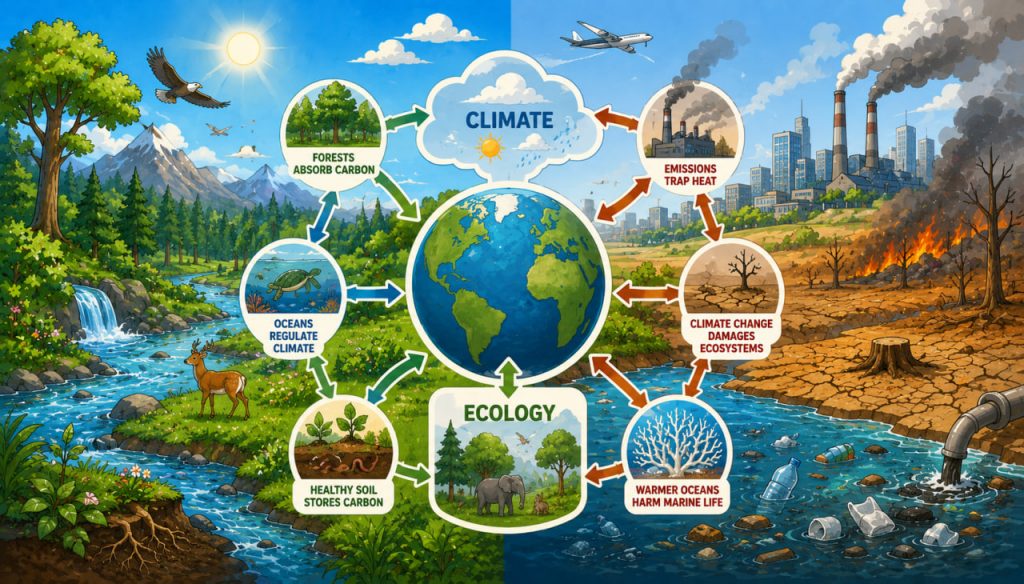
Climate affects ecosystems, while ecosystems themselves also influence climate stability. Forests regulate rainfall, oceans absorb heat, plants store carbon, and biodiversity helps ecosystems remain resilient during environmental stress. When ecological systems become damaged, climate systems may also become less stable.
Today, researchers around the world study the complex relationship between:
- Climate change
- Biodiversity
- Ecosystem health
- Human activity
- Atmospheric processes
Understanding this connection is essential because many modern environmental problems cannot be solved independently. Climate and ecology influence each other at nearly every level of life on Earth.
What Is Climate?
Climate refers to long-term patterns of:
- Temperature
- Rainfall
- Wind
- Humidity
- Seasonal conditions
Unlike weather, which changes daily, climate describes average conditions over many years or decades.
Earth’s climate system depends on interactions between:
- The atmosphere
- Oceans
- Ice sheets
- Land surfaces
- Living organisms
Even relatively small changes in global climate may strongly affect ecosystems.
What Is Ecology?
Ecology is the scientific study of how living organisms interact with:
- Each other
- Their environment
Ecologists study relationships between:
- Plants
- Animals
- Microorganisms
- Water systems
- Soil
- Climate conditions
Healthy ecosystems rely on balance and long-term environmental stability.
Climate is one of the most important factors shaping ecosystems worldwide.
How Climate Influences Ecosystems
Climate directly affects where organisms can survive.
Temperature and rainfall determine:
- Forest growth
- Water availability
- Animal migration
- Plant distribution
- Agricultural productivity
For example:
- Tropical rainforests require warm, humid conditions
- Deserts form in dry climates
- Polar ecosystems depend on cold temperatures
When climate conditions change rapidly, ecosystems may struggle to adapt.
Climate scientist Michael Mann explained:
“Climate change is not only about temperature. It affects entire environmental systems.”
This is why climate shifts often create ecological consequences far beyond warming alone.
How Forests Affect Climate
Ecosystems also influence climate.
Forests play an especially important role by:
- Absorbing carbon dioxide
- Producing oxygen
- Regulating humidity
- Influencing rainfall patterns
Large forests such as the Amazon rainforest help stabilize regional and even global climate systems.
Deforestation may contribute to:
- Reduced rainfall
- Higher temperatures
- Soil degradation
- Increased carbon emissions
This demonstrates how ecological destruction may intensify climate instability.
Oceans and Climate Regulation
Oceans are another major connection between climate and ecology.
Marine ecosystems absorb enormous amounts of:
- Heat
- Carbon dioxide
Ocean currents help regulate global temperature patterns.
However, climate change now affects oceans through:
- Warming waters
- Coral bleaching
- Rising sea levels
- Ocean acidification
Marine biodiversity may decline when ocean ecosystems become unstable.
Healthy oceans are essential for climate balance.
Biodiversity and Ecosystem Stability
Biodiversity refers to the variety of life within ecosystems.
Highly diverse ecosystems often handle environmental stress better because:
- Multiple species perform similar ecological functions
- Food webs remain more stable
- Recovery becomes easier after disturbances
Climate change may threaten biodiversity by:
- Destroying habitats
- Altering migration patterns
- Increasing extreme weather events
As biodiversity decreases, ecosystems may become more fragile and less capable of adapting.
Climate Change and Extreme Weather
One major environmental concern involves increasing extreme weather events.
Scientists study links between climate change and:
- Heatwaves
- Droughts
- Floods
- Wildfires
- Stronger storms
Extreme weather can severely damage ecosystems by:
- Destroying forests
- Drying wetlands
- Disrupting food chains
- Killing sensitive species
Ecological damage may then worsen climate effects further.
Human Activity and Environmental Systems
Human activity strongly affects both climate and ecology.
Major environmental pressures include:
- Fossil fuel use
- Deforestation
- Industrial pollution
- Urban expansion
- Intensive agriculture
These activities may:
- Increase greenhouse gas emissions
- Destroy habitats
- Reduce biodiversity
- Pollute water systems
Modern environmental science increasingly treats climate and ecological issues as interconnected rather than separate problems.
Agriculture and Food Systems
Climate and ecology strongly influence food production.
Agriculture depends on:
- Stable rainfall
- Healthy soil
- Pollinators
- Predictable seasons
Climate instability may reduce crop yields in some regions, while ecological degradation weakens soil and water systems.
Sustainable agriculture attempts to protect both climate and ecosystem health simultaneously.
Why Scientists Study Earth as One System
Modern Earth system science views the planet as a network of interconnected processes.
Researchers now study how:
- Forests influence rainfall
- Ice affects ocean circulation
- Oceans influence weather
- Biodiversity affects resilience
This systems-based approach helps scientists better understand environmental risks.
Small changes in one part of Earth’s system may trigger large effects elsewhere.
Can Ecosystems Recover?
Many ecosystems show remarkable resilience when protected properly.
Environmental restoration projects include:
- Reforestation
- Wetland recovery
- Ocean conservation
- Sustainable farming
- Pollution reduction
Scientists believe restoring ecosystems may also help stabilize climate systems over time.
Protecting nature therefore benefits both ecology and climate simultaneously.
Why the Climate-Ecology Connection Matters
Climate and ecology cannot realistically be separated.
The atmosphere, forests, oceans, animals, and human civilization all interact continuously within one planetary system.
Understanding these connections is essential for:
- Environmental protection
- Climate policy
- Sustainable development
- Future food security
- Human health
The future of civilization may depend on how successfully humanity protects both climate stability and ecological balance together.
Interesting Facts
- Forests influence rainfall through moisture release into the atmosphere.
- Oceans absorb much of the excess heat generated by global warming.
- Coral reefs are highly sensitive to temperature changes.
- Biodiversity helps ecosystems recover from environmental stress.
- Wetlands naturally store large amounts of carbon.
Glossary
- Climate — Long-term patterns of weather conditions in a region or globally.
- Ecology — The study of interactions between organisms and their environment.
- Biodiversity — The variety of living organisms within ecosystems.
- Ecosystem — A community of organisms interacting with their environment.
- Deforestation — Large-scale removal of forests and trees.