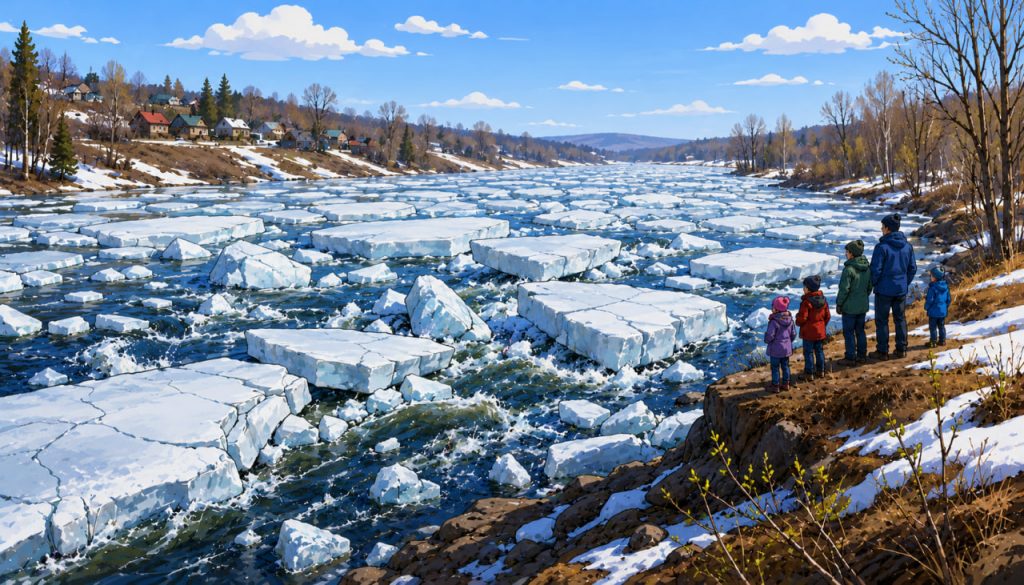
Every spring in cold regions around the world, rivers awaken after long winter months. Thick layers of ice that once seemed completely solid begin to crack, shift, and move downstream under the force of flowing water. This dramatic process is called:
- Ice drift
Ice drift is one of the most visually impressive seasonal natural events. Massive sheets of river ice collide, rotate, break apart, and travel with tremendous force. In some regions, entire cities gather to observe the first major river breakup of the year as a symbol of winter ending and spring beginning.
However, despite its beauty, ice drift can also become dangerous. Powerful moving ice may cause:
- Flooding
- Damage to bridges
- Shoreline destruction
- Threats to people and animals
Scientists study ice drift because it affects:
- Hydrology
- Climate systems
- River ecosystems
- Human infrastructure
Understanding how ice drift forms helps explain the complex relationship between weather, rivers, seasonal cycles, and climate.
What Is Ice Drift?
Ice drift occurs when frozen river ice begins breaking apart and moving downstream during seasonal warming.
Throughout winter, rivers in cold climates may freeze into thick continuous ice sheets.
As temperatures rise during spring:
- Ice weakens
- Cracks develop
- Water flow increases
- Ice begins moving
Eventually, large ice masses separate and drift along the river current.
This process may continue for:
- Hours
- Days
- Weeks
depending on river size and weather conditions.
Why Rivers Freeze in Winter
Rivers freeze when air temperatures remain below freezing long enough for water surfaces to cool significantly.
Ice formation depends on:
- Temperature
- Water speed
- River depth
- Snow cover
- Wind conditions
Slow-moving rivers freeze more easily than fast currents.
Over time, ice layers may become extremely thick in northern climates.
Some Arctic rivers remain frozen for many months each year.
What Causes Ice Drift To Begin?
The main trigger for ice drift is:
- Spring warming
As temperatures rise:
- Snow melts
- Water levels increase
- River currents strengthen
- Ice weakens structurally
Sunlight also contributes by heating the ice surface.
Eventually, pressure from flowing water becomes strong enough to break the frozen river cover apart.
Hydrologists closely monitor these processes because sudden breakups may become dangerous.
The Power of Moving Ice
Moving river ice contains enormous physical force.
Large ice blocks may:
- Crush structures
- Damage bridges
- Erode riverbanks
- Destroy docks
Ice jams occur when drifting ice becomes trapped in narrow river sections.
These jams may rapidly raise water levels and trigger flooding upstream.
Engineer and river researcher Donald Lawson explained:
“River ice is one of the most powerful natural mechanical forces in cold regions.”
This is why ice monitoring is extremely important in northern countries.
Ice Jams and Flooding
One of the greatest dangers during ice drift is:
- Ice jam flooding
When ice blocks accumulate and block water flow:
- Rivers may overflow rapidly
- Floodwaters spread into nearby areas
- Infrastructure may become damaged
Flooding caused by ice jams can happen suddenly with little warning.
Communities near northern rivers often prepare extensively for spring breakup seasons.
Why Ice Drift Looks So Dramatic
Ice drift is visually spectacular because enormous ice sheets move with tremendous energy.
Observers may witness:
- Cracking sounds
- Ice collisions
- Rotating ice plates
- Rising water
- Explosive breakups
Some ice blocks may become:
- Several meters wide
- Extremely heavy
The sound of breaking river ice can travel long distances.
In many northern regions, ice drift is considered one of spring’s most iconic natural events.
Ice Drift and Climate Change
Scientists increasingly study how climate change affects river ice behavior.
Warmer temperatures may alter:
- Ice thickness
- Freeze duration
- Breakup timing
- Flood patterns
Some regions now experience:
- Earlier spring breakups
- Thinner ice formation
- More unstable winter conditions
Changes in river ice systems may affect:
- Ecosystems
- Transportation
- Hydropower systems
- Flood risks
Ice drift therefore became important in climate research.
Animals and River Ice
Many animals depend on frozen rivers during winter.
River ice may affect:
- Migration routes
- Hunting behavior
- Ecosystem interactions
Spring ice breakup changes aquatic environments dramatically.
Fish, birds, and mammals often adapt their seasonal behavior to river ice cycles.
Sudden flooding from ice jams may also impact wildlife habitats.
Human History and Ice Drift
For centuries, northern civilizations closely observed river ice cycles.
Frozen rivers historically functioned as:
- Winter roads
- Transportation routes
- Trade pathways
Spring ice breakup signaled:
- Seasonal transition
- Navigation reopening
- Agricultural preparation
Many cultures developed traditions and festivals connected to spring river breakup.
In some cities, ice drift remains a major seasonal attraction today.
Modern Monitoring and Forecasting
Modern technology helps predict dangerous ice conditions.
Scientists use:
- Satellites
- River sensors
- Drones
- Weather models
- Hydrological monitoring systems
These tools help authorities prepare for:
- Flood risks
- Infrastructure protection
- Emergency response
Accurate forecasting became increasingly important as climate variability grows.
Safety During Ice Drift
Ice drift creates dangerous river conditions.
People should avoid:
- Walking on unstable ice
- Standing near collapsing riverbanks
- Approaching moving ice masses
Spring river ice is often unpredictable and fragile.
Every year, accidents occur because people underestimate the power of moving water and breaking ice.
Ice Drift and the Arctic Future
In Arctic regions, river ice systems strongly influence:
- Transportation
- Ecosystems
- Indigenous communities
- Climate patterns
As polar climates continue changing, scientists expect major shifts in river ice behavior across northern regions.
Understanding these changes may become increasingly important for environmental management and infrastructure planning.
Why Ice Drift Matters
Ice drift is more than a seasonal natural spectacle.
It represents the interaction between:
- Climate
- Water systems
- Physics
- Ecosystems
- Human civilization
The dramatic breakup of frozen rivers reminds humanity how powerful seasonal natural processes remain even in highly technological societies.
From Arctic science to local spring traditions, ice drift continues shaping both nature and human life across cold regions of the world.
Interesting Facts
- Some river ice sheets become several feet thick during winter.
- Ice jams may cause sudden and severe flooding.
- The sound of breaking river ice can travel long distances.
- Northern communities often monitor river breakup closely each spring.
- Climate change is affecting river freeze and breakup patterns worldwide.
Glossary
- Ice Drift — The movement of broken river ice during spring thaw.
- Ice Jam — A blockage formed by accumulated drifting ice.
- Hydrology — The scientific study of water systems.
- Floodplain — Land near rivers that may flood periodically.
- Spring Thaw — Seasonal warming causing snow and ice to melt.