Human civilization has constantly changed the way people live. From ancient river valleys and early agricultural settlements to megacities connected by global digital networks, humanity continuously adapts to new environmental, technological, and social conditions.
Today, scientists, architects, urban planners, and futurists are asking an important question:
Where will humans live one hundred years from now?
Rapid technological progress, climate change, population growth, artificial intelligence, renewable energy systems, and space exploration are already transforming ideas about future habitats.
The cities and settlements of the next century may look dramatically different from today’s urban environments. Future human habitats may include:
- Smart eco-cities
- Floating ocean communities
- Underground infrastructure
- Arctic settlements
- Desert megacities
- Space colonies
Rather than one single future model, humanity may develop multiple “new cradles of civilization” adapted to different environmental and technological realities.
Why Human Habitats Keep Changing
Throughout history, civilizations formed around:
- Water access
- Fertile land
- Trade routes
- Climate stability
Ancient civilizations emerged near:
- The Nile River
- Mesopotamia
- The Indus Valley
- The Yellow River
Modern civilization later shifted toward:
- Industrial cities
- Coastal megacities
- Global transportation hubs
Today, technological systems increasingly influence where people can live comfortably.
Future settlements may depend less on geography and more on:
- Energy systems
- Climate resilience
- Digital infrastructure
- Resource efficiency
Climate Change and Future Cities
Climate change is expected to strongly influence future human settlement patterns.
Scientists project increasing risks from:
- Heatwaves
- Rising sea levels
- Droughts
- Flooding
- Extreme weather
Some coastal cities may require:
- Massive protective infrastructure
- Relocation strategies
- Floating urban systems
Meanwhile, colder northern regions may become more suitable for larger populations as temperatures shift.
Climate adaptation will likely become a central part of future urban planning.
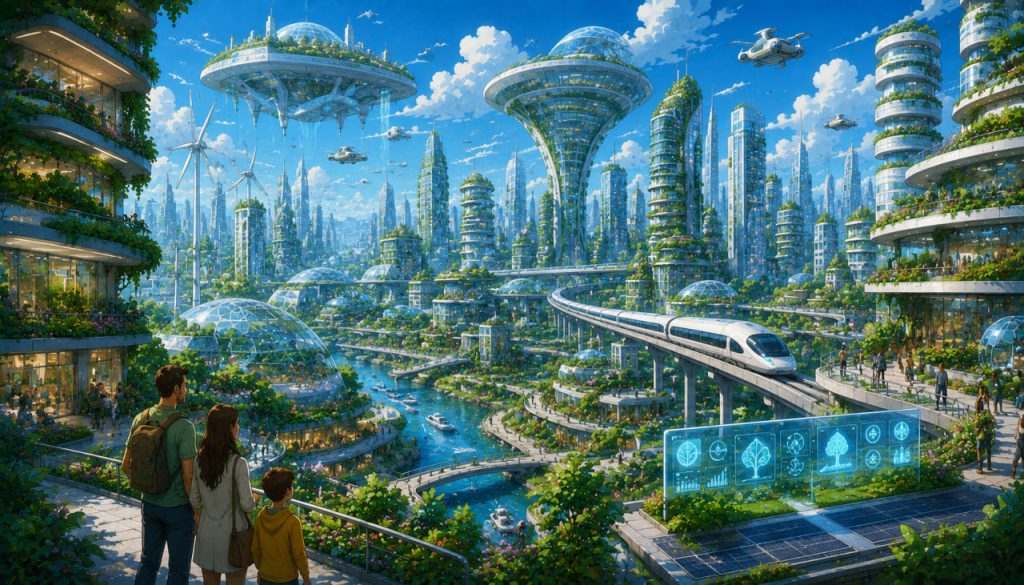
Smart Eco-Cities
Many experts believe future cities will become highly integrated with digital and ecological systems.
Smart eco-cities may include:
- Renewable energy networks
- AI-controlled infrastructure
- Autonomous transportation
- Vertical farming
- Advanced recycling systems
- Energy-efficient buildings
These cities may optimize:
- Traffic flow
- Energy use
- Water systems
- Waste management
Architect Bjarke Ingels described future cities as:
“Places where sustainability and technology work together instead of competing.”
This idea increasingly shapes modern urban development.
Vertical Cities and Megastructures
As urban populations grow, future cities may expand vertically rather than horizontally.
Some futurists imagine:
- Massive skyscraper ecosystems
- Multi-level transportation systems
- Vertical forests
- Integrated residential megastructures
Vertical urban design may help reduce:
- Land consumption
- Transportation distances
- Infrastructure inefficiency
Future megacities may function almost like self-contained ecosystems.
Floating Cities and Ocean Habitats
Because oceans cover most of Earth’s surface, some researchers explore floating city concepts.
Possible future ocean habitats may include:
- Floating residential platforms
- Marine farming systems
- Renewable ocean energy systems
Floating infrastructure could potentially help address:
- Population pressure
- Rising sea levels
- Land shortages
Although still experimental, ocean urbanization is becoming a serious engineering discussion.
Underground and Climate-Controlled Cities
Extreme climate conditions may push future infrastructure underground in some regions.
Underground environments offer:
- Temperature stability
- Weather protection
- Energy efficiency
Some modern cities already use extensive underground systems for:
- Transportation
- Shopping
- Utilities
Future climate-controlled underground districts may expand significantly.
Desert Cities and Renewable Energy
Deserts may become important locations for future settlements because of:
- Vast solar energy potential
- Advanced desalination technologies
- Controlled-environment agriculture
Some countries are already building futuristic desert cities powered largely by renewable energy.
Technologies such as:
- Water recycling
- Smart cooling systems
- AI infrastructure
could make harsh environments increasingly habitable.
Arctic and Northern Expansion
As Arctic regions warm, northern territories may become more economically active.
Future development may expand in:
- Northern Canada
- Scandinavia
- Siberia
- Greenland
However, Arctic expansion also raises serious environmental concerns regarding:
- Ecosystem disruption
- Permafrost thaw
- Biodiversity impacts
Future northern settlements would require careful ecological planning.
Space Colonies and Off-World Habitats
Some futurists believe humanity’s long-term future may extend beyond Earth itself.
Space agencies and private companies are researching:
- Lunar bases
- Mars habitats
- Orbital stations
Although permanent large-scale space colonization remains highly difficult, technology continues advancing rapidly.
Possible future off-world habitats may rely on:
- Artificial ecosystems
- Closed-loop recycling
- Autonomous robotics
- Advanced life-support systems
Space colonization remains one of humanity’s most ambitious long-term goals.
Artificial Intelligence and Urban Life
AI may become deeply integrated into future human habitats.
Future cities could use AI to manage:
- Transportation
- Healthcare
- Energy systems
- Security
- Environmental monitoring
Smart infrastructure may continuously adapt to human behavior and environmental conditions.
However, increasing digital integration also raises concerns about:
- Privacy
- Surveillance
- Cybersecurity
- Dependence on automation
Will Traditional Cities Disappear?
Despite futuristic visions, many experts believe traditional cities will continue evolving rather than disappearing completely.
Historical cities often adapt successfully to new technologies.
Future urban environments may combine:
- Historic architecture
- Green infrastructure
- Advanced digital systems
The future of civilization will likely involve both continuity and transformation.
Human Psychology and the Need for Nature
Future cities may increasingly prioritize psychological well-being.
Research shows humans benefit from:
- Green spaces
- Natural light
- Social interaction
- Contact with nature
As a result, many future urban concepts integrate:
- Urban forests
- Parks
- Water systems
- Ecological architecture
The future city may function not only as a technological system, but also as a healthier living environment.
Why Future Habitats Matter
The places humans choose to live shape:
- Society
- Economics
- Health
- Environment
- Culture
Future human habitats will likely reflect humanity’s biggest challenges and technological achievements simultaneously.
Whether people live in smart eco-cities, floating ocean communities, underground districts, or even extraterrestrial colonies, the next century may redefine civilization itself in ways difficult to fully imagine today.
Interesting Facts
- More than half of humanity already lives in urban areas.
- Some modern buildings contain entire vertical ecosystems with plants and green spaces.
- Floating city concepts are actively studied by engineers and architects.
- Arctic regions may become increasingly accessible as climates change.
- Future smart cities may use AI to optimize energy and transportation systems.
Glossary
- Megacity — A very large urban area with millions of inhabitants.
- Smart City — A city using digital technologies to improve infrastructure and efficiency.
- Vertical Farming — Growing crops inside vertically stacked systems or buildings.
- Desalination — The process of removing salt from seawater to produce freshwater.
- Climate Resilience — The ability of systems or communities to adapt to climate-related challenges.