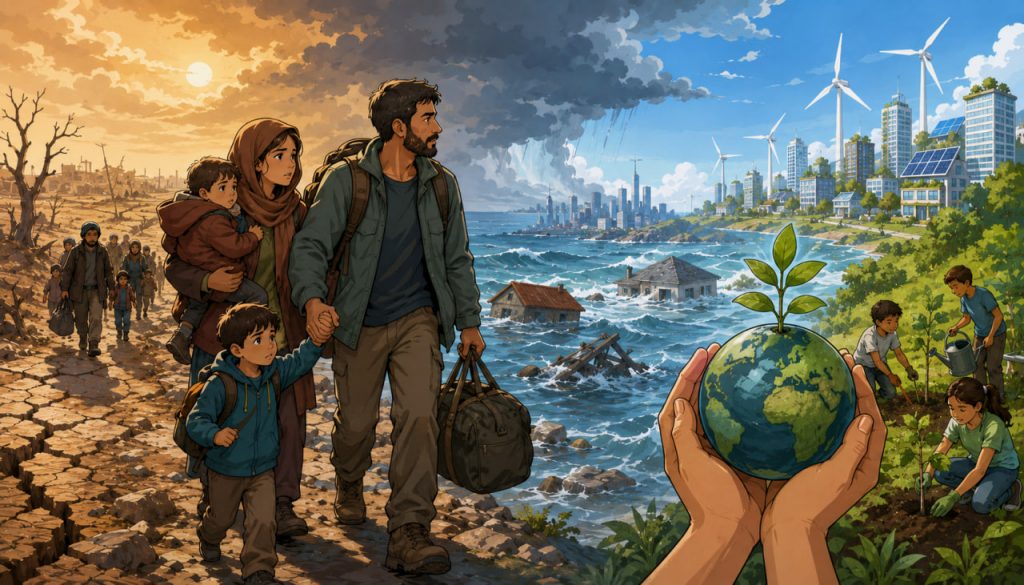
Climate change is no longer discussed only as an environmental issue. Scientists, governments, economists, and humanitarian organizations increasingly recognize it as a growing social and geopolitical challenge that may affect millions of people worldwide.
One of the most serious emerging concerns is the rise of:
- Climate refugees
These are people forced to leave their homes because environmental conditions become dangerous or unsustainable.
Climate-related migration may occur due to:
- Rising sea levels
- Droughts
- Flooding
- Desertification
- Heatwaves
- Extreme storms
- Crop failures
Unlike traditional migration caused by war or economics, climate displacement is closely connected to environmental instability and changing ecosystems.
The possibility of large-scale climate migration raises difficult questions about:
- Human rights
- Infrastructure
- International cooperation
- Urban planning
- Global inequality
Avoiding a future climate refugee crisis may become one of humanity’s greatest challenges during the 21st century.
What Are Climate Refugees?
Climate refugees are people forced to move because environmental conditions threaten their survival, safety, or livelihoods.
Although international law does not yet universally define “climate refugee” as an official legal category, the concept is increasingly discussed worldwide.
People may relocate because:
- Homes become flooded
- Water becomes scarce
- Agriculture fails
- Temperatures become extreme
- Storms repeatedly destroy infrastructure
Some migration happens suddenly after disasters, while other displacement develops gradually over years or decades.
Why Climate Migration Is Increasing
Climate change intensifies many environmental risks already affecting vulnerable regions.
Major drivers include:
- Sea-level rise
- Drought
- Water shortages
- Coastal erosion
- Extreme weather events
Regions highly dependent on:
- Agriculture
- Fishing
- Fragile ecosystems
may face especially severe challenges.
Climate scientist Michael Oppenheimer explained:
“Climate change acts as a threat multiplier for social and economic instability.”
This means environmental stress may worsen existing problems involving poverty, food security, and political tension.
Rising Sea Levels and Coastal Cities
One of the most serious long-term threats involves:
- Rising sea levels
Many major cities worldwide are located near coastlines.
As oceans gradually rise, risks increase for:
- Flooding
- Saltwater intrusion
- Infrastructure damage
- Population displacement
Low-lying islands and coastal communities may become especially vulnerable.
Some regions already experience:
- Chronic flooding
- Shoreline retreat
- Increased storm surge risks
Protecting coastal populations may require enormous investments in adaptation infrastructure.
Drought and Water Scarcity
Water shortages may become another major cause of climate migration.
Long-term drought can damage:
- Agriculture
- Drinking water systems
- Local economies
In some regions, farmers may lose the ability to sustain crops and livestock.
Water scarcity may also contribute to:
- Economic instability
- Food insecurity
- Regional conflict
Scientists increasingly warn that water stress could become one of the defining global challenges of this century.
Extreme Heat and Habitability
Some researchers study whether certain regions may eventually become dangerously hot for regular outdoor activity during parts of the year.
Extreme heat may affect:
- Human health
- Labor productivity
- Infrastructure
- Food production
Urban areas are especially vulnerable because concrete and asphalt retain heat.
Heat adaptation may become critically important for future cities.
Food Security and Agriculture
Climate change strongly affects food systems.
Environmental instability may reduce agricultural productivity through:
- Droughts
- Floods
- Soil degradation
- Heat stress
Food insecurity may push populations to relocate in search of:
- Work
- Resources
- Stable living conditions
Future migration patterns may increasingly follow environmental and agricultural pressures.
Climate Migration and Global Inequality
Climate impacts often affect vulnerable populations most severely.
Poorer regions may have:
- Less infrastructure
- Limited adaptation funding
- Greater dependence on agriculture
At the same time, wealthier countries often possess stronger:
- Flood protection
- Emergency systems
- Technological resources
This imbalance raises important ethical and political questions about global responsibility.
Can Technology Help Prevent Climate Displacement?
Technology may help reduce climate migration risks in some areas.
Possible solutions include:
- Renewable energy systems
- Water desalination
- Climate-resilient agriculture
- Smart urban planning
- Flood barriers
- Early warning systems
Modern climate adaptation increasingly combines:
- Engineering
- Environmental science
- Artificial intelligence
- Infrastructure planning
However, technological solutions alone may not solve all challenges.
Sustainable Cities and Urban Adaptation
Cities will likely play a central role in climate adaptation.
Future urban planning may increasingly prioritize:
- Green infrastructure
- Flood-resistant design
- Heat reduction systems
- Renewable energy
- Water management
Some cities already invest heavily in climate resilience projects.
Architects and engineers are developing:
- Floating structures
- Elevated infrastructure
- Climate-adaptive neighborhoods
Urban resilience may become one of the most important priorities of future civilization.
International Cooperation and Policy
Climate migration is a global issue requiring international cooperation.
Governments increasingly discuss:
- Climate agreements
- Emission reduction
- Humanitarian planning
- Disaster response systems
Experts argue that preventing climate refugee crises requires both:
- Mitigation
- Adaptation
Mitigation aims to reduce climate change itself, while adaptation helps societies cope with unavoidable impacts.
Forests, Ecosystems, and Climate Stability
Healthy ecosystems help reduce environmental instability.
Forests, wetlands, and natural systems support:
- Water regulation
- Carbon storage
- Soil protection
- Flood reduction
Environmental destruction may worsen climate-related displacement risks.
Protecting ecosystems therefore became connected not only to biodiversity, but also to long-term human stability.
Climate Anxiety and Social Stability
Climate concerns increasingly affect psychological well-being, especially among younger generations.
Fears involving:
- Environmental collapse
- Displacement
- Resource scarcity
may influence politics, economics, and social behavior.
Managing climate risks therefore involves not only environmental science, but also social resilience and public trust.
Could Climate Refugee Numbers Become Massive?
Researchers disagree about future migration numbers because outcomes depend heavily on:
- Emission reductions
- Infrastructure investment
- Political cooperation
- Technological progress
Some projections suggest climate displacement could affect millions of people during this century if warming intensifies significantly.
However, many experts emphasize that strong action today could reduce future risks substantially.
Why This Crisis Matters
Climate refugees represent more than environmental migration.
The issue connects directly to:
- Human rights
- Economic stability
- Global security
- Infrastructure
- International relations
The way humanity responds to climate adaptation during the coming decades may strongly influence the future stability of civilization itself.
Avoiding large-scale climate displacement will likely require:
- Scientific innovation
- Sustainable development
- Environmental protection
- International cooperation
The challenge is enormous, but many scientists believe proactive action today can still help reduce the worst future outcomes.
Interesting Facts
- Many of the world’s largest cities are located near coastlines.
- Climate change may increase the frequency of extreme weather events in some regions.
- Wetlands and forests help reduce flooding and environmental instability.
- Some cities already build infrastructure specifically designed for climate adaptation.
- Water scarcity is becoming a growing global concern in multiple regions.
Glossary
- Climate Refugee — A person displaced because environmental conditions become unsafe or unsustainable.
- Sea-Level Rise — Gradual increase in ocean water levels caused partly by climate change.
- Desertification — The process where fertile land becomes increasingly dry and degraded.
- Climate Adaptation — Adjustments helping societies cope with environmental changes.
- Infrastructure — Physical systems such as roads, buildings, power networks, and water systems.