Modern civilization offers enormous technological advantages, but many people increasingly feel overwhelmed by:
- Urban stress
- Pollution
- Noise
- Consumer culture
- Rising living costs
- Social isolation
As a result, interest in eco-settlements and sustainable communities has grown rapidly worldwide. What was once considered a niche lifestyle chosen mainly by environmental activists is now attracting:
- Families
- Remote workers
- Entrepreneurs
- Scientists
- Architects
- Young professionals
Eco-settlements combine ideas from:
- Sustainability
- Renewable energy
- Organic agriculture
- Community living
- Ecological architecture
Some people view them as an escape from modern civilization, while others see them as experimental models for the future of human society.
The growing popularity of eco-communities raises important questions about how people may live during the coming decades in a world facing:
- Climate change
- Resource pressures
- Urban overcrowding
- Technological transformation
What Are Eco-Settlements?
Eco-settlements are communities designed to reduce environmental impact while supporting sustainable lifestyles.
Although every project differs, common goals include:
- Energy efficiency
- Renewable energy use
- Local food production
- Reduced waste
- Water conservation
- Ecological building methods
Some eco-settlements are small rural communities, while others are highly organized experimental towns.
The movement combines environmental concerns with social and economic ideas about healthier ways of living.
Why People Are Interested in Eco-Living
Several global trends increased interest in eco-settlements.
These include:
- Rising environmental awareness
- Remote work opportunities
- Desire for healthier lifestyles
- Interest in self-sufficiency
- Concerns about climate change
Many people feel disconnected from nature in highly urbanized environments.
Eco-settlements often promise:
- Cleaner air
- Slower lifestyles
- Stronger communities
- More direct connection with natural systems
Architect and sustainability researcher William McDonough explained:
“The goal is not simply to reduce harm, but to design systems that work with nature.”
This philosophy strongly influences many eco-community projects.
Renewable Energy and Self-Sufficiency
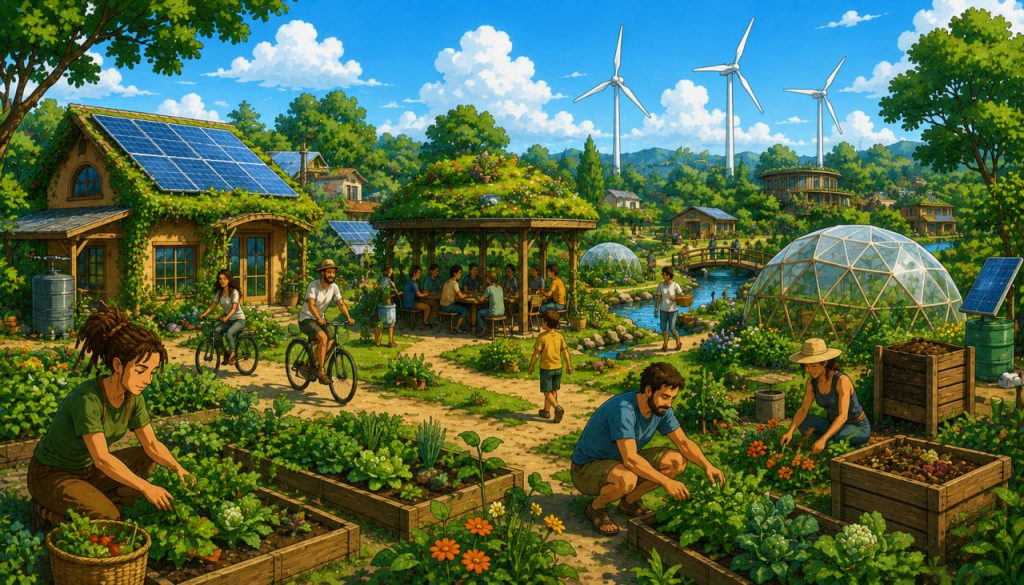
Many eco-settlements attempt to produce at least part of their own energy.
Common technologies include:
- Solar panels
- Wind turbines
- Rainwater collection
- Energy storage systems
- Composting systems
Some communities aim for near-total independence from centralized infrastructure.
This approach may increase resilience during:
- Energy crises
- Natural disasters
- Economic instability
However, achieving complete self-sufficiency is often difficult in practice.
Eco-Houses and Sustainable Architecture
Architecture plays a major role in eco-settlement design.
Many communities use:
- Natural materials
- Passive heating systems
- Green roofs
- Energy-efficient insulation
- Recycled construction materials
Some homes are designed to minimize energy use through:
- Sunlight optimization
- Natural ventilation
- Thermal efficiency
Modern sustainable architecture increasingly combines ecological principles with advanced engineering technologies.
Food Production and Organic Farming
Food systems are central to many eco-settlements.
Communities often practice:
- Organic agriculture
- Permaculture
- Community gardening
- Local food production
The goal is to reduce dependence on industrial agriculture and long-distance supply chains.
Some eco-communities attempt to produce a significant portion of their own food locally.
This may improve:
- Food security
- Soil health
- Environmental sustainability
Community and Social Structure
One major difference between eco-settlements and ordinary suburbs involves community organization.
Many eco-communities emphasize:
- Shared decision-making
- Cooperative projects
- Resource sharing
- Social interaction
Supporters argue that strong communities improve:
- Mental well-being
- Social resilience
- Cooperation
In modern cities, many people experience increasing social isolation despite dense populations.
Eco-settlements attempt to rebuild stronger social connections.
Technology and Modern Eco-Communities
Contrary to stereotypes, many eco-settlements are highly technological.
Modern projects may include:
- Smart energy systems
- Internet infrastructure
- Water recycling technologies
- Automated agriculture
- AI-supported resource management
Many residents continue working remotely through digital networks.
This means eco-living does not necessarily require rejecting modern technology.
Instead, some communities attempt to combine:
- High technology
- Ecological sustainability
in new ways.
Criticism and Challenges
Eco-settlements also face criticism and practical limitations.
Common challenges include:
- High startup costs
- Infrastructure difficulties
- Social conflicts
- Limited economic opportunities
- Isolation from services
Some projects fail because maintaining sustainable communities requires:
- Organization
- Cooperation
- Long-term planning
Critics sometimes argue that eco-settlements may be difficult to scale for large populations.
Are Eco-Settlements Escaping Civilization?
Some people view eco-communities as attempts to escape modern society.
However, many eco-settlement advocates reject this interpretation.
Instead, they argue that these communities function as:
- Experimental models
- Sustainability laboratories
- Alternative urban planning concepts
Many eco-settlements remain connected to:
- Technology
- Education
- Business networks
- Scientific research
Rather than rejecting civilization entirely, they often seek to redesign parts of it.
Climate Change and the Future of Living
Climate concerns increasingly influence housing and infrastructure planning.
Extreme weather, rising energy costs, and environmental instability may push societies toward:
- More localized systems
- Energy-efficient housing
- Sustainable agriculture
- Resource-conscious communities
Some experts believe eco-settlement ideas may gradually influence mainstream urban planning.
Features once considered unusual — such as solar roofs or rainwater systems — are becoming more common globally.
The Psychological Appeal of Nature
Humans evolved in close connection with natural environments for most of history.
Many psychologists believe exposure to:
- Green spaces
- Natural landscapes
- Quiet environments
may improve:
- Stress levels
- Mood
- Mental clarity
Eco-settlements often emphasize reconnecting daily life with nature.
This psychological factor contributes strongly to their growing popularity.
Why Eco-Settlements Matter
Eco-settlements represent more than alternative housing experiments.
They reflect broader questions about:
- Sustainability
- Human well-being
- Technology
- Community
- Environmental responsibility
As global environmental pressures increase, societies may increasingly explore new ways of organizing cities, resources, and lifestyles.
Whether eco-settlements remain niche communities or influence mainstream civilization, they are already shaping discussions about the future of sustainable living.
Interesting Facts
- Some eco-settlements generate most of their electricity from renewable sources.
- Modern eco-communities often include high-speed internet and smart technologies.
- Permaculture is commonly used in sustainable food production systems.
- Certain eco-villages operate cooperative economic systems.
- Sustainable architecture increasingly influences mainstream urban development.
Glossary
- Eco-Settlement — A community designed around ecological sustainability principles.
- Permaculture — A sustainable agricultural and ecological design system.
- Renewable Energy — Energy generated from naturally replenishing sources.
- Passive Heating — Building design using natural heat from sunlight and insulation.
- Sustainability — Long-term balance between human activity and environmental protection.