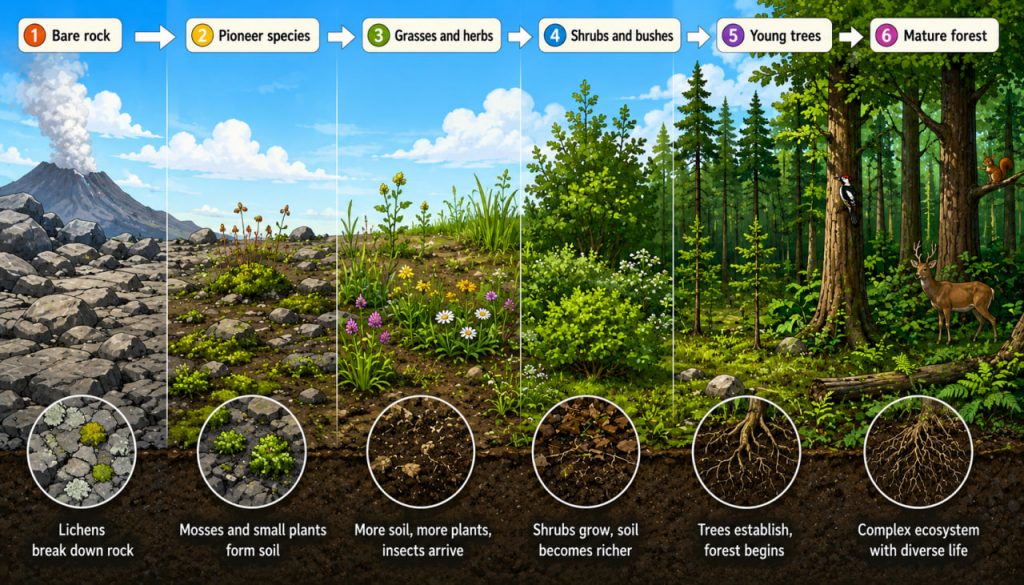
Nature is constantly changing. A barren landscape created by a volcanic eruption, an abandoned agricultural field, or a patch of land cleared by fire may initially appear lifeless. Yet given enough time, these places can transform into thriving ecosystems filled with grasses, shrubs, trees, insects, birds, and mammals.
This remarkable process is known as ecological succession. It describes the gradual and predictable way ecosystems develop over time. Ecological succession is one of the most important concepts in ecology because it explains how nature recovers from disturbances and how complex ecosystems emerge from seemingly empty land.
Understanding succession helps us appreciate the resilience of nature and the dynamic processes that shape forests, grasslands, wetlands, and other habitats.
What Is Ecological Succession?
Ecological succession is the gradual change in the composition and structure of a biological community over time.
As conditions in an environment change, different groups of organisms become established, grow, and eventually replace earlier species.
The process involves:
- Colonization by new species
- Competition for resources
- Changes in soil conditions
- Alterations in light, moisture, and nutrient availability
Over many years or even centuries, an ecosystem may evolve from a simple community into a highly complex one.
Why Succession Happens
No ecosystem remains completely stable forever.
Natural disturbances such as:
- Wildfires
- Floods
- Hurricanes
- Volcanic eruptions
- Landslides
can dramatically alter landscapes.
Human activities may also create opportunities for succession:
- Farming
- Logging
- Construction
- Mining
When a disturbance occurs, nature begins rebuilding through ecological succession.
Primary Succession: Starting from Bare Rock
The most dramatic form of succession is called primary succession.
Primary succession occurs when life begins on surfaces where no soil exists.
Examples include:
- Newly formed volcanic islands
- Fresh lava flows
- Areas exposed by retreating glaciers
Because there is no soil, conditions are extremely challenging.
Pioneer Species
The first organisms to arrive are known as pioneer species.
These often include:
- Lichens
- Certain bacteria
- Mosses
Lichens are particularly important because they slowly break down rock surfaces while trapping dust and organic material.
Over time, this process contributes to soil formation.
Without pioneer species, more complex plants would struggle to establish themselves.
Secondary Succession: Recovery After Disturbance
Secondary succession occurs when soil already exists but the ecosystem has been disrupted.
Examples include:
- Abandoned farmland
- Burned forests
- Storm-damaged areas
Because soil remains present, recovery is usually much faster than in primary succession.
Seeds, roots, microorganisms, and nutrients already exist within the environment, providing a foundation for regrowth.
The Stages of Succession
Although every ecosystem is unique, ecological succession often follows a recognizable sequence.
Stage 1: Grasses and Small Plants
The first visible plants are usually:
- Grasses
- Wildflowers
- Fast-growing herbs
These species grow quickly and help stabilize the soil.
Their roots reduce erosion while adding organic material as they die and decompose.
Stage 2: Shrubs and Bushes
As soil quality improves, shrubs begin to establish themselves.
These plants:
- Provide shade
- Retain moisture
- Create habitats for insects and small animals
The growing plant diversity attracts more wildlife.
Stage 3: Young Trees
Eventually, tree seedlings begin to appear.
Common early tree species include:
- Birch
- Aspen
- Pine
These trees grow rapidly and take advantage of abundant sunlight.
At this stage, the landscape starts resembling a young forest.
Stage 4: Mature Forest
Over decades or centuries, slower-growing tree species may replace earlier trees.
Examples include:
- Oak
- Beech
- Maple
- Spruce
These species often tolerate shade better and can dominate mature forests.
The resulting ecosystem contains multiple layers of vegetation and supports a rich diversity of life.
The Concept of a Climax Community
Ecologists once described the final stage of succession as a climax community, a relatively stable ecosystem that persists until disturbed.
Modern ecology recognizes that ecosystems continue changing and responding to environmental conditions.
Nevertheless, mature forests often represent the later stages of succession in many temperate regions.
How Animals Participate in Succession
Succession is not driven solely by plants.
Animals play important roles by:
- Dispersing seeds
- Pollinating flowers
- Modifying habitats
- Influencing plant competition
Birds, mammals, insects, and microorganisms all contribute to ecosystem development.
For example, birds may carry seeds from distant locations, introducing new plant species into recovering habitats.
Ecological Succession and Climate Change
Succession is increasingly important in a changing world.
As climate patterns shift, ecosystems must adapt.
Understanding succession helps scientists:
- Predict vegetation changes
- Restore damaged habitats
- Improve conservation efforts
- Manage forests sustainably
Many restoration projects rely on ecological succession to rebuild ecosystems naturally.
Expert Perspective
Ecologist Eugene Odum, often called the father of modern ecosystem ecology, emphasized the importance of succession in understanding nature:
“Succession is one of the fundamental processes through which ecosystems develop organization, stability, and diversity.”
His work helped establish succession as a central concept in ecological science.
Why Succession Matters
Ecological succession demonstrates that nature is remarkably resilient.
Even after severe disturbances, ecosystems possess the ability to recover and reorganize.
The transformation from an empty field into a mature forest illustrates how simple biological interactions can create extraordinary complexity over time.
Every forest, meadow, and wetland around us represents a chapter in an ongoing ecological story—a story written by countless organisms working together across generations.
Interesting Facts
- Some volcanic islands have developed complex ecosystems within just a few decades.
- Lichens can survive in some of the harshest environments on Earth.
- A mature forest may take hundreds of years to develop fully.
- Certain plant species specialize in colonizing recently disturbed land.
- Ecological succession occurs in aquatic ecosystems as well as on land.
Glossary
- Ecological Succession — The gradual change in an ecosystem’s species composition over time.
- Primary Succession — Succession that begins on surfaces where no soil exists.
- Secondary Succession — Succession that occurs after disturbance when soil remains.
- Pioneer Species — The first organisms to colonize a newly available habitat.
- Climax Community — A relatively stable ecosystem that develops during later stages of succession.
- Lichen — A symbiotic organism formed by fungi and photosynthetic partners such as algae.