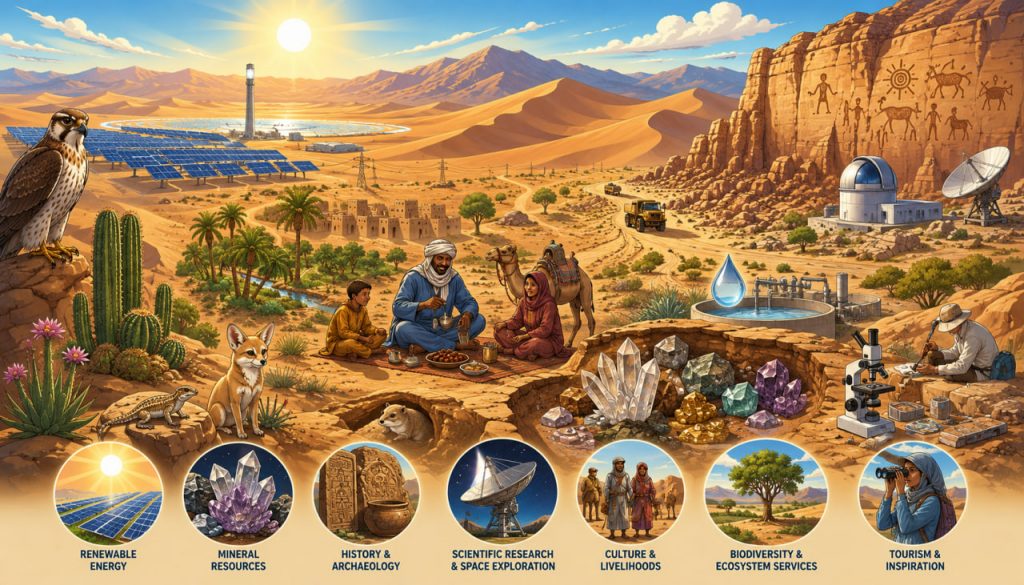
Deserts are often described as empty, hostile wastelands where almost nothing can survive. In reality, they are complex ecosystems that influence climate, support specialized wildlife, preserve geological history, contain valuable resources, and provide opportunities for renewable energy, science, tourism, and traditional livelihoods.
A desert is defined mainly by its lack of precipitation, not by heat. Some deserts contain towering sand dunes, while others consist of rock, gravel, salt flats, mountains, or frozen landscapes.
Deserts can be extremely useful to humanity, but their value depends on careful management rather than unrestricted exploitation.
What Makes an Area a Desert?
A desert is a region that receives very little precipitation compared with the amount of water that could evaporate from it.
Many deserts are hot during the day, but temperature alone does not create a desert. Antarctica is considered the world’s largest desert because its interior receives very little precipitation.
Major desert types include:
- Hot subtropical deserts
- Coastal deserts
- Rain-shadow deserts
- Cold continental deserts
- Polar deserts
The Sahara, Arabian, Gobi, Atacama, Kalahari, Mojave, and Antarctic deserts formed under different combinations of atmospheric circulation, geography, ocean currents, and long-term climate patterns.
Deserts Are Living Ecosystems
Desert landscapes may appear empty because their plants and animals are less densely distributed than those in forests or grasslands.
However, many species are highly adapted to arid conditions. They may store water, avoid daytime heat, remain dormant during drought, or complete their life cycles rapidly after rainfall.
Desert ecosystems support:
- Reptiles and insects
- Small and large mammals
- Migratory birds
- Drought-resistant grasses
- Succulents and shrubs
- Microorganisms living in soil and rock
- Rare species found nowhere else
The United Nations Environment Programme emphasizes that deserts and drylands contribute to biodiversity and climate regulation rather than functioning as biologically useless areas.
A landscape does not need dense vegetation to possess ecological value.
Desert Dust Can Fertilize Distant Ecosystems
One of the most remarkable benefits of deserts occurs thousands of kilometers away from them.
Powerful winds lift mineral-rich dust from the Sahara and transport it across the Atlantic Ocean. Some of this material reaches the Amazon rainforest.
NASA satellite observations estimated that approximately 27 to 28 million tonnes of African dust are deposited over the Amazon basin in an average year. The dust includes phosphorus, an essential plant nutrient that is gradually removed from Amazon soils by heavy rainfall and flooding.
This does not mean dust storms are always beneficial. Heavy airborne dust can worsen respiratory illness, reduce visibility, disrupt transport, and damage infrastructure.
The important lesson is that desert processes can connect distant ecosystems and participate in global nutrient cycles.
Enormous Potential for Solar Energy
Many desert regions receive intense sunlight, experience relatively few cloudy days, and contain large areas with low population density.
These conditions can make them attractive locations for photovoltaic solar farms and concentrated solar power plants.
Concentrated solar power uses mirrors to focus sunlight and generate heat. In some facilities, that heat can be stored and used to produce electricity after sunset.
IRENA has identified strong solar irradiation as an important advantage for renewable-energy development in desert countries.
Desert solar projects may provide:
- Large quantities of low-carbon electricity
- Employment and infrastructure
- Power for desalination
- Energy for remote communities
- Reduced dependence on imported fuels
However, building in a desert is not automatically environmentally harmless. Projects require roads, transmission lines, cleaning water, land, and maintenance. Dust reduces panel performance, while extreme heat can affect electrical efficiency and equipment life.
Wildlife corridors, culturally important land, and fragile desert surfaces must also be protected.
Valuable Mineral Resources
Arid regions contain many important mineral deposits.
The U.S. Geological Survey notes that desert and arid lands contain resources including copper, iron, lead, zinc, gold, silver, uranium, lithium, clays, mica, and other industrial materials.
Dry climates can sometimes expose geological formations that are hidden beneath soil and vegetation elsewhere. Evaporation can also concentrate minerals in salt lakes and dry basins.
These materials may support:
- Construction
- Electronics
- Electrical grids
- Batteries
- Transport
- Renewable-energy technologies
- Agriculture and chemical production
Mining can also consume scarce water, disturb habitats, create toxic waste, and affect local communities. The presence of useful minerals therefore creates both economic opportunities and serious environmental responsibilities.
Deserts Preserve Earth’s History
Dry landscapes can preserve ancient landforms, fossils, tools, settlements, and rock art for long periods.
Low rainfall and limited vegetation may reduce some forms of weathering and biological decay. Archaeologists have recovered remarkably well-preserved textiles, human remains, wooden objects, manuscripts, and buildings from arid environments.
Desert sediments also contain evidence of earlier climates. Dry lakebeds, dunes, river channels, and mineral deposits can reveal periods when a modern desert was wetter or supported extensive vegetation.
The USGS describes desert landscapes as records shaped by tectonic activity, erosion, weathering, and long cycles of wetter and drier climate.
Deserts function as natural archives of environmental and human history.
Scientific Research and Space Exploration
Desert conditions make certain regions valuable for scientific research.
Astronomical observatories are often built in high, dry deserts because the atmosphere contains little moisture and artificial light may be limited. These conditions can provide clearer views of space.
Deserts are also used to test:
- Rovers and robotic vehicles
- Space suits
- Remote communication systems
- Solar technologies
- Geological instruments
- Equipment designed for extreme environments
Some desert surfaces resemble conditions found on Mars, although Earth’s atmosphere and biology make them very different environments.
Researchers also study desert organisms to understand heat tolerance, water conservation, dormancy, and survival under extreme stress.
Traditional Livelihoods and Local Knowledge
People have lived in drylands for thousands of years.
Pastoral communities move livestock between grazing areas and water sources. Oasis agriculture supports crops such as dates, grains, vegetables, and fruit. Trade routes historically connected distant cities across desert regions.
Traditional knowledge may include:
- Locating seasonal water
- Conserving food
- Building heat-resistant homes
- Navigating large landscapes
- Managing grazing pressure
- Selecting drought-tolerant crops
- Reading weather and animal behavior
UNEP reports that drylands are home to more than two billion people, demonstrating that these regions are not simply empty spaces awaiting industrial development.
Successful desert development should therefore respect land rights, cultural heritage, and local expertise.
Tourism and Human Well-Being
Deserts attract visitors with enormous skies, silence, unusual geology, wildlife, archaeology, and dramatic light.
Activities may include hiking, stargazing, photography, camel trekking, cultural tourism, camping, and geological exploration.
Responsible tourism can generate income for local guides, accommodation providers, craftspeople, conservation projects, and transport services.
But desert tourism has limits. Vehicle tracks may remain visible for decades, visitors can damage biological soil crusts, and excessive groundwater use can threaten communities and ecosystems.
Heat illness, dehydration, flash floods, poor mobile coverage, and large temperature changes also make deserts dangerous for unprepared travelers.
Deserts Influence Climate
Desert surfaces exchange heat with the atmosphere and influence winds, dust transport, cloud formation, and regional weather.
Drylands also contain significant amounts of carbon in their soils and vegetation. UNEP has highlighted the importance of drylands in global carbon storage and climate regulation.
Desert vegetation may grow slowly, making disturbance particularly long-lasting. A shrub damaged by construction or off-road driving may require many years to recover.
Protecting existing desert ecosystems is therefore different from encouraging desertification.
Desert and Desertification Are Not the Same
A natural desert is an established ecosystem shaped by climate and geography.
Desertification is the degradation of productive dryland caused by factors such as overgrazing, vegetation removal, unsustainable farming, poor water management, and climate stress.
Desertification can reduce soil fertility, food security, biodiversity, and access to water. UNEP warns that land degradation and desertification have serious consequences for ecosystems and human well-being.
Preventing desertification does not mean eliminating natural deserts. It means protecting productive land from unnecessary degradation while conserving genuine desert habitats.
Expert Perspective
UNEP presents deserts and drylands as valuable ecosystems that contribute to biodiversity, climate regulation, natural resources, and human livelihoods.
This perspective challenges the idea that land is useful only when it is green, intensively farmed, or densely populated.
The real value of a desert lies not only in what humans can extract from it, but also in the ecological processes, cultural knowledge, scientific information, and specialized life that the landscape already supports.
Interesting Facts
- Antarctica is the largest desert on Earth because it receives extremely little precipitation.
- Not every desert is covered with sand; many are dominated by gravel, rock, salt, or ice.
- Saharan dust can cross the Atlantic Ocean and deliver phosphorus to the Amazon rainforest.
- Some desert plants remain dormant for years before rainfall triggers rapid growth and flowering.
- Coastal deserts can be extremely dry even when located beside an ocean.
- Desert nights may become very cold because dry air and clear skies allow heat to escape quickly.
- Ancient lakebeds can contain concentrated mineral deposits.
- High-altitude deserts are valuable locations for astronomical observatories.
- Vehicle tracks can remain visible on fragile desert surfaces for many years.
- Deserts contain organisms whose adaptations may inspire new technologies and medical research.
Glossary
- Desert — A region receiving very little precipitation relative to potential evaporation.
- Arid — Extremely dry or lacking sufficient moisture.
- Dryland — An area where water availability is limited for part or most of the year.
- Desertification — Degradation of productive land in dry regions due to climatic and human pressures.
- Oasis — A fertile desert location where groundwater reaches or approaches the surface.
- Rain Shadow — A dry region formed when mountains block moisture-carrying air.
- Subtropical Desert — A desert associated with descending dry air in subtropical atmospheric circulation.
- Polar Desert — A very dry, cold region receiving little snow or rain.
- Dust Transport — Movement of airborne mineral particles by wind over local or global distances.
- Concentrated Solar Power — Technology that uses mirrors to focus sunlight and produce heat for electricity generation.
- Biodiversity — The variety of genes, species, and ecosystems in a region.
- Biological Soil Crust — A fragile surface community of microorganisms, lichens, and mosses that stabilizes desert soil.
- Pastoralism — A livelihood based primarily on raising and moving grazing animals.
- Desalination — Removal of dissolved salts from seawater or brackish water.
- Ecosystem Service — A benefit that people receive from natural systems, such as climate regulation, resources, or recreation.