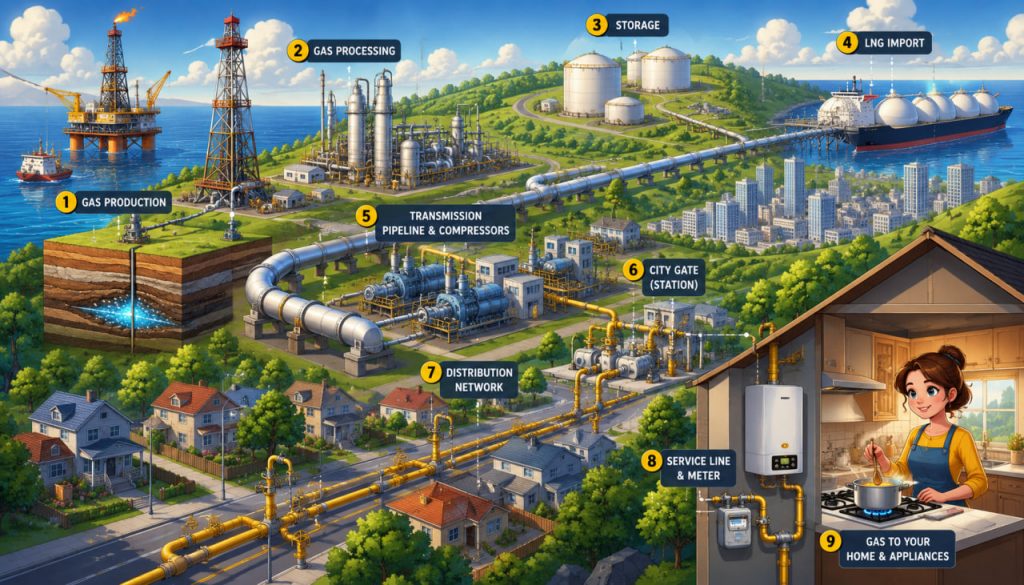
Natural gas reaches homes, businesses, power stations, and factories through a vast network of production facilities, processing plants, pipelines, storage sites, pressure-control stations, and local distribution pipes.
Although consumers usually see only a gas meter and a stove or boiler, the complete gas supply system may stretch across thousands of kilometers. Its main purpose is to move large quantities of gas safely, maintain stable pressure, balance seasonal demand, and deliver the correct amount of fuel to every customer.
Modern gas supply is not a single pipeline. It is a carefully controlled chain connecting gas production with the final appliance.
Where Natural Gas Comes From
Natural gas is extracted from underground geological formations through wells drilled on land or beneath the seabed. It may come from conventional reservoirs, shale formations, or fields that also produce crude oil.
Raw gas taken from a well is rarely ready for direct use. It can contain water vapor, sand, carbon dioxide, hydrogen sulfide, and heavier hydrocarbons.
At a processing facility, unwanted substances are removed and useful components may be separated. The resulting marketable gas consists mainly of methane and must meet technical quality requirements before entering a major pipeline system.
Gathering Gas From Production Fields
The first part of the network is known as the gathering system.
Smaller pipelines collect gas from individual wells and carry it to a central processing plant or transmission connection. Depending on the gas field, the gathering network may include:
- Separators that remove liquids
- Filters that capture particles
- Dehydration equipment
- Measuring instruments
- Valves and pressure-control equipment
After treatment, the gas is measured and transferred into the high-pressure transmission network.
Long-Distance Gas Transmission
Transmission pipelines move large volumes of natural gas from production and processing regions to cities, industrial areas, storage sites, and distribution centers.
These pipelines generally have a much larger diameter and operate at significantly higher pressure than local distribution pipes. High pressure allows substantial quantities of gas to travel efficiently over long distances.
A transmission pipeline is more than a steel tube. The complete system also contains valves, meters, communication equipment, control centers, and compressor stations.
Transmission pipelines function like the highways of the gas network, while local distribution pipes resemble city streets.
Why Compressor Stations Are Necessary
As natural gas travels through a pipeline, friction gradually causes its pressure to fall.
Compressor stations restore the required pressure and keep the gas moving toward consumers. They are positioned at intervals along major transmission routes and may use gas turbines, reciprocating engines, or electric motors to drive compressors.
Operators continuously monitor pressure, temperature, flow rate, and equipment condition. Modern pipeline control centers can receive information from remote sensors and adjust valves or compressor output when demand changes.
The Role of Underground Gas Storage
Gas consumption is rarely constant. Demand may rise sharply during cold weather when millions of buildings use gas for heating.
To balance production and consumption, operators store gas during periods of lower demand and withdraw it when additional supply is required.
Gas can be stored in:
- Depleted oil or gas fields
- Underground salt caverns
- Aquifer storage formations
- Above-ground tanks in liquefied form
Storage provides flexibility during seasonal peaks, supply interruptions, infrastructure maintenance, and unexpected changes in demand. The International Energy Agency identifies storage capacity, pipeline interconnections, and flexible liquefied natural gas supplies as important tools for responding to major market fluctuations.
How Liquefied Natural Gas Enters the System
Not all natural gas reaches a country through pipelines.
Gas can be cooled to approximately −162°C, turning it into liquefied natural gas, or LNG. Liquefaction dramatically reduces its volume, making long-distance transport by specialized ships practical.
At an importing terminal, LNG is unloaded into insulated storage tanks. It is later warmed in regasification equipment, returned to a gaseous state, measured, and injected into the transmission network.
LNG terminals often connect directly to major pipelines, storage facilities, and large consuming regions.
What Happens at the City Gate
Before high-pressure gas can enter a local distribution network, it passes through a city gate or gate station.
This is the connection point where a distribution utility receives gas from a transmission system. At the station, equipment measures the quantity and quality of the gas and reduces its pressure for movement through smaller local pipelines.
An odorant is commonly added at this stage or elsewhere in the distribution system. Natural gas is naturally colorless and usually has little or no detectable smell, so sulfur-like odorants help people recognize leaks.
Local Gas Distribution Networks
Local distribution companies deliver gas from city gates to residential, commercial, and smaller industrial customers.
The distribution system consists of:
- Distribution mains running beneath streets
- Service lines connecting mains to individual buildings
- Pressure regulators
- Isolation valves
- Gas meters
- Monitoring and leak-detection equipment
Distribution pipelines are normally smaller than transmission lines and operate at lower pressures. Depending on local standards, age, pressure, and installation conditions, they may be made from steel or specialized plastic materials.
Different sections of a city may operate at different pressure levels. Regulators reduce pressure gradually so the gas reaches buildings at a level suitable for safe use.
From the Street to the Building
A service line branches from the distribution main and carries gas toward a property.
Before entering the building’s internal pipework, the gas normally passes through a regulator and meter. The regulator maintains suitable delivery pressure, while the meter records consumption for billing and system management.
Inside the property, pipes direct gas to approved appliances such as:
- Heating boilers
- Furnaces
- Water heaters
- Cooking equipment
- Fireplaces
- Industrial burners
Each appliance contains controls designed to regulate gas flow and support safe combustion.
How Operators Balance Supply and Demand
A gas network must remain balanced: the amount entering the system must broadly match the amount being consumed or stored.
Operators forecast demand using factors such as weather, historical consumption, industrial schedules, electricity generation requirements, and storage levels.
They can respond to changing conditions by adjusting compressor stations, withdrawing gas from storage, changing pipeline flows, importing LNG, or asking major consumers to alter demand under specific commercial arrangements.
Pressure is one of the network’s most important operating indicators. A significant imbalance between supply and consumption can cause pressure to move outside its intended range.
Safety Systems Across the Network
Gas infrastructure uses multiple layers of protection rather than relying on a single safety device.
Typical measures include automatic shutoff systems, pressure-relief equipment, corrosion protection, pipeline inspections, leak surveys, emergency plans, remote monitoring, and controlled maintenance programs.
Valves can isolate damaged sections, while sensors and control systems help operators identify unusual pressure or flow conditions.
Odorization provides an additional warning for people near distribution leaks. In regulated distribution systems, operators must ensure that odorant remains detectable throughout the network rather than only at the injection point.
Anyone who notices a strong gas odor should avoid flames and electrical switches, leave the affected area, and contact the local emergency or gas service from a safe location.
Expert Perspective
Pipeline-safety specialists treat gas delivery as an integrated system in which engineering, inspection, monitoring, maintenance, and public awareness work together.
Guidance from the U.S. Pipeline and Hazardous Materials Safety Administration emphasizes that odorization is a primary public-warning measure and must be maintained continuously and consistently.
This reflects a broader engineering principle: safe gas supply depends not only on strong pipelines, but also on detecting small problems before they become major failures.
Interesting Facts
- Natural gas can travel across several countries before reaching the final consumer.
- High-pressure transmission pipelines carry gas most of the distance, while lower-pressure distribution pipes complete the delivery.
- Underground gas storage can use geological formations that once contained natural gas or oil.
- LNG occupies far less volume than natural gas in its gaseous state, allowing it to be transported by ship.
- Compressor stations compensate for pressure losses caused by friction inside pipelines.
- The familiar sulfur-like gas smell usually comes from an added odorant, not from methane itself.
- A gas meter measures consumption, while a regulator controls delivery pressure.
- Some pipeline networks can reverse flow direction to respond to changing supply routes.
Glossary
- Natural Gas — A gaseous fossil fuel composed mainly of methane.
- Gathering System — A network of pipes that collects gas from production wells.
- Transmission Pipeline — A large, high-pressure pipeline used for long-distance gas transportation.
- Distribution Main — A local pipeline carrying gas through towns and cities.
- Service Line — A smaller pipe connecting a distribution main to an individual property.
- Compressor Station — A facility that increases gas pressure to maintain pipeline flow.
- City Gate — A station where gas moves from the transmission network into a local distribution system.
- Pressure Regulator — A device that reduces and stabilizes gas pressure.
- Gas Meter — An instrument that measures the amount of gas consumed.
- Odorant — A strongly smelling chemical added to gas to make leaks easier to detect.
- LNG — Liquefied natural gas that has been cooled for storage or transportation.
- Regasification — The process of warming LNG and converting it back into gas.
- Underground Storage — Geological facilities used to store natural gas for later withdrawal.