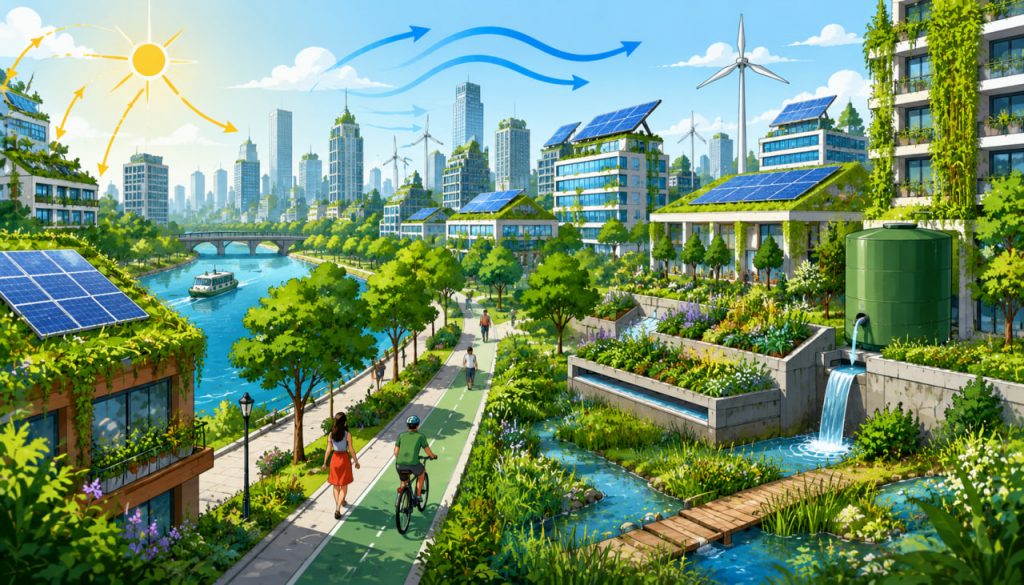
Modern cities are often viewed as engineering achievements, yet they are also ecosystems. Streets, buildings, parks, rivers, and infrastructure interact with natural forces every day. Urban ecology is the discipline that studies these interactions and seeks to create cities that work with nature rather than against it.
As climate change, population growth, and resource pressures intensify, urban planners are increasingly recognizing the importance of designing cities around natural elements such as wind, sunlight, and water. When these forces are properly considered, cities become more energy-efficient, resilient, comfortable, and environmentally sustainable.
What Is Urban Ecology?
Urban ecology examines the relationship between human settlements and the natural environment.
Rather than treating nature as an obstacle to development, urban ecology views natural systems as essential components of healthy cities.
Its goals include:
- Improving environmental quality
- Reducing energy consumption
- Enhancing public health
- Increasing climate resilience
- Supporting biodiversity
- Creating more livable urban spaces
The most successful cities do not eliminate nature—they integrate it into every stage of planning and development.
Why Natural Forces Matter in City Design
For thousands of years, settlements were built according to local geography and climate. Ancient cities often took advantage of prevailing winds, solar exposure, and nearby water sources.
However, rapid industrialization and modern construction sometimes ignored these principles.
The result can include:
- Urban heat islands
- Air pollution accumulation
- Flooding problems
- Excessive energy consumption
- Reduced comfort for residents
Urban ecological planning seeks to reverse these trends by understanding how environmental systems influence urban life.
Designing with Wind in Mind
Wind plays a crucial role in urban comfort and air quality.
Properly managed airflow can cool streets, disperse pollutants, and reduce dependence on mechanical ventilation systems.
Urban planners often study prevailing wind patterns before designing neighborhoods.
Important strategies include:
- Aligning streets with natural airflow corridors
- Preserving open spaces that allow air circulation
- Avoiding dense building arrangements that block ventilation
- Designing green corridors through urban areas
Poorly designed skyscraper districts can create “wind tunnels” that make streets uncomfortable and even dangerous for pedestrians.
Conversely, well-designed ventilation corridors can improve urban temperatures and reduce pollution concentrations.
Natural airflow is one of the most cost-effective forms of climate control available to cities.
The Role of Sunlight in Sustainable Urban Planning
Sunlight affects everything from building energy use to public health.
A city’s orientation and building layout can significantly influence heating and cooling demands.
Solar-conscious planning often focuses on:
- Maximizing winter sunlight
- Reducing excessive summer heat
- Increasing natural daylight indoors
- Supporting solar energy generation
Buildings that receive adequate daylight typically require less artificial lighting, reducing energy consumption.
Access to sunlight also benefits residents by supporting mental health, circadian rhythms, and overall well-being.
Many modern eco-cities now require solar studies before approving major construction projects.
This helps ensure that new developments do not excessively shade neighboring buildings, parks, or public spaces.
Water as the Foundation of Urban Resilience
Water management is becoming one of the most important challenges facing modern cities.
Traditional urban design often focused on moving rainwater away as quickly as possible through pipes and drainage systems.
Today, urban ecologists recognize that water should be treated as a valuable resource rather than a problem.
Modern water-sensitive design includes:
- Rain gardens
- Green roofs
- Bioswales
- Permeable pavements
- Stormwater retention ponds
- Urban wetlands
These systems help cities absorb rainfall naturally, reducing flood risks while improving water quality.
They also replenish groundwater supplies and support urban biodiversity.
Cities that cooperate with natural water cycles are often better prepared for both floods and droughts.
Combating the Urban Heat Island Effect
One of the most visible consequences of poor urban planning is the urban heat island effect.
This phenomenon occurs when cities become significantly warmer than surrounding rural areas due to:
- Asphalt surfaces
- Concrete structures
- Limited vegetation
- Waste heat from buildings and vehicles
Temperatures in heavily urbanized areas can be several degrees Celsius higher than nearby countryside.
Urban ecological solutions include:
- Expanding tree canopies
- Creating green roofs
- Increasing reflective building materials
- Designing shaded public spaces
- Enhancing natural ventilation
These measures not only improve comfort but can also reduce energy demand for air conditioning.
Green Infrastructure: Working with Nature
Green infrastructure refers to natural and semi-natural systems that provide environmental services within urban areas.
Examples include:
- Urban forests
- Green corridors
- Wetlands
- Green roofs
- Community gardens
- Restored riverbanks
Unlike conventional infrastructure, green infrastructure often performs multiple functions simultaneously.
A city park, for example, may:
- Reduce temperatures
- Absorb rainwater
- Support wildlife
- Improve air quality
- Provide recreational opportunities
This multifunctionality makes green infrastructure increasingly attractive to planners and policymakers.
Cities Leading the Way
Several cities have become global examples of ecological urban planning.
Singapore integrates green spaces throughout its urban environment while using advanced water-management systems to improve sustainability.
Copenhagen has invested heavily in climate-resilient infrastructure, including parks and streets designed to temporarily store stormwater during heavy rainfall.
Freiburg is internationally recognized for solar-oriented neighborhoods, energy-efficient buildings, and environmentally conscious transportation planning.
These cities demonstrate that economic development and environmental responsibility can successfully coexist.
Expert Perspective
Renowned Danish architect and urban planner Jan Gehl has long advocated designing cities around human needs and environmental realities.
His philosophy emphasizes that urban spaces should be comfortable, healthy, and responsive to local climate conditions.
“First life, then spaces, then buildings – the other way around never works.”
This principle reflects a central idea of urban ecology: cities function best when planners begin with people and natural systems rather than treating environmental factors as secondary concerns.
The Future of Ecological Cities
Emerging technologies are making ecological planning more precise than ever before.
Urban planners increasingly use:
- Climate simulation software
- AI-assisted design tools
- Satellite monitoring
- Digital twin models
- Smart water management systems
These technologies help predict how wind, sunlight, and water will interact with future developments before construction even begins.
As climate challenges grow, cities that incorporate ecological principles from the beginning are likely to be more resilient, efficient, and attractive places to live.
Interesting Facts
- Urban trees can reduce surrounding air temperatures by several degrees during heat waves.
- A mature tree may intercept thousands of liters of rainwater annually.
- Green roofs can extend roof lifespan by protecting surfaces from extreme temperatures.
- Some ancient Middle Eastern cities used wind towers for natural cooling centuries before air conditioning.
- Permeable pavements can dramatically reduce stormwater runoff during heavy rainfall.
- Studies show that access to green spaces is associated with improved mental health and reduced stress.
- Singapore is often called a “City in Nature” because of its extensive integration of vegetation into urban design.
Glossary
- Urban Ecology — The study of interactions between humans, cities, and natural ecosystems.
- Urban Heat Island — A phenomenon in which urban areas become warmer than surrounding rural regions.
- Green Infrastructure — Natural systems used to provide environmental and social benefits within cities.
- Bioswale — A landscaped channel designed to absorb and filter stormwater runoff.
- Permeable Pavement — A surface that allows water to pass through and infiltrate the ground.
- Ventilation Corridor — An open pathway that allows wind to circulate through urban areas.
- Stormwater Management — Strategies used to control and utilize rainwater runoff.
- Climate Resilience — The ability of a city or community to withstand and adapt to climate-related challenges.