Deep beneath the surface, some caves contain ecosystems so isolated and chemically unusual that they resemble miniature alien worlds.
The most famous example is Movile Cave in southeastern Romania. Its chambers are dark, humid, poor in oxygen, and rich in carbon dioxide, methane, ammonium, and hydrogen sulfide. Yet bacteria, fungi, worms, crustaceans, spiders, centipedes, and other organisms survive there in a food web almost completely disconnected from sunlight.
The popular description “hydrogen sulfide instead of oxygen” is not entirely accurate. The cave still contains oxygen, although often at unusually low concentrations. Hydrogen sulfide serves mainly as a chemical energy source, while oxygen and several other compounds can participate in the reactions that release that energy.
A Cave Cut Off From the Sun
Movile Cave was discovered in 1986 near the Romanian city of Mangalia, close to the Black Sea coast.
Research indicates that its groundwater ecosystem has been isolated from direct surface influence for millions of years. The exact history is complex, but genetic, geological, and hydrological evidence supports prolonged separation from ordinary sun-powered ecosystems.
No green plants grow in the deepest chambers because there is no sunlight for photosynthesis.
In a normal forest, lake, or grassland, plants and algae capture solar energy and convert carbon dioxide into organic matter. Herbivores eat the plants, predators eat the herbivores, and decomposers recycle their remains.
Inside Movile Cave, the base of the food web is different.
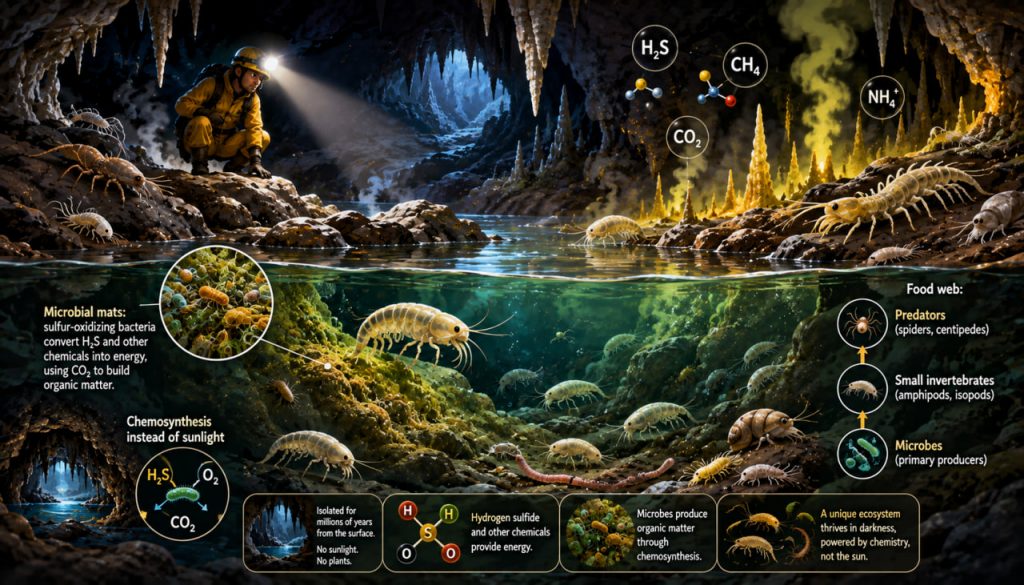
Microorganisms manufacture organic matter using energy released from chemical reactions rather than sunlight. This process is called chemosynthesis.
How Chemosynthesis Replaces Photosynthesis
Chemosynthetic bacteria and archaea obtain energy by oxidizing reduced chemical compounds.
In Movile Cave, important energy sources include:
- Hydrogen sulfide
- Methane
- Ammonium
- Nitrite
- Hydrogen and other reduced compounds in smaller roles
Microorganisms use the released energy to fix carbon dioxide into cellular material. In effect, they become the cave’s primary producers—the ecological equivalent of plants in a surface ecosystem.
Sulfur-oxidizing bacteria are especially important. They convert hydrogen sulfide into elemental sulfur, sulfate, or intermediate sulfur compounds.
The energy obtained from these reactions supports thick microbial films that float on the water or coat submerged and damp surfaces.
These pale microbial mats may look like slime, but they are the biological foundation of the entire ecosystem.
Is Hydrogen Sulfide Replacing Oxygen?
Hydrogen sulfide is not used as a breathable substitute for oxygen by the cave’s animals.
Instead, it functions as an electron donor—a chemical that microbes can oxidize to obtain energy. Oxygen may act as an electron acceptor in some of these reactions.
Other electron acceptors can include nitrate, sulfate, or oxidized iron, depending on the organism and the chemical conditions.
This distinction matters because hydrogen sulfide is toxic to most oxygen-breathing organisms. It can interfere with enzymes involved in cellular respiration and damage nervous and respiratory systems.
The cave’s larger animals therefore do not simply inhale hydrogen sulfide and use it as fuel.
They depend indirectly on it because microbes convert its chemical energy into edible biomass.
Hydrogen sulfide powers the food web, while the animals survive through specialized tolerance, behavior, and access to zones where enough oxygen remains available.
The Cave’s Strange Food Web
The first consumers are microscopic organisms and small invertebrates that graze on bacterial films.
They may include protozoans, nematodes, rotifers, springtails, isopods, amphipods, snails, and other tiny animals.
Larger predators then feed on these grazers. Spiders, water scorpions, leeches, pseudoscorpions, and centipedes occupy higher positions in the food web.
A modern inventory reported more than 50 cave-dwelling invertebrate species in Movile Cave, with a large proportion found nowhere else. These endemic species include both aquatic and terrestrial animals.
The system is not entirely uniform. Different chambers, pools, water layers, sediments, and biofilms contain different chemical conditions and microbial communities.
Some zones are richer in oxygen. Others are dominated by sulfide, methane, or ammonium metabolism.
How Animals Survive Toxic Conditions
Life in a sulfidic cave requires more than the ability to tolerate darkness.
The animals must cope with:
- Low oxygen
- High humidity
- Elevated carbon dioxide
- Hydrogen sulfide exposure
- Limited and unevenly distributed food
- Permanent darkness
- Small, isolated habitats
Many cave animals show familiar subterranean adaptations. Their bodies may lack pigment, and their eyes may be reduced or absent.
Long antennae, legs, sensory hairs, and chemical receptors help them navigate, locate prey, and find mates without vision.
Low metabolic rates may also be advantageous. An organism that uses energy slowly can survive where food and oxygen are scarce.
Some species may avoid the most toxic water layers or remain close to boundaries where oxygenated and sulfide-rich waters meet. These chemical interfaces are biologically productive because microbes can access both an energy-rich compound and an oxidizing agent.
Why Oxygen Does Not Disappear Completely
Movile Cave is isolated, but it is not a perfectly sealed container.
Small quantities of gases can enter through rock fractures, groundwater movement, or limited connections with the surrounding geological system.
Oxygen is consumed rapidly by animals and microorganisms, especially where it meets hydrogen sulfide and methane.
As a result, oxygen concentrations can be much lower than at the surface, while carbon dioxide and toxic gases accumulate.
This creates vertical and horizontal chemical gradients. The cave may contain narrow habitable zones where oxygen is sufficient for animals but sulfide remains available to support microbial production.
The ecosystem exists because different chemicals meet in the right places—not because the cave is completely oxygen-free.
Microbes Also Shape the Cave Itself
Sulfur-oxidizing microorganisms do more than feed animals.
Their metabolism can produce sulfuric acid. This acid reacts with limestone, gradually dissolving carbonate rock and enlarging cavities.
Such processes contribute to the formation of sulfuric-acid caves, where biology and geology become closely connected.
Microbial films can therefore transform:
- Water chemistry
- Mineral surfaces
- Sediments
- Cave walls
- The availability of nutrients
Studies of sulfidic caves show that microbial communities can live in highly acidic biofilms and actively participate in limestone corrosion.
The cave is not simply a shelter occupied by organisms. It is an environment continually modified by their metabolism.
Why These Caves Matter to Astrobiology
Sunless caves provide natural laboratories for studying how life might survive beyond Earth.
Several moons in the outer Solar System, including Europa and Enceladus, are thought to contain liquid water beneath icy crusts. Sunlight cannot reach those hidden oceans, but water–rock reactions may provide hydrogen, sulfur compounds, methane, and other chemical energy sources.
Movile Cave does not prove that extraterrestrial life exists.
However, it demonstrates that a diverse biological community can persist without photosynthesis when geology supplies suitable chemical energy and liquid water.
This broadens the range of environments scientists consider potentially habitable.
Instead of searching only for worlds with sunlight, oxygen-rich atmospheres, and surface vegetation, astrobiologists also investigate dark subsurface habitats powered by chemical reactions.
Are Isolated Caves Truly Closed Ecosystems?
The phrase “closed ecosystem” should be used carefully.
Movile Cave receives little conventional organic material from the surface, and its food web is strongly supported by internal chemosynthesis.
Yet chemicals, groundwater, minerals, and gases still move through the surrounding geological environment.
The cave is therefore better described as a largely isolated chemosynthetic ecosystem rather than a perfectly closed biological world.
Even tiny inputs can matter over millions of years.
Researchers continue to investigate how much energy comes from sulfur oxidation, methane oxidation, nitrification, and other pathways. Modern genetic and metagenomic studies show that the microbial network is more diverse than a single hydrogen-sulfide-based reaction.
Expert Perspective
Microbiological studies led by researchers examining Movile Cave have concluded that its primary production is driven mainly by chemolithoautotrophic microorganisms, particularly sulfur-oxidizing bacteria, with methane-oxidizing and nitrogen-cycling microbes also making important contributions.
This research overturns a deeply rooted assumption about complex ecosystems.
Sunlight is the dominant energy source for life on Earth, but it is not the only possible foundation for a food web. Where geology supplies usable chemical energy, life can build an ecosystem in permanent darkness.
Interesting Facts
- Movile Cave was discovered only in 1986 despite having existed beneath the landscape for millions of years.
- Its primary producers are microorganisms rather than plants or photosynthetic algae.
- Hydrogen sulfide smells like rotten eggs at low concentrations but becomes dangerous at higher exposure levels.
- The cave contains aquatic and terrestrial food webs connected by microbial production.
- Many Movile Cave animals are endemic and have not been found anywhere else.
- Some cave inhabitants have reduced eyes, little pigmentation, and elongated sensory structures.
- Methane oxidation and nitrogen cycling supplement sulfur-based chemosynthesis.
- Microorganisms can contribute to cave enlargement by generating acids that dissolve limestone.
- Similar sulfur-powered communities occur in other caves and deep groundwater systems.
- Sunless ecosystems are useful models for considering possible life beneath the surfaces of icy moons.
Glossary
- Chemosynthesis — Production of organic matter using energy released by chemical reactions rather than sunlight.
- Chemolithoautotroph — An organism that obtains energy from inorganic chemicals and carbon from carbon dioxide.
- Hydrogen Sulfide — A toxic sulfur-containing gas that some microorganisms can oxidize for energy.
- Primary Producer — An organism that creates organic matter forming the base of a food web.
- Electron Donor — A substance that releases electrons during a chemical reaction and may provide metabolic energy.
- Electron Acceptor — A substance that receives electrons during respiration or another metabolic process.
- Biofilm — A community of microorganisms embedded in a self-produced layer attached to a surface.
- Microbial Mat — A layered community of microorganisms growing across water, sediment, or rock.
- Suboxic — Containing very little oxygen but not necessarily being completely oxygen-free.
- Anoxic — Lacking measurable oxygen.
- Endemic Species — A species naturally restricted to one particular location.
- Troglobiont — An animal permanently adapted to living in caves.
- Metagenomics — The study of genetic material recovered directly from an environmental sample.
- Sulfur Oxidation — A microbial process that extracts energy by converting reduced sulfur compounds into more oxidized forms.
- Astrobiology — The scientific study of life’s origins, limits, distribution, and potential existence beyond Earth.