Lichens are often mistaken for moss, mold, or a strange plant disease. In reality, they are highly organized partnerships that can survive on bare cliffs, volcanic lava, desert crusts, roofs, monuments, and tree bark.
A lichen usually consists of a fungus living together with a photosynthetic alga or cyanobacterium. The photosynthetic partner produces carbohydrates, while the fungus provides structure, protection, water retention, and access to minerals.
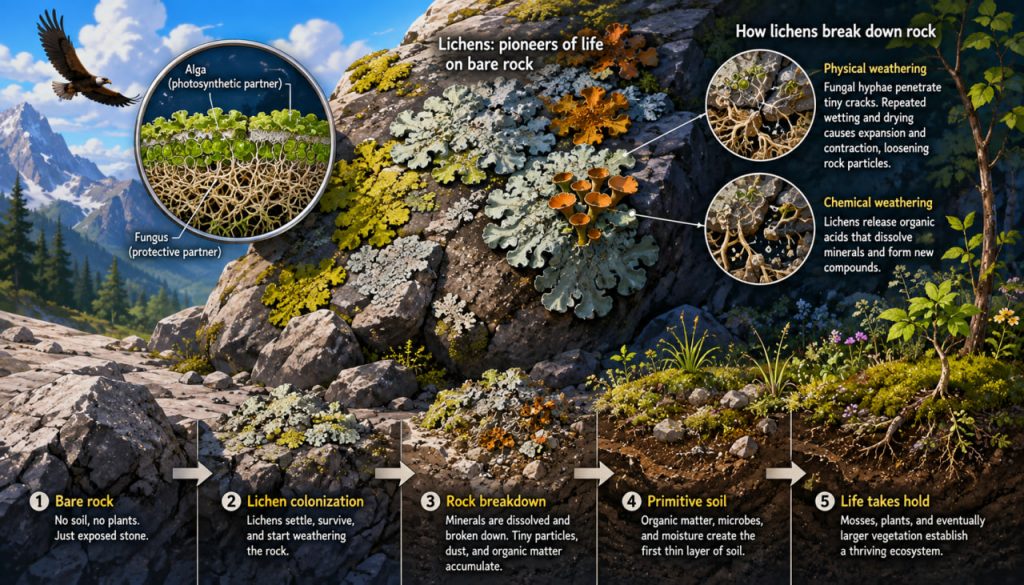
These organisms are famous as pioneer species because they can colonize surfaces where ordinary plants cannot yet grow. At the same time, lichens physically and chemically alter the material beneath them.
So are lichens ecological builders or destructive pests?
In natural ecosystems, lichens are usually pioneers that help transform exposed rock into the earliest stages of soil. On buildings and monuments, however, the same weathering abilities may contribute to surface deterioration.
Why Lichens Can Live on Bare Rock
Most plants require soil, roots, and a relatively stable water supply. Lichens need none of these in the conventional sense.
They absorb moisture and dissolved substances across their surface. Many can dry out almost completely during drought, suspend much of their metabolic activity, and reactivate when water becomes available again.
This ability allows them to survive in places exposed to:
- Strong sunlight
- Freezing temperatures
- Wind
- Nutrient scarcity
- Long dry periods
- Repeated wetting and drying
Crustose lichens grow as thin crusts tightly attached to stone. Foliose lichens form leaf-like lobes, while fruticose lichens develop shrubby or branching structures.
Because lichens can establish themselves without pre-existing soil, they are often among the first visible colonizers of newly exposed rock.
How Lichens Physically Break Down Rock
Lichens do not smash stones rapidly. Their influence accumulates slowly through repeated microscopic processes.
The fungal portion consists of fine filaments called hyphae. These may grow into tiny cracks, mineral boundaries, pores, and weakened zones in the rock surface.
As the lichen absorbs water and later dries, its tissues expand and contract. Repeated hydration cycles can place mechanical stress on already vulnerable mineral grains.
Salts associated with lichen activity may also crystallize inside small cavities. Crystal growth can exert pressure and gradually loosen particles.
A major scientific review of lichen-induced weathering identified several physical mechanisms, including hyphal penetration, expansion and contraction of the thallus, and swelling or crystallization of salts.
Over long periods, these processes can contribute to:
- Surface pitting
- Microscopic fractures
- Flaking
- Loosening of mineral grains
- Increased surface roughness
Once a surface becomes rougher and more porous, it can retain additional water, dust, and organic matter, making further colonization easier.
How Lichens Chemically Dissolve Minerals
Mechanical action is only part of the story. Lichens also change the chemistry of their immediate environment.
The fungal partner releases carbon dioxide and various organic compounds. Some lichens produce oxalic acid and other substances capable of binding metal ions and reacting with rock-forming minerals.
This process can remove elements such as calcium, magnesium, iron, and aluminium from the mineral structure.
Oxalic acid may combine with metals to form new mineral compounds known as oxalates. Researchers have also found etched mineral surfaces, iron-rich deposits, aluminosilicate material, and secondary clay minerals beneath lichen colonies.
Lichens therefore do not merely sit on rock. They create a chemically active microscopic zone where minerals are dissolved, transformed, and rearranged.
The strength of this effect depends on the lichen species, rock type, climate, moisture, mineral composition, and length of colonization.
From Broken Rock to Primitive Soil
Rock fragments alone are not complete soil. True soil contains mineral particles, organic matter, water, air, microorganisms, and eventually increasingly complex biological communities.
Lichens help initiate this transition in several ways.
First, weathering releases small mineral particles from the rock. These particles can collect in cracks and depressions.
Second, lichen surfaces trap airborne dust, pollen, microbial cells, and other debris.
Third, parts of the lichen eventually die and decompose, adding organic carbon to the developing material.
Microorganisms living around and within lichens further process this organic matter. Over time, the mixture becomes better able to retain moisture and nutrients.
Research on lichen–mineral systems has shown that microorganisms can alter mineral dissolution, clay formation, and the early processes involved in soil development.
A study of lichens and mosses growing on gneiss found that biological colonization greatly intensified chemical weathering and contributed to the formation of secondary minerals and early soil.
Lichens and Primary Ecological Succession
Primary succession begins on surfaces where no developed soil exists, such as fresh lava, exposed bedrock, glacial deposits, or land stripped by severe disturbance.
Lichens are classic pioneers in these environments because they can tolerate conditions that exclude most vascular plants.
As weathered material and organic debris accumulate, mosses may establish themselves. Small plants can follow once enough moisture and nutrients become available. Their roots, litter, and associated microorganisms accelerate soil development further.
The process may eventually support grasses, shrubs, and trees, although the precise sequence varies greatly between climates and ecosystems.
Lichens do not create a mature forest soil by themselves. They help open the ecological door through which more demanding organisms can enter.
Cyanobacterial Lichens Can Add Nitrogen
Some lichens contain cyanobacteria rather than green algae, or include cyanobacteria as an additional partner.
Certain cyanobacteria can perform nitrogen fixation. This process converts atmospheric nitrogen gas into biologically usable compounds.
When nitrogen-fixing lichens release material, decompose, or are eaten, some of that nitrogen may enter the surrounding ecosystem.
This contribution can be especially important in young, cold, or nutrient-poor environments where usable nitrogen is scarce.
Lichens may therefore influence not only mineral weathering but also the early nutrient economy of developing soils.
Are Lichens Harmful to Trees?
Lichens growing on tree bark are usually not parasites.
They use the bark primarily as a surface on which to live. They do not normally send feeding structures into healthy wood or steal nutrients through the tree’s vascular system.
A heavy lichen covering may be more noticeable on slow-growing, old, or stressed trees because their bark remains undisturbed for longer. This can create the misleading impression that lichens caused the decline.
Removing lichens from a living tree is generally unnecessary and may damage the bark.
Their presence can also provide microhabitats for small invertebrates and material used by birds or mammals.
When Lichens Can Become a Conservation Problem
The word “pest” becomes more understandable when lichens colonize statues, gravestones, historic masonry, roof tiles, or painted surfaces.
Hyphal penetration, moisture retention, mineral dissolution, and repeated expansion can contribute to surface alteration. On carved stone, even a very slow loss of detail may matter.
However, the effect is not always purely destructive.
Lichen layers can sometimes reduce direct exposure to wind, rain, or temperature changes. Removing them aggressively with metal tools, high-pressure washing, bleach, or unsuitable chemicals may cause more damage than leaving them in place.
The correct treatment depends on:
- The stone or building material
- The lichen species
- The condition of the surface
- Moisture and pollution levels
- The historical value of the object
Conservation work should therefore be based on professional assessment rather than the assumption that every lichen colony must be destroyed.
Do Lichens Always Accelerate Weathering?
Lichens generally enhance weathering at the microscopic interface beneath at least some colonies, but their overall effect is not identical everywhere.
A lichen-covered rock may weather differently from an uncovered rock because the thallus changes temperature, water retention, chemical conditions, and exposure to erosion.
In some circumstances, a continuous lichen crust may partially shield a surface from raindrop impact or extreme temperature fluctuations. In others, biochemical activity and penetration clearly intensify deterioration.
This means the ecological question is not simply whether lichens weather rocks, but how quickly, through which mechanisms, and under what environmental conditions.
Expert Perspective
Soil scientists Jie Chen, Hans-Peter Blume, and Lothar Beyer reviewed evidence from numerous rock–lichen interfaces and concluded that lichen colonization can accelerate mineral weathering through both physical and chemical mechanisms. They highlighted fungal penetration, hydration cycles, organic acids, metal binding, and the formation of new minerals.
Their work supports a broader view of soil formation: geology is not shaped by water, temperature, and wind alone. Living organisms actively participate in transforming minerals and building habitable terrestrial surfaces.
Interesting Facts
- A lichen is a biological partnership rather than a single conventional organism.
- Many lichens can become almost completely inactive when dry and resume metabolism after rehydration.
- Some crustose lichens are so tightly attached that removing them also removes part of the rock surface.
- Lichen hyphae can penetrate microscopic cracks and spaces between mineral grains.
- Lichen activity may produce metal oxalates and secondary clay minerals.
- Some cyanobacterial lichens contribute usable nitrogen to nutrient-poor ecosystems.
- Lichens can grow in deserts, polar regions, high mountains, forests, and urban environments.
- Lichens on tree bark generally use the tree for support rather than feeding on it.
- Biological weathering can operate over centuries while remaining almost invisible from day to day.
- Lichen communities are also widely studied as indicators of air quality because they absorb substances directly from the atmosphere.
Glossary
- Lichen — A stable partnership involving a fungus and one or more photosynthetic algae or cyanobacteria.
- Photobiont — The photosynthetic partner within a lichen.
- Hyphae — Fine fungal filaments that form much of the lichen’s structure.
- Thallus — The visible body of a lichen.
- Weathering — The physical or chemical breakdown and alteration of rock at or near Earth’s surface.
- Bioweathering — Weathering caused or accelerated by living organisms.
- Pioneer Species — An organism capable of colonizing a newly exposed or severely disturbed environment.
- Primary Succession — Ecological development beginning on a surface without established soil.
- Oxalic Acid — An organic acid involved in mineral dissolution and the formation of metal oxalates.
- Chelation — Chemical binding in which an organic molecule attaches to a metal ion.
- Secondary Mineral — A mineral formed through alteration or weathering of an earlier mineral.
- Nitrogen Fixation — The conversion of atmospheric nitrogen into compounds usable by living organisms.
- Crustose Lichen — A lichen that forms a crust tightly attached to its surface.
- Foliose Lichen — A lichen with flattened, leaf-like lobes.
- Fruticose Lichen — A branching or shrubby lichen attached at a limited number of points.