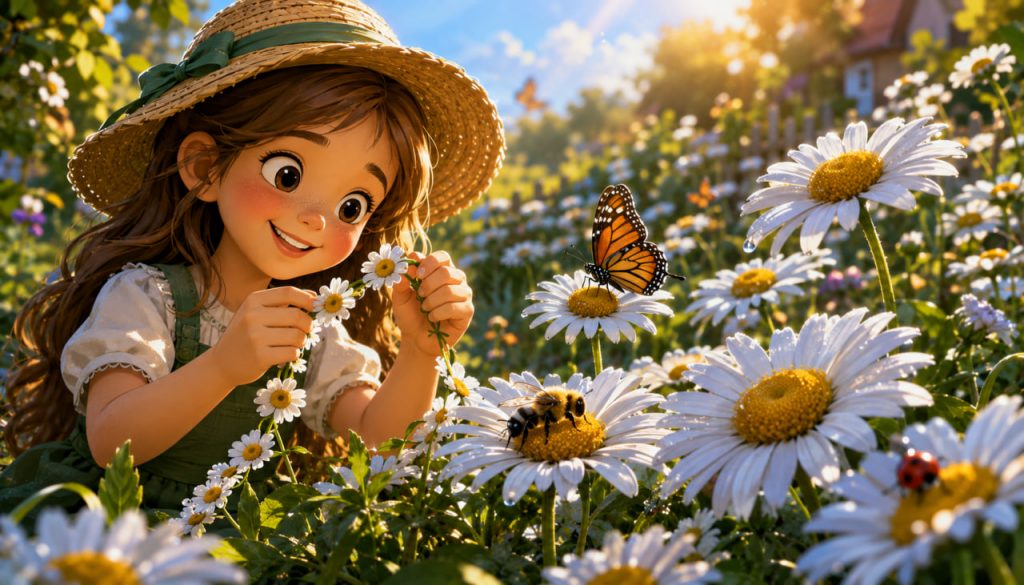
Daisies are among the most recognizable flowers in the world. Their bright centers, radiating petals, and simple shape appear in lawns, gardens, wildflower meadows, bouquets, art, and traditional symbolism.
Yet the word “daisy” does not describe just one plant. It is used for numerous flowering species in the Asteraceae family, including the common daisy, oxeye daisy, Shasta daisy, gerbera, and several other plants with a similar flower-head structure.
The classic lawn daisy is Bellis perennis, a small perennial native across much of Europe and parts of western and central Asia. It has also become naturalized in many other temperate regions.
What looks like one simple daisy flower is actually a compact community of many tiny flowers working together.
What Is a Daisy?
The common daisy belongs to the family Asteraceae, one of the largest families of flowering plants.
Its scientific name, Bellis perennis, reflects its lasting growth habit. It is a low-growing perennial that forms a rosette of spoon-shaped leaves close to the ground. Individual flower stalks rise above this rosette, usually carrying one flower head.
The familiar “petals” around the edge are actually individual flowers called ray florets. The yellow center contains many smaller disc florets.
Together, these florets form a structure known as a capitulum, or composite flower head. Kew Gardens notes that this arrangement allows numerous small flowers to be presented to a pollinator at the same time.
This design is highly efficient. A visiting bee, fly, or beetle can contact several florets during a single landing.
Why Daisies Open and Close
Many daisies respond visibly to changes in light, temperature, and moisture.
Their flower heads commonly open during daylight and close at night or during poor weather. This movement can help protect reproductive structures from cold, rain, and excessive moisture.
The behavior also helps explain the English name “daisy,” traditionally associated with the phrase “day’s eye.” The flower appears to open its eye in daylight and close it after sunset.
Daisy flower heads may track favorable light conditions, although their movement is less dramatic than the well-known solar tracking of young sunflowers.
Opening at the right time helps a daisy display its pollen and nectar when pollinating insects are most active.
Common Types of Daisies
The common lawn daisy is only one member of a much broader group of daisy-like plants.
The common daisy (Bellis perennis) is small, low-growing, and often found in lawns, parks, paths, and short grass. Wild flowers are usually white with yellow centers, sometimes developing pink or red edges.
The oxeye daisy (Leucanthemum vulgare) is taller and produces larger white flower heads. It is common in grasslands and roadsides but can spread aggressively outside its native range.
The Shasta daisy is a popular ornamental hybrid with large white flowers and strong upright stems.
Gerbera daisies produce large, intensely colored flower heads in shades of red, orange, yellow, pink, and white.
Other plants commonly called daisies include African daisies, painted daisies, seaside daisies, and marguerites. They share the characteristic composite flower structure but belong to different genera.
Daisies in Lawns: Flower or Weed?
Whether a common daisy is considered beautiful or unwanted depends largely on how a lawn is managed.
Its low rosette allows it to survive regular mowing. It can flower on short stems, spread through seed, and regrow after repeated cutting.
For gardeners seeking a perfectly uniform grass lawn, daisies may be treated as weeds. In a wildlife-friendly garden, they provide color and a modest source of nectar and pollen.
Kew describes common daisies as a small but valuable food source for insects, including solitary bees, beetles, and flies.
A lawn containing daisies is not necessarily neglected. It can be a more biologically diverse habitat than a flower-free lawn.
Reducing mowing frequency during peak flowering periods allows the plants to produce more blooms and gives insects longer access to them.
How Daisies Reproduce
Daisies reproduce through seeds, but established plants can also expand vegetatively.
After pollination, individual florets in the flower head develop small fruits containing seeds. These may fall near the parent plant or be moved by wind, animals, soil disturbance, and human activity.
Common daisies also form compact clumps. Garden varieties can be propagated by division, in which an established plant is separated into smaller rooted sections.
The Royal Horticultural Society recommends propagating Bellis perennis by seed or division after flowering.
Some ornamental varieties produce double flower heads containing many additional ray florets. These cultivars are selected for appearance and may differ significantly from the simpler wild form.
How to Grow Daisies Successfully
Common daisies are relatively undemanding plants.
They generally grow best in:
- Full sun or partial shade
- Moist but well-drained soil
- Temperate conditions
- Open beds, borders, containers, or short grass
The Royal Horticultural Society recommends well-drained soil and notes that many Bellis perennis varieties tolerate both full sun and partial shade.
Seeds can be sown into prepared soil, while established plants may be divided in spring or after flowering.
Regular deadheading removes faded blooms and can encourage continued flowering. It also reduces unwanted self-seeding where spread needs to be controlled.
Daisies in containers require more consistent watering than those growing in the ground. However, permanently waterlogged soil can promote root problems and poor growth.
Are Daisies Perennial?
The common daisy is botanically a perennial, meaning that it can live for more than two years. In mild conditions, its leaves may remain green through much of the year.
Some cultivated forms are grown as annuals or biennials because their best floral display occurs during the first or second growing season.
Cold winters, summer heat, drought, disease, and competition can shorten an individual plant’s lifespan.
The word “daisy” also covers species with different life cycles. Some are annual, others are biennial, and many are perennial.
Daisies and Pollinators
The flat, open structure of a daisy flower head gives insects easy access to its central florets.
Small bees, hoverflies, beetles, and other insects can land directly on the disc and move across many flowers without navigating a deep floral tube.
Not every ornamental daisy offers equal value to pollinators. Highly double cultivars may have fewer accessible disc florets because extra petals replace or conceal reproductive structures.
Simple, open-centered varieties generally provide easier access to pollen and nectar than densely doubled flowers.
For a pollinator-friendly garden, daisies work best as part of a diverse planting scheme that offers flowers of different shapes and blooming periods.
Are Daisies Edible or Medicinal?
Some daisy species have histories of culinary or traditional medicinal use. Kew records Bellis perennis as having food, medicinal, and environmental uses.
However, common names create confusion. Chamomile is a daisy-family plant, but it is not the same species as the common lawn daisy.
Chamomile tea is widely consumed, yet even familiar herbal products can cause allergic reactions. The US National Center for Complementary and Integrative Health warns that people allergic to ragweed, chrysanthemums, marigolds, or daisies may be more likely to react to chamomile.
Plants should never be eaten solely because they resemble a daisy. Correct identification is essential, and flowers exposed to pesticides, roadside pollution, or animal contamination should not be used as food.
Daisy Symbolism and Cultural Meaning
Daisies commonly symbolize innocence, simplicity, renewal, loyalty, and new beginnings.
Their ability to reappear after mowing and survive in disturbed ground has also made them symbols of resilience.
White ray florets are often associated with purity, while the bright yellow center suggests warmth and optimism.
Daisy chains, made by linking flower stems, have been part of childhood play and seasonal traditions in many European cultures.
The flower’s simple geometry has made it a lasting visual symbol in jewelry, clothing, logos, illustration, and decorative art.
Expert Perspective: One Flower Made From Many
Botanists view the daisy’s apparent simplicity as an evolutionary innovation.
Kew Gardens explains that the common daisy’s yellow center and white outer “petals” are numerous separate flowers combined into one capitulum. This arrangement increases the number of florets that may be pollinated during a single insect visit.
The daisy succeeds not by producing one large flower, but by making many tiny flowers look and function like one highly visible target.
That strategy is one reason composite flowers are so widespread and ecologically successful.
Interesting Facts
- A daisy flower head is composed of many individual florets rather than one flower.
- Common daisies can bloom through much of the year in mild climates.
- Their low leaf rosettes help them survive repeated lawn mowing.
- Wild common daisies may develop pink or reddish tips on their white ray florets.
- Some ornamental varieties have pompon-like double flower heads up to several centimeters across.
- Daisies belong to the same large plant family as sunflowers, asters, dandelions, and chrysanthemums.
- Open-centered daisies are accessible to many small pollinating insects.
- Common daisies can reproduce through both seeds and plant division.
- A daisy may be considered a lawn weed in one garden and a valuable wildflower in another.
- The name “daisy” is traditionally connected with the expression “day’s eye.”
Glossary
- Asteraceae — The large flowering-plant family containing daisies, sunflowers, asters, and many related species.
- Bellis perennis — The scientific name of the common lawn daisy.
- Capitulum — A flower head composed of many small flowers arranged together.
- Ray Floret — A small flower forming part of the petal-like outer ring of a daisy head.
- Disc Floret — One of the small central flowers forming the yellow disc of many daisies.
- Perennial — A plant that normally lives for more than two years.
- Biennial — A plant that usually completes its life cycle over two growing seasons.
- Rosette — A circular arrangement of leaves growing close to the ground.
- Cultivar — A plant variety selected and maintained for particular characteristics.
- Deadheading — Removing faded flowers to improve appearance, encourage blooming, or reduce seed production.
- Naturalized Plant — A non-native plant that has established self-sustaining populations.
- Pollinator — An animal that carries pollen between flowers, enabling fertilization.
- Self-Seeding — The natural production and dispersal of seeds around the parent plant.