When people discuss climate change, attention often focuses on renewable energy, electric vehicles, and energy-efficient buildings. While these sectors are important, another major challenge lies in heavy industry. Steel and cement are essential materials for modern civilization, forming the backbone of infrastructure, transportation, manufacturing, and urban development.
However, producing these materials generates enormous amounts of carbon dioxide. Together, the steel and cement industries account for a significant share of global greenhouse gas emissions. As countries work toward climate goals, finding ways to decarbonize these sectors has become one of the most important technological and environmental challenges of the 21st century.
The good news is that scientists, engineers, and companies are developing innovative solutions that could dramatically reduce industrial emissions while maintaining economic growth.
Why Steel and Cement Matter
Steel and cement are often called “foundation materials” because modern society depends on them.
Steel is used in:
- Buildings
- Bridges
- Railways
- Automobiles
- Ships
- Machinery
Cement is the key ingredient in concrete, which is used for:
- Roads
- Dams
- Homes
- Office buildings
- Infrastructure projects
Global demand remains enormous.
Every year, the world produces billions of tons of cement and nearly two billion tons of steel.
Without steel and cement, modern civilization as we know it would not exist.
Why Steel Production Generates Carbon Emissions
Traditional steelmaking relies on blast furnaces.
The process typically uses:
- Iron ore
- Coke (derived from coal)
- Limestone
Coal serves two important functions:
- It provides heat.
- It acts as a chemical reducing agent that removes oxygen from iron ore.
During this process, large amounts of carbon dioxide are released.
For every ton of steel produced through conventional methods, significant greenhouse gas emissions are generated.
Because of the industry’s scale, steel production accounts for roughly 7–9% of global carbon dioxide emissions.
Why Cement Is Difficult to Decarbonize
Cement presents a unique challenge.
The primary ingredient is clinker, which is produced by heating limestone to very high temperatures.
This process releases carbon dioxide in two ways:
Fuel Combustion
Fossil fuels are often burned to generate the required heat.
Chemical Reactions
When limestone is heated, it naturally decomposes and releases carbon dioxide.
This second source is particularly difficult to eliminate because it is part of the chemistry itself.
Even if cement plants operated entirely on renewable electricity, some emissions would still occur during clinker production.
This makes cement one of the most challenging sectors to decarbonize.
Green Steel: Replacing Coal with Hydrogen
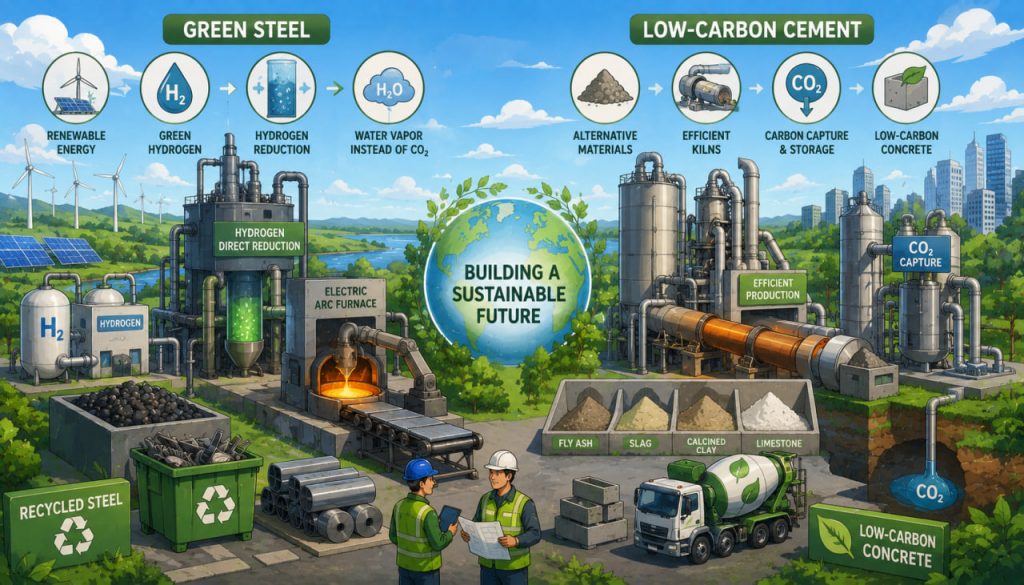
One of the most promising solutions for steel production is hydrogen-based steelmaking.
Instead of using coal, manufacturers use hydrogen gas to remove oxygen from iron ore.
The process produces:
- Iron
- Water vapor
rather than large quantities of carbon dioxide.
This approach is often called green steel when the hydrogen is produced using renewable electricity.
Several major projects in Europe and elsewhere are already demonstrating the technology at industrial scales.
Potential benefits include:
- Dramatically lower emissions
- Reduced dependence on coal
- Improved long-term sustainability
However, large-scale adoption requires significant investments in renewable energy and hydrogen infrastructure.
Electric Arc Furnaces and Recycling
Another important pathway involves increasing steel recycling.
Electric arc furnaces melt scrap steel using electricity rather than coal-fired blast furnaces.
Advantages include:
- Lower emissions
- Reduced raw material demand
- Lower energy consumption
Steel has a valuable property:
It can be recycled repeatedly without losing many of its essential characteristics.
Many countries are expanding steel recycling systems as part of broader decarbonization strategies.
The more steel that can be recycled, the less need there is for carbon-intensive primary production.
Low-Carbon Cement Technologies
Researchers are developing multiple approaches to reduce cement emissions.
Alternative Clinker Formulations
Some new cement types use less clinker while maintaining performance.
Because clinker production generates most cement-related emissions, reducing its proportion can significantly lower carbon footprints.
Supplementary Cementitious Materials
Industrial by-products such as:
- Fly ash
- Slag
- Calcined clay
can partially replace clinker.
Novel Cement Chemistries
Scientists are exploring entirely new formulations that require fewer emissions during production.
Some experimental materials even absorb carbon dioxide during curing.
Carbon Capture and Storage (CCS)
Carbon capture and storage is another major strategy for both steel and cement industries.
CCS involves:
- Capturing carbon dioxide before it enters the atmosphere.
- Compressing the gas.
- Transporting it.
- Storing it deep underground.
For cement production, CCS may be particularly important because many emissions originate from unavoidable chemical reactions.
Several pilot projects are already operating around the world.
While promising, CCS faces challenges including:
- High costs
- Infrastructure requirements
- Energy consumption
- Public acceptance
The Role of Renewable Energy
Renewable electricity is becoming increasingly important for industrial decarbonization.
Sources include:
- Solar power
- Wind power
- Hydropower
- Geothermal energy
Clean electricity can support:
- Hydrogen production
- Electric furnaces
- Industrial heating systems
- Carbon capture technologies
As renewable energy becomes more affordable, decarbonization pathways become increasingly viable.
Many experts believe abundant clean electricity will be a cornerstone of future green industry.
Economic Challenges
Despite technological progress, significant obstacles remain.
Key challenges include:
High Initial Costs
New industrial facilities require substantial investment.
Infrastructure Development
Hydrogen pipelines, renewable power systems, and carbon storage networks must be expanded.
Global Competition
Industries operate in highly competitive international markets.
Technology Scaling
Many solutions have proven successful in pilot projects but must still be deployed at global scale.
Governments are increasingly supporting industrial decarbonization through incentives, research funding, and carbon policies.
Expert Perspective
Energy researcher Vaclav Smil, known for his work on energy transitions and industrial systems, has frequently emphasized the importance of steel and cement in modern society.
His analysis highlights that these materials are deeply embedded in economic development and infrastructure.
“Modern civilization rests on four pillars: cement, steel, plastics, and ammonia.”
This observation illustrates why decarbonizing steel and cement is so critical for achieving climate goals.
Reducing emissions from these industries could significantly influence the future trajectory of global greenhouse gas emissions.
The Future of Green Industry
The coming decades are likely to bring major changes to industrial production.
Emerging technologies include:
- Green hydrogen
- Advanced recycling systems
- Carbon capture
- Alternative cement formulations
- Electrified industrial processes
- AI-driven efficiency improvements
No single solution will eliminate all emissions.
Instead, experts expect a combination of technologies to drive progress.
The transition toward green steel and low-carbon cement represents one of the most ambitious industrial transformations in history, with the potential to reshape manufacturing while helping address the climate crisis.
Interesting Facts
- Cement production is responsible for roughly 7–8% of global carbon dioxide emissions.
- Steel production contributes approximately 7–9% of global emissions.
- Steel is one of the most recycled materials on Earth.
- Hydrogen-based steelmaking produces water vapor instead of carbon dioxide during reduction.
- Concrete is the most widely used human-made material in the world.
- Some experimental cements can absorb carbon dioxide during curing.
- Renewable electricity is expected to play a major role in future industrial decarbonization.
Glossary
- Decarbonization — The process of reducing carbon dioxide emissions from human activities.
- Blast Furnace — A traditional industrial furnace used to produce iron from iron ore.
- Green Steel — Steel produced using low-carbon or carbon-free methods, often involving hydrogen.
- Hydrogen Reduction — A process that uses hydrogen to remove oxygen from iron ore.
- Clinker — The primary component of cement produced by heating limestone and other materials.
- Carbon Capture and Storage (CCS) — Technology used to capture and store carbon dioxide emissions.
- Electric Arc Furnace (EAF) — A furnace that melts metal using electrical energy.
- Renewable Energy — Energy derived from naturally replenishing sources such as wind and solar power.
- Supplementary Cementitious Materials — Alternative materials used to partially replace clinker in cement.
- Greenhouse Gas — A gas that traps heat in Earth’s atmosphere and contributes to climate change.