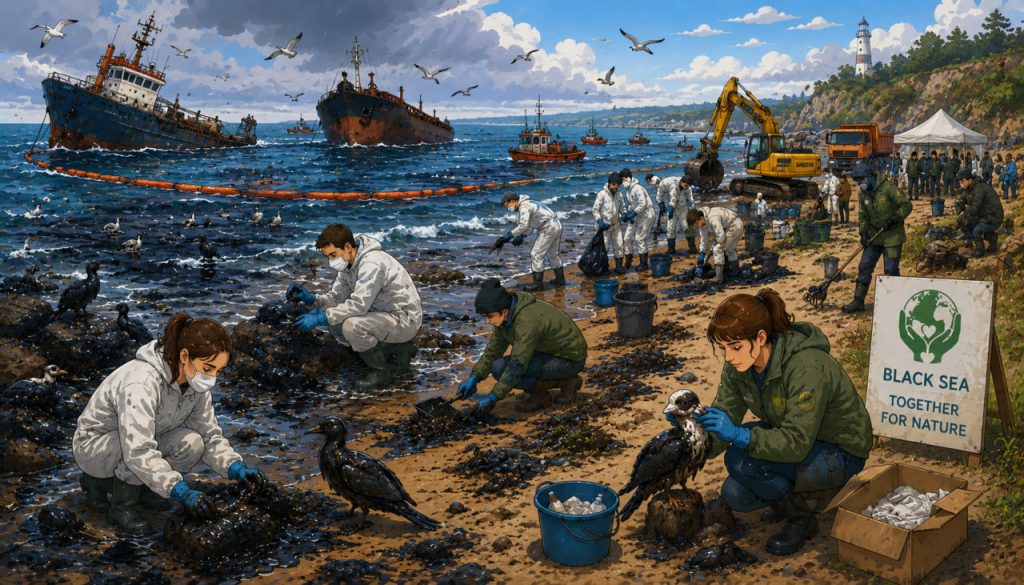
Oil spills remain among the most serious environmental disasters affecting marine ecosystems. Even in an age of advanced navigation systems and environmental regulations, accidents involving tankers, cargo vessels, and fuel transportation continue to pose significant risks. The Black Sea, one of the world’s most unique semi-enclosed marine ecosystems, is particularly vulnerable because of its limited water exchange with other seas and its rich biodiversity.
A major fuel oil spill that occurred following the accident involving two vessels in the Kerch Strait region attracted international attention due to concerns about pollution, impacts on wildlife, fisheries, tourism, and coastal ecosystems. One year after the incident, scientists and environmental experts continue to assess both the immediate damage and the longer-term ecological consequences.
Understanding what happened helps illustrate the broader challenges of preventing and responding to marine pollution events.
Why the Black Sea Is Environmentally Sensitive
The Black Sea differs from many other marine environments.
Several factors increase its vulnerability:
- Limited water circulation
- Relatively slow pollutant dispersion
- Unique ecosystem structure
- Extensive coastal habitats
- Important fisheries
- Migratory bird routes
The sea supports numerous species of fish, marine mammals, seabirds, and invertebrates.
Many coastal communities also depend on the Black Sea for:
- Tourism
- Fishing
- Transportation
- Recreation
Because the Black Sea exchanges water relatively slowly with the Mediterranean Sea, pollutants can persist longer than in more open marine systems.
This characteristic increases the ecological importance of pollution prevention.
What Happened During the Spill?
The accident involved severe weather conditions that affected vessels operating in the Kerch Strait area, a strategically important waterway connecting the Black Sea and the Sea of Azov.
As a result of vessel damage and fuel release, petroleum products entered the marine environment.
Fuel oil differs from lighter petroleum products.
It is generally:
- More viscous
- Heavier
- Slower to evaporate
- More persistent in the environment
These characteristics can complicate cleanup operations and increase environmental risks.
Weather conditions often play a critical role in determining how rapidly spilled oil spreads and where it eventually accumulates.
How Fuel Oil Affects Marine Ecosystems
Oil spills can impact marine environments through several mechanisms.
Physical Smothering
Oil can coat:
- Shorelines
- Rocks
- Sediments
- Marine vegetation
This coating interferes with normal biological processes.
Toxic Exposure
Petroleum products contain compounds that may be harmful to marine organisms.
Exposure can affect:
- Fish
- Shellfish
- Plankton
- Marine mammals
- Birds
Food Web Disruption
Damage to one group of organisms can affect species higher in the food chain.
Marine ecosystems are highly interconnected, meaning local pollution can trigger broader ecological consequences.
Impact on Seabirds
Birds are often among the most visible victims of oil spills.
When feathers become coated with oil:
- Waterproofing is reduced.
- Insulation is lost.
- Flight performance may decline.
Affected birds can suffer from:
- Hypothermia
- Exhaustion
- Poisoning during preening
- Reduced reproductive success
Wildlife rehabilitation teams often prioritize bird rescue efforts following major spills.
The effectiveness of these efforts varies depending on contamination levels and response speed.
Effects on Fish and Fisheries
The Black Sea supports commercially important fisheries.
Oil contamination can affect fish populations through:
- Direct toxicity
- Habitat degradation
- Food source disruption
- Reproductive impacts
Young fish and eggs are often particularly vulnerable.
Although adult fish can sometimes avoid contaminated areas, early life stages may be unable to escape exposure.
As a result, environmental monitoring typically continues long after cleanup operations end.
Fisheries may also experience economic impacts due to public concerns about seafood safety.
Coastal Ecosystems Under Threat
Oil often accumulates along shorelines.
Coastal habitats affected may include:
- Sandy beaches
- Rocky shores
- Wetlands
- Estuaries
- Coastal vegetation zones
Cleanup in these environments presents significant challenges.
Aggressive removal methods can sometimes damage habitats further.
Environmental specialists must balance:
- Pollution removal
- Habitat preservation
- Wildlife protection
This makes shoreline restoration a complex and often lengthy process.
Cleanup and Recovery Efforts
Responding to an oil spill typically involves multiple strategies.
These may include:
Mechanical Recovery
Specialized equipment collects floating oil from the water surface.
Containment Booms
Floating barriers help prevent oil from spreading.
Shoreline Cleanup
Manual and mechanical techniques remove contaminated materials.
Environmental Monitoring
Scientists assess impacts on water quality, sediments, and wildlife.
Recovery efforts often continue for months or years after the initial event.
The duration depends on:
- Spill size
- Oil type
- Weather conditions
- Ecosystem sensitivity
Long-Term Ecological Consequences
One year after a significant spill, visible contamination may have declined substantially.
However, ecological recovery often takes longer.
Potential long-term effects include:
- Sediment contamination
- Habitat degradation
- Reduced reproductive success
- Changes in species composition
- Local biodiversity impacts
Fortunately, marine ecosystems can demonstrate considerable resilience when pollution sources are removed and restoration measures are implemented.
Recovery rates vary widely among species and habitats.
The absence of visible oil does not necessarily mean that ecological recovery is complete.
Scientific monitoring remains essential for understanding long-term outcomes.
Expert Perspective
Marine ecologist Dr. Sylvia Earle, one of the world’s leading ocean conservation advocates, has repeatedly emphasized the importance of preventing marine pollution rather than relying solely on cleanup efforts.
Her work highlights the vulnerability of marine ecosystems to human-caused disturbances.
“With every drop of water you drink, every breath you take, you’re connected to the sea.”
This perspective underscores why protecting marine ecosystems such as the Black Sea remains a global environmental priority.
Preventing Future Marine Pollution
Lessons from major oil spills continue to influence maritime safety practices.
Preventive measures include:
- Improved vessel design
- Enhanced navigation systems
- Better weather forecasting
- Emergency response planning
- Stronger environmental regulations
- International cooperation
Technological advances are helping reduce risks, but human error, severe weather, and equipment failures remain potential threats.
As maritime transport continues to play a critical role in global trade, balancing economic activity with environmental protection will remain an ongoing challenge.
The Black Sea fuel oil spill serves as a reminder that marine ecosystems can be affected by accidents within hours, while recovery may require years of monitoring, restoration, and conservation efforts.
Interesting Facts
- The Black Sea contains one of the largest oxygen-free deep-water zones in the world.
- Oil spills are generally easier to prevent than to clean up.
- Seabirds are often among the first wildlife groups visibly affected by marine oil pollution.
- Fuel oil is typically more persistent in the environment than lighter petroleum products.
- The Kerch Strait connects the Black Sea with the Sea of Azov.
- Marine ecosystems can sometimes recover surprisingly well when pollution sources are removed quickly.
- Environmental monitoring after major spills may continue for many years.
Glossary
- Fuel Oil — A heavy petroleum product commonly used as marine fuel.
- Oil Spill — The release of petroleum products into the environment, especially marine waters.
- Marine Ecosystem — A community of organisms living in ocean or sea environments.
- Biodiversity — The variety of living organisms within an ecosystem.
- Containment Boom — A floating barrier used to limit the spread of spilled oil.
- Sediment — Particles that settle on the bottom of aquatic environments.
- Habitat — The natural environment where a species lives.
- Toxicity — The degree to which a substance can harm living organisms.
- Ecological Recovery — The process by which ecosystems regain structure and function after disturbance.
- Kerch Strait — A narrow waterway connecting the Black Sea and the Sea of Azov.