Weather patterns around the world are influenced by many factors, including ocean currents, atmospheric circulation, solar radiation, and geographic features. Among the most powerful natural climate phenomena are El Niño and La Niña, two opposite phases of a larger climate system known as the El Niño–Southern Oscillation (ENSO).
Although these events originate in the tropical Pacific Ocean, their effects can be felt thousands of kilometers away. They influence rainfall, droughts, hurricanes, heatwaves, agricultural productivity, fisheries, and even global temperatures.
Because ENSO affects billions of people worldwide, scientists closely monitor its development and use sophisticated forecasting systems to predict its impacts.
What Is the El Niño–Southern Oscillation (ENSO)?
ENSO is a naturally occurring climate cycle involving interactions between the Pacific Ocean and the atmosphere above it.
It has three primary phases:
- El Niño
- La Niña
- Neutral conditions
These phases typically develop every two to seven years and can last for several months or even longer.
The cycle affects:
- Sea surface temperatures
- Wind patterns
- Rainfall distribution
- Storm activity
ENSO is one of the most important drivers of year-to-year climate variability on Earth.
Its influence extends far beyond the Pacific region.
What Is El Niño?
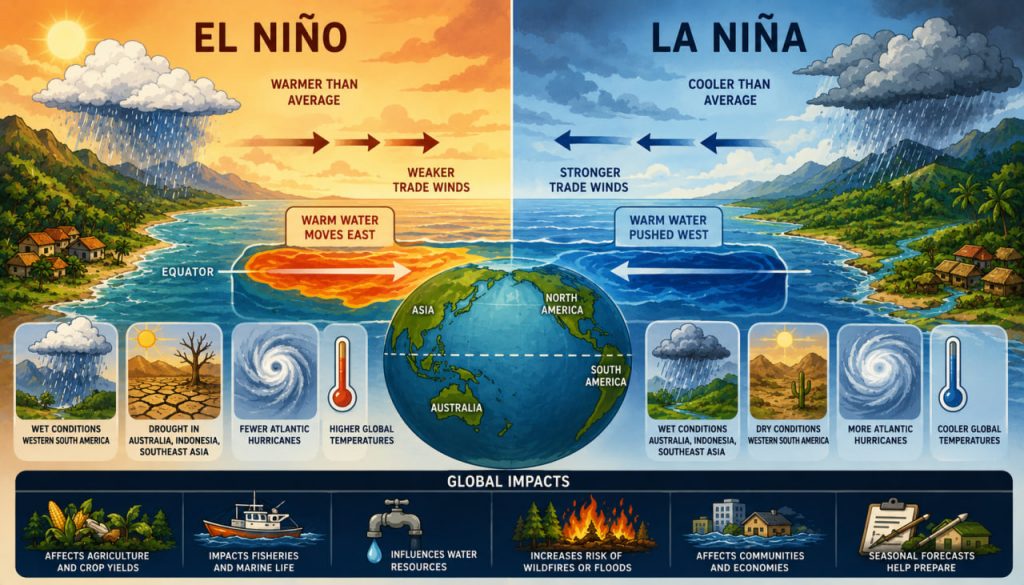
El Niño occurs when sea surface temperatures in the central and eastern tropical Pacific Ocean become significantly warmer than average.
Under normal conditions, trade winds push warm surface water westward toward Asia and Australia.
During El Niño:
- Trade winds weaken.
- Warm water shifts eastward.
- Ocean temperatures rise across large areas of the Pacific.
- Atmospheric circulation patterns change.
These changes alter weather systems around the globe.
The name “El Niño” originated from Peruvian fishermen who noticed unusually warm ocean waters appearing around Christmas. The term means “The Little Boy” in Spanish and refers to the Christ Child.
Global Effects of El Niño
El Niño can produce a wide variety of weather impacts.
Common effects include:
Increased Rainfall
Regions that often become wetter during El Niño include:
- Western South America
- Parts of the southern United States
- Eastern Pacific coastal regions
Drought Conditions
Some areas frequently experience reduced rainfall, including:
- Australia
- Indonesia
- Parts of Southeast Asia
- Southern Africa
Higher Global Temperatures
El Niño years are often among the warmest years on record because additional heat is released from the Pacific Ocean into the atmosphere.
Reduced Atlantic Hurricane Activity
El Niño can increase wind shear in the Atlantic Ocean, making it more difficult for hurricanes to develop.
A strong El Niño event can influence weather patterns across multiple continents simultaneously.
What Is La Niña?
La Niña is essentially the opposite phase of El Niño.
During La Niña:
- Trade winds strengthen.
- Warm water is pushed farther west.
- Colder-than-average water rises to the surface in the eastern Pacific.
- Atmospheric circulation intensifies.
The name “La Niña” means “The Little Girl” in Spanish.
Like El Niño, La Niña affects global weather through changes in ocean-atmosphere interactions.
Global Effects of La Niña
La Niña often produces weather patterns that contrast with those associated with El Niño.
Common effects include:
Increased Rainfall in Australia and Southeast Asia
Stronger trade winds often enhance rainfall in these regions.
Drier Conditions in Western South America
Some areas experience reduced precipitation compared with normal conditions.
Cooler Global Temperatures
La Niña years tend to be slightly cooler globally than El Niño years.
Increased Atlantic Hurricane Activity
Reduced wind shear can create more favorable conditions for tropical cyclone development.
Because of these influences, La Niña can affect agriculture, water resources, and disaster preparedness worldwide.
How ENSO Influences Agriculture
Agriculture is highly sensitive to weather conditions.
Changes in rainfall and temperature associated with ENSO can significantly affect crop production.
Potential impacts include:
- Drought-related crop failures
- Flood damage
- Reduced yields
- Pest outbreaks
- Water shortages
Farmers often monitor ENSO forecasts when making decisions about:
- Planting schedules
- Irrigation planning
- Crop selection
- Harvest timing
In some regions, ENSO forecasts provide valuable opportunities to prepare for adverse conditions months in advance.
Effects on Fisheries and Marine Ecosystems
The Pacific Ocean contains some of the world’s most productive fisheries.
ENSO can strongly influence marine ecosystems.
During El Niño:
- Warm surface waters suppress nutrient-rich upwelling.
- Fish populations may decline in affected regions.
- Marine food webs can be disrupted.
The Peruvian anchovy fishery is particularly sensitive to El Niño events.
During La Niña:
- Stronger upwelling often increases nutrient availability.
- Marine productivity may improve in some areas.
Ocean temperature changes associated with ENSO can have significant economic consequences for fishing industries.
Extreme Weather and Natural Disasters
ENSO frequently influences the occurrence of extreme weather events.
Possible consequences include:
- Floods
- Droughts
- Heatwaves
- Wildfires
- Tropical cyclones
For example:
- El Niño-related droughts have contributed to severe wildfire seasons in some regions.
- La Niña-related rainfall has caused major flooding events in Australia and South America.
While ENSO does not directly cause every extreme event, it can increase the likelihood of certain weather patterns.
Expert Perspective
Meteorologist Dr. Klaus Wolter, one of the researchers involved in developing ENSO monitoring tools, has emphasized the importance of understanding ENSO as a global climate driver rather than a regional phenomenon.
His work helped improve seasonal climate forecasting based on ENSO behavior.
“El Niño and La Niña influence weather patterns across much of the globe.”
This understanding has significantly improved long-range weather and climate prediction.
Climate Change and ENSO
Scientists continue studying how climate change may affect ENSO behavior.
Several questions remain under investigation:
- Will El Niño events become stronger?
- Will La Niña events become more frequent?
- Will impacts become more extreme?
Current research suggests that a warmer climate may amplify certain ENSO-related weather extremes.
However, ENSO itself remains a naturally occurring climate cycle that has existed for thousands of years.
Climate change may modify its behavior rather than create it.
As forecasting technology improves, scientists hope to better understand the relationship between global warming and ENSO dynamics.
The ability to predict El Niño and La Niña events months in advance provides valuable opportunities for governments, farmers, businesses, and communities to prepare for changing weather conditions and reduce potential risks.
Interesting Facts
- El Niño and La Niña originate in the tropical Pacific but influence weather worldwide.
- Strong El Niño years are often among the warmest years in modern climate records.
- The ENSO cycle has been occurring naturally for thousands of years.
- El Niño can reduce nutrient-rich ocean upwelling along the coast of South America.
- Some ENSO events persist for more than a year.
- Seasonal climate forecasts often rely heavily on ENSO monitoring.
- Fisheries, agriculture, water management, and disaster planning are all influenced by ENSO forecasts.
Glossary
- ENSO (El Niño–Southern Oscillation) — A climate cycle involving interactions between the Pacific Ocean and atmosphere.
- El Niño — The warm phase of ENSO characterized by above-average Pacific Ocean temperatures.
- La Niña — The cool phase of ENSO characterized by below-average Pacific Ocean temperatures.
- Trade Winds — Persistent winds that blow from east to west across the tropics.
- Upwelling — The rise of cold, nutrient-rich water from deeper ocean layers.
- Sea Surface Temperature — The temperature of the ocean’s uppermost layer.
- Wind Shear — Changes in wind speed or direction with altitude.
- Climate Variability — Natural fluctuations in climate conditions over time.
- Seasonal Forecasting — Predicting weather and climate conditions months in advance.
- Atmospheric Circulation — Large-scale movement of air that helps distribute heat around the planet.