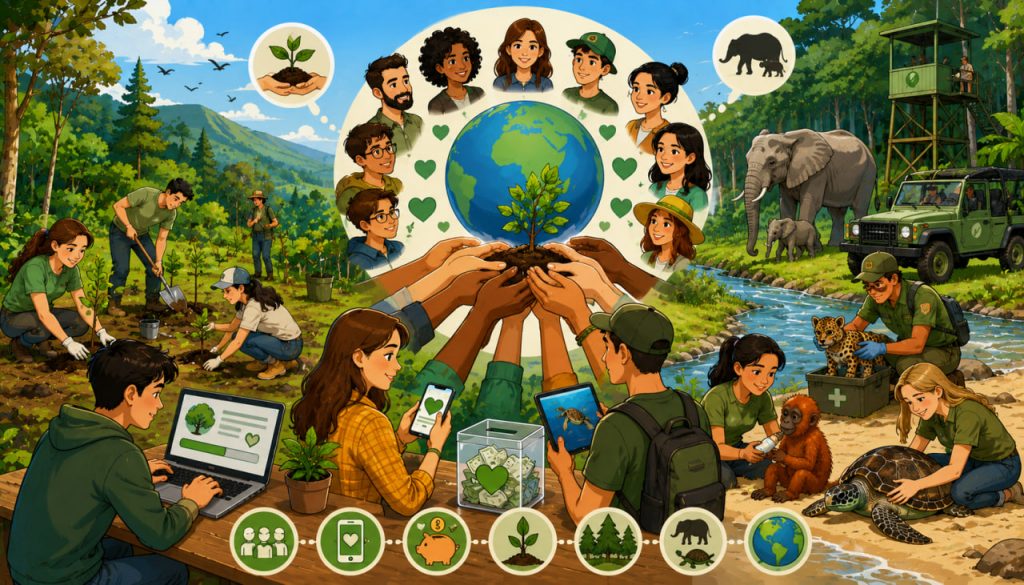
Conservation has traditionally been funded by governments, international organizations, research institutions, and wealthy philanthropists. While these sources remain essential, a new force has emerged in environmental protection over the past two decades: crowdfunding.
Crowdfunding allows large numbers of people to contribute relatively small amounts of money toward a shared goal. Thanks to online platforms and social media, individuals from around the world can now directly support wildlife conservation, reforestation projects, habitat restoration, scientific research, and environmental education initiatives.
This democratization of environmental funding is changing the way conservation projects are launched and supported. In many cases, ordinary citizens are becoming active participants in protecting ecosystems and endangered species.
What Is Environmental Crowdfunding?
Crowdfunding is a method of raising money from many individuals rather than relying on a single large investor or organization.
Environmental crowdfunding applies this concept to nature conservation.
Typical projects include:
- Tree planting campaigns
- Wildlife rescue centers
- Habitat restoration
- Scientific expeditions
- Anti-poaching initiatives
- Marine conservation programs
- Environmental education projects
Contributors may donate a few dollars or much larger amounts depending on their interest and resources.
Crowdfunding transforms conservation from something people merely support in theory into something they can actively participate in.
Why Crowdfunding Has Become Popular
Several factors have contributed to the growth of environmental crowdfunding.
Internet Accessibility
Online platforms make it easy for organizations to present projects and reach global audiences.
Social Media
Conservation campaigns can spread rapidly through social networks.
Powerful photographs and videos often help generate public engagement.
Transparency
Many crowdfunding projects provide regular updates showing how donated funds are used.
Public Awareness
Growing concern about climate change, biodiversity loss, and pollution has motivated more people to support environmental causes directly.
As environmental challenges become more visible, public willingness to contribute often increases.
How Small Donations Create Large Impacts
One of the most remarkable aspects of crowdfunding is the power of collective action.
A single donation may seem insignificant.
However, when thousands of people contribute, substantial resources can be generated.
For example:
- Ten thousand people donating $10 each can raise $100,000.
- One hundred thousand donors contributing $5 each can fund major conservation projects.
This approach allows individuals who might never be able to finance large initiatives alone to become part of meaningful environmental solutions.
Conservation crowdfunding demonstrates that small actions can create significant cumulative effects.
Protecting Forests Through Crowdfunding
Forests are among the most common targets of environmental crowdfunding campaigns.
Projects may focus on:
- Reforestation
- Forest protection
- Wildfire recovery
- Community forestry
- Biodiversity conservation
Many organizations allow donors to sponsor tree planting efforts.
Some campaigns provide:
- Geographic coordinates
- Satellite imagery
- Progress reports
- Growth monitoring updates
This transparency helps donors feel connected to the outcomes of their contributions.
Reforestation projects funded through crowdfunding have helped restore degraded landscapes in numerous countries.
Saving Endangered Wildlife
Wildlife conservation is another area where crowdfunding has become highly influential.
Funds may support:
- Veterinary treatment
- Wildlife rehabilitation
- Habitat protection
- Scientific monitoring
- Anti-poaching patrols
- Breeding programs
Endangered species often attract public attention because people feel emotional connections to animals.
Campaigns involving:
- Sea turtles
- Elephants
- Rhinos
- Big cats
- Orangutans
- Pandas
frequently generate significant public support.
Visual storytelling plays a major role in these efforts.
Images and videos help donors understand the challenges facing wildlife populations.
Supporting Conservation Science
Scientific research can be expensive.
Field studies often require funding for:
- Equipment
- Transportation
- Laboratory analysis
- Personnel
- Data collection
Crowdfunding increasingly helps researchers finance projects that may struggle to secure traditional grants.
Citizen-supported science projects have funded studies involving:
- Bird migration
- Marine ecosystems
- Pollinator populations
- Climate monitoring
- Rare species surveys
This trend allows the public to participate directly in the advancement of environmental knowledge.
Advantages of Environmental Crowdfunding
Crowdfunding offers several unique benefits.
Public Engagement
Donors often become advocates for environmental causes after contributing.
Funding Flexibility
Projects can be launched quickly without waiting for lengthy grant approval processes.
Innovation
Unconventional ideas may receive support even when traditional funding sources are unavailable.
Awareness Building
Campaigns often educate participants about environmental issues while raising funds.
These advantages help explain why crowdfunding continues to grow within the conservation sector.
Challenges and Risks
Despite its benefits, crowdfunding is not a perfect solution.
Several challenges exist.
Verification
Not every campaign is equally credible.
Potential donors should investigate organizations carefully before contributing.
Funding Uncertainty
Campaign success depends heavily on public interest and visibility.
Short-Term Focus
Highly emotional projects may attract attention more easily than less visible but equally important conservation efforts.
Limited Scale
Some environmental challenges require funding far beyond what crowdfunding alone can provide.
As a result, crowdfunding is generally most effective when combined with traditional conservation funding mechanisms.
Expert Perspective
Conservation biologist Jane Goodall has frequently emphasized the importance of individual action in environmental protection.
Throughout her career, she has argued that meaningful change often begins with ordinary people making small contributions toward larger goals.
“Every individual matters. Every individual has a role to play. Every individual makes a difference.”
This principle reflects the core philosophy of environmental crowdfunding.
Large-scale conservation outcomes can emerge from the collective efforts of countless individuals.
The Future of Crowdfunding for Nature
Emerging technologies are making environmental crowdfunding even more sophisticated.
New developments include:
- Satellite monitoring of projects
- Blockchain-based transparency systems
- Real-time reporting tools
- Interactive conservation maps
- Artificial intelligence-assisted project management
These innovations can help donors track environmental outcomes more accurately.
At the same time, global environmental awareness continues to increase.
Younger generations are particularly active in supporting environmental initiatives through digital platforms.
As technology and public engagement continue to evolve, crowdfunding may become an increasingly important complement to traditional conservation funding, helping communities and organizations protect forests, wildlife, and ecosystems around the world.
Interesting Facts
- Some conservation crowdfunding campaigns have raised millions of dollars within weeks.
- Tree-planting initiatives are among the most popular environmental crowdfunding projects.
- Wildlife rescue campaigns often receive support from donors in dozens of countries simultaneously.
- Social media can dramatically increase the visibility of conservation projects.
- Citizen-funded research has contributed to studies of endangered species and climate change.
- Some organizations allow donors to track trees or conservation sites through satellite imagery.
- Environmental crowdfunding has grown significantly alongside global internet access.
Glossary
- Crowdfunding — Raising money from a large number of individuals, usually through online platforms.
- Conservation — The protection and management of natural resources and ecosystems.
- Reforestation — The restoration of forests through tree planting or natural regeneration.
- Habitat — The natural environment where a species lives.
- Biodiversity — The variety of living organisms within an ecosystem.
- Anti-Poaching — Activities aimed at preventing illegal hunting of wildlife.
- Citizen Science — Scientific research involving participation by members of the public.
- Environmental NGO — A non-governmental organization focused on environmental protection.
- Transparency — Openness regarding how funds or resources are used.
- Ecosystem Restoration — Actions taken to repair damaged natural environments.