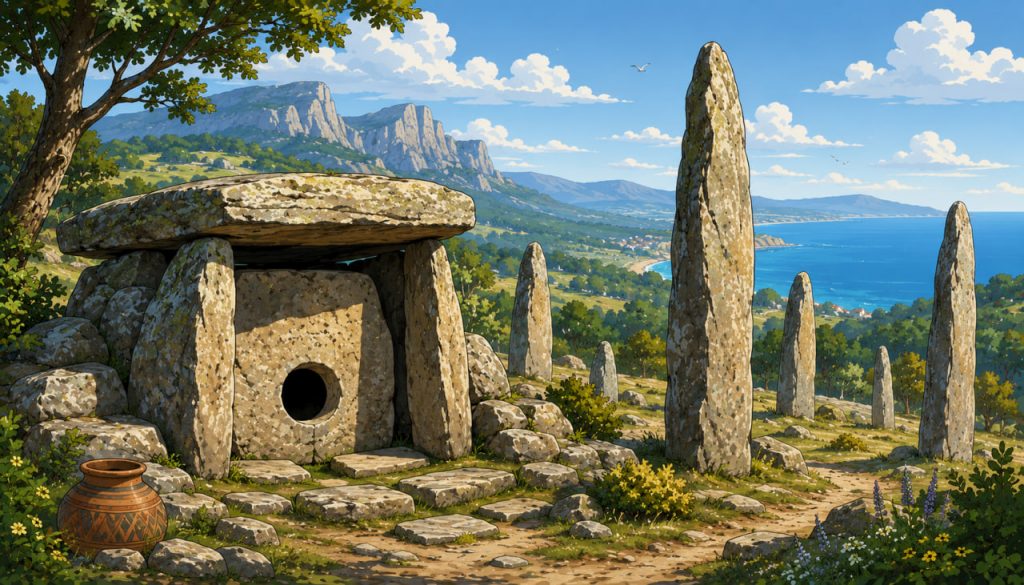
The Crimean Peninsula is famous for its dramatic mountains, coastal landscapes, and rich cultural history. However, hidden among forests, valleys, and remote highlands are some of the region’s most intriguing archaeological monuments: dolmens and menhirs. These ancient stone structures have fascinated historians, archaeologists, travelers, and local legends for generations.
Although they are less famous than monuments such as Stonehenge, the pyramids of Egypt, or the megalithic sites of Western Europe, Crimean dolmens and menhirs provide valuable insights into the prehistoric societies that once inhabited the region. They also raise questions that continue to challenge researchers today.
Who built these structures? Why were they constructed? And what role did they play in the lives of ancient people?
What Are Dolmens?
A dolmen is a megalithic structure built from large stone slabs.
The term comes from the Breton language and roughly means “stone table.”
Typical dolmens consist of:
- Vertical stone walls
- A massive stone roof
- An entrance opening
Many archaeologists believe dolmens served as burial chambers, ceremonial sites, or places associated with ancestor worship.
Dolmens are found across many regions of the world, including:
- Western Europe
- The Caucasus
- Korea
- India
- North Africa
Crimea contains several examples of megalithic structures that share characteristics with dolmens found elsewhere.
These monuments were built without modern machinery, demonstrating impressive engineering skills for their time.
What Are Menhirs?
A menhir is a single upright standing stone intentionally placed by humans.
Unlike dolmens, menhirs usually consist of one large stone rather than a chamber-like structure.
Their functions remain debated.
Possible purposes include:
- Territorial markers
- Religious monuments
- Astronomical alignments
- Memorials
- Ceremonial gathering points
Some menhirs stand alone, while others are part of larger ritual landscapes.
Crimean examples vary in size and condition, but they represent an important part of the peninsula’s prehistoric heritage.
When Were They Built?
Determining exact construction dates can be difficult because stone itself cannot usually be dated directly.
Archaeologists instead rely on:
- Associated artifacts
- Burial remains
- Sediment analysis
- Radiocarbon dating of nearby organic material
Many megalithic structures in the wider Black Sea and Caucasus regions date to the Bronze Age or earlier.
Some researchers estimate that certain Crimean examples may be several thousand years old.
This means they were constructed long before:
- Classical Greece
- The Roman Empire
- Medieval kingdoms
Some Crimean megaliths may have stood for over four millennia.
The Famous Menhirs of Bakhchisarai Region
Among the most well-known standing stones in Crimea are several menhir-like monuments found near the Bakhchisarai area.
These stones have attracted scientific interest because of their unusual placement and possible connections to ancient ritual practices.
Researchers have proposed various explanations.
Some suggest they were:
- Sacred landmarks
- Observation points
- Community gathering sites
Others argue that their positioning may have had astronomical significance.
However, definitive evidence remains limited.
As with many prehistoric monuments worldwide, mystery continues to surround their original purpose.
Possible Religious and Ceremonial Functions
Many archaeologists believe dolmens and menhirs were closely connected to spiritual life.
Ancient societies often invested tremendous effort in constructing monuments associated with:
- Ancestor worship
- Burial rituals
- Seasonal ceremonies
- Community identity
Large stones possess an enduring and imposing presence that may have symbolized permanence, power, or connections between generations.
Some researchers suggest that megalithic monuments helped unify communities through shared rituals and cultural traditions.
The social and symbolic value of these structures may have been as important as any practical function they served.
Astronomical Theories
One of the most popular theories surrounding megalithic monuments involves astronomy.
Across Europe and Asia, some ancient stone structures appear aligned with:
- Solstices
- Equinoxes
- Sunrise points
- Lunar cycles
Certain Crimean monuments have also been studied for potential astronomical relationships.
While some alignments may be intentional, researchers caution against assuming that every apparent orientation has cosmic significance.
Human beings naturally recognize patterns, and some alignments may simply be coincidental.
Nevertheless, ancient peoples often paid close attention to celestial events because they influenced:
- Agriculture
- Navigation
- Seasonal planning
This makes astronomical interpretations plausible in some cases.
Challenges Facing Archaeologists
Studying Crimean megalithic sites is not always straightforward.
Researchers face several difficulties:
Limited Written Records
Prehistoric builders left no written explanations.
Weathering
Thousands of years of exposure have altered many structures.
Human Activity
Agriculture, construction, and looting have damaged some sites.
Fragmentary Evidence
Many associated artifacts have been lost or displaced.
As a result, archaeologists often rely on indirect evidence when reconstructing the history of these monuments.
Folklore and Legends
Local folklore frequently surrounds ancient stone monuments.
Throughout Crimea, stories have linked mysterious stones with:
- Giants
- Ancient heroes
- Sacred powers
- Hidden treasures
- Supernatural beings
These legends developed long after the monuments were built but reflect their enduring influence on local culture.
Even today, some visitors describe the sites as having a unique atmosphere that inspires curiosity and imagination.
While legends are not scientific evidence, they form an important part of the monuments’ cultural heritage.
Expert Perspective
British archaeologist Colin Renfrew, one of the world’s leading experts on prehistoric Europe and megalithic monuments, has emphasized that such structures should be viewed within their broader social and cultural contexts.
His research suggests that megalithic monuments often served as symbols of community organization and collective identity.
“Monuments are expressions of social structure as much as engineering achievement.”
This perspective helps explain why prehistoric communities invested enormous effort into constructing stone structures that have endured for thousands of years.
Why These Monuments Still Matter
Crimean dolmens and menhirs are more than archaeological curiosities.
They represent:
- Ancient engineering
- Cultural heritage
- Human creativity
- Early religious practices
- Community organization
Modern technologies such as:
- Ground-penetrating radar
- 3D scanning
- GIS mapping
- Radiometric analysis
are helping researchers learn more about these enigmatic structures.
Although many questions remain unanswered, every new study contributes to a deeper understanding of the people who once inhabited the Crimean Peninsula.
These ancient stones continue to connect modern observers with a distant prehistoric past that shaped the cultural landscape of the Black Sea region long before recorded history began.
Interesting Facts
- The word “dolmen” comes from a Breton term meaning “stone table.”
- Megalithic monuments exist on every inhabited continent.
- Some standing stones have remained upright for thousands of years.
- Many ancient stone monuments are aligned with landscape features rather than settlements.
- Archaeologists still debate the exact functions of numerous megalithic sites.
- Local legends often attribute ancient stone monuments to giants or supernatural beings.
- Modern 3D scanning technology is helping preserve fragile archaeological sites.
Glossary
- Dolmen — A megalithic stone structure often interpreted as a burial or ceremonial monument.
- Menhir — A single upright standing stone erected by humans.
- Megalith — A large stone used in prehistoric monuments.
- Bronze Age — A prehistoric period characterized by the widespread use of bronze tools and weapons.
- Archaeology — The study of past human societies through material remains.
- Radiocarbon Dating — A scientific method used to estimate the age of organic materials.
- Solstice — The time of year when the Sun reaches its highest or lowest point in the sky.
- Equinox — A time when day and night are approximately equal in length.
- GIS (Geographic Information System) — Technology used to analyze and map spatial data.
- Cultural Heritage — Historical, archaeological, and cultural resources preserved for future generations.