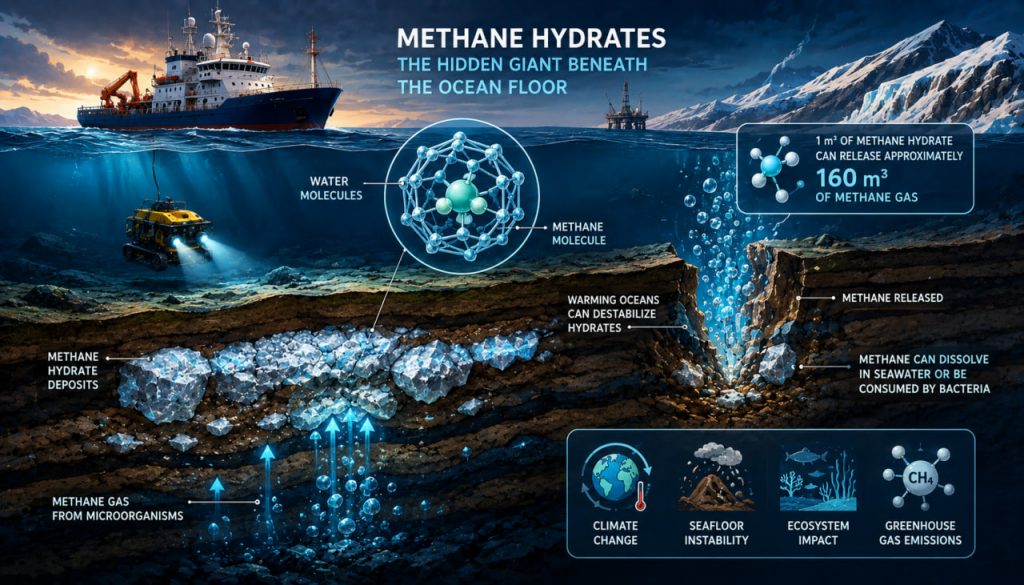
Far below the ocean’s surface, beneath layers of sediment and icy cold seawater, lies one of Earth’s largest hidden carbon reservoirs—methane hydrates. Often described as “flammable ice,” these unusual crystalline compounds trap enormous amounts of methane gas inside cages of frozen water molecules. Scientists estimate that methane hydrates contain more carbon than all known reserves of coal, oil, and natural gas combined.
Because methane is a powerful greenhouse gas, methane hydrates have attracted enormous scientific interest. Some researchers have referred to them as a potential “climate time bomb,” raising concerns that warming oceans could destabilize these deposits and release methane into the atmosphere. However, while this possibility deserves careful study, current scientific evidence does not support the idea that a sudden, global methane hydrate release is imminent. Instead, researchers continue investigating how these deposits may respond to long-term climate change.
What Are Methane Hydrates?
Methane hydrates are solid crystalline materials formed when methane gas becomes trapped within a lattice of water molecules under conditions of high pressure and low temperature.
Although they resemble ordinary ice, methane hydrates behave very differently.
When brought to warmer temperatures or lower pressures, they become unstable and release methane gas.
This unique material is often called flammable ice because the escaping methane can ignite while the remaining water continues to melt.
One cubic meter of methane hydrate can release approximately 160 cubic meters of methane gas under normal atmospheric conditions.
Where Are Methane Hydrates Found?
Methane hydrates occur naturally in two main environments:
- Deep ocean sediments
- Arctic permafrost
The largest known deposits lie beneath continental margins at depths generally greater than 500 meters (1,640 feet).
Suitable conditions include:
- Cold temperatures
- High pressure
- Organic-rich sediments
- Microbial methane production
Large hydrate accumulations have been identified in regions including:
- The Gulf of Mexico
- Offshore Japan
- The Arctic Ocean
- The eastern Pacific
- The Indian Ocean
- The Black Sea
These deposits formed gradually over thousands to millions of years.
How Do Methane Hydrates Form?
Methane hydrates begin with organic matter buried beneath the seafloor.
As microorganisms decompose this material in oxygen-poor sediments, they produce methane.
Under sufficient pressure and low temperatures, water molecules naturally organize into crystal cages surrounding methane molecules.
This creates a remarkably stable solid.
The process continues slowly as additional methane migrates upward through sediment layers.
Over geological timescales, enormous hydrate deposits can accumulate beneath the ocean floor.
Why Are Scientists Concerned?
Methane is an extremely effective greenhouse gas.
Over a 20-year period, methane has a much stronger warming effect per molecule than carbon dioxide, although it remains in the atmosphere for a much shorter time.
If large quantities of methane were released into the atmosphere, they could contribute to additional warming.
Scientists therefore monitor methane hydrates because warming oceans may gradually destabilize some shallow deposits.
Potential consequences include:
- Increased methane release into seawater
- Changes in seafloor stability
- Underwater landslides
- Local ecosystem changes
- Additional greenhouse gas emissions
However, most methane released from deep seafloor hydrates dissolves in seawater or is consumed by methane-eating microorganisms before reaching the atmosphere.
This natural filtering process greatly limits atmospheric emissions from many deep-water hydrate sources.
Is There Really a “Methane Bomb”?
The phrase “methane bomb” is frequently used in popular media, but most climate scientists consider it an oversimplification.
Current evidence suggests that a sudden, catastrophic global release of methane hydrates is highly unlikely under present conditions.
Instead, research indicates that hydrate destabilization would most likely occur gradually over decades to centuries, with regional differences depending on ocean temperature, water depth, and local geology.
Some shallow Arctic hydrate deposits may be more vulnerable than deep-ocean deposits, but scientists continue investigating their long-term behavior.
Understanding these processes remains an active area of climate research.
Could Methane Hydrates Become an Energy Source?
Because methane hydrates contain enormous quantities of natural gas, several countries are investigating whether they could become a future energy resource.
Research programs have been conducted in:
- Japan
- China
- India
- Canada
- United States
Experimental extraction methods include:
- Depressurization
- Heat injection
- Chemical replacement using carbon dioxide
Although technically promising, commercial production remains difficult.
Challenges include:
- High costs
- Environmental risks
- Maintaining deposit stability
- Preventing methane leakage
For now, methane hydrates remain primarily a scientific research topic rather than a practical commercial energy source.
Methane Hydrates and Ancient Climate Change
Scientists have long investigated whether methane hydrate releases contributed to ancient climate events.
One frequently studied example is the Paleocene–Eocene Thermal Maximum (PETM) approximately 56 million years ago, when global temperatures rose rapidly.
Some researchers have proposed that methane released from hydrate deposits may have amplified warming during this event.
However, current evidence suggests that methane hydrates were likely one of several contributing factors rather than the sole cause. Volcanic activity, carbon dioxide emissions, and other feedback mechanisms also appear to have played important roles.
This remains an active area of geological research.
Expert Perspective
Marine geoscientist Professor Carolyn Ruppel of the U.S. Geological Survey (USGS) is one of the world’s leading experts on methane hydrates. Her research emphasizes that while methane hydrates represent an important component of Earth’s carbon cycle, the idea of an imminent, catastrophic global methane release is not supported by current scientific evidence.
According to Ruppel, most hydrate deposits are stable under present-day conditions, and understanding how they respond to long-term ocean warming requires continued monitoring, improved climate models, and further geological research. Her work has helped clarify the distinction between legitimate scientific concerns and exaggerated public claims.
Why Methane Hydrates Matter
Methane hydrates sit at the intersection of geology, oceanography, climate science, and energy research.
Studying them helps scientists better understand:
- Earth’s carbon cycle
- Ocean chemistry
- Climate feedback mechanisms
- Marine geology
- Seafloor stability
- Future energy possibilities
As ocean temperatures and climate continue changing, methane hydrates will remain an important focus of international scientific research.
Rather than representing an immediate global catastrophe, they are best understood as a complex natural system whose long-term behavior continues to be carefully investigated.
Interesting Facts
- Methane hydrates are sometimes called “flammable ice” because they can burn while the surrounding ice melts.
- Scientists estimate that methane hydrates contain more carbon than all known fossil fuel reserves combined.
- Most known hydrate deposits occur hundreds of meters beneath the ocean surface.
- Specialized bacteria consume much of the methane released from deep sediments before it reaches the atmosphere.
- Japan has conducted several experimental methane hydrate extraction projects.
- Methane hydrates help scientists study both Earth’s climate history and potential future climate changes.
- Similar hydrate-like compounds may exist on icy moons elsewhere in the Solar System.
Glossary
- Methane Hydrate — A crystalline solid in which methane molecules are trapped within cages of water molecules under high pressure and low temperature.
- Methane (CH₄) — A greenhouse gas and the primary component of natural gas.
- Continental Margin — The submerged outer edge of a continent where many methane hydrate deposits are found.
- Permafrost — Ground that remains frozen for at least two consecutive years and can contain methane hydrates.
- Carbon Cycle — The movement of carbon among Earth’s atmosphere, oceans, rocks, soil, and living organisms.
- Depressurization — A proposed extraction method that lowers pressure to release methane from hydrate deposits.
- Paleocene–Eocene Thermal Maximum (PETM) — A period of rapid global warming approximately 56 million years ago that is widely studied by climate scientists.
- Climate Feedback — A process that either amplifies or reduces the effects of climate change, such as changes involving greenhouse gases or ice cover.