Agriculture has always depended on weather, but climate change is making farming increasingly unpredictable. Rising temperatures, prolonged droughts, irregular rainfall, and declining freshwater supplies are placing enormous pressure on food production around the world. In many regions, crops that once thrived under stable climatic conditions now struggle to survive during increasingly frequent dry seasons.
To address these challenges, farmers, scientists, and governments are investing in climate-resilient agriculture, with one of the most important strategies being the transition to drought-resistant crops. These crops require less water, tolerate extreme heat more effectively, and help maintain food production even under difficult environmental conditions. Rather than replacing traditional farming entirely, drought-resistant agriculture represents an adaptation that allows food systems to become more resilient in a changing climate.
Why Is Drought Becoming a Bigger Challenge?
Drought has always been part of Earth’s natural climate, but many regions are now experiencing longer and more frequent periods of low rainfall.
Several factors contribute to increasing agricultural water stress:
- Rising average temperatures
- Higher evaporation rates
- Irregular rainfall patterns
- Reduced snowpack in mountain regions
- Increasing demand for freshwater
- Soil degradation
Even when total annual rainfall changes only slightly, rain may fall in fewer but more intense storms, leaving crops without sufficient moisture during critical growing periods.
For agriculture, reliable water availability often matters more than the total amount of annual rainfall.
What Are Drought-Resistant Crops?
Drought-resistant crops are plants capable of maintaining growth and producing harvests under limited water conditions.
Some species naturally evolved in arid environments, while others have been improved through conventional breeding or modern plant science.
Common drought-tolerant crops include:
- Sorghum
- Millet
- Chickpeas
- Lentils
- Pigeon peas
- Quinoa
- Certain varieties of maize
- Drought-tolerant wheat
- Drought-tolerant rice
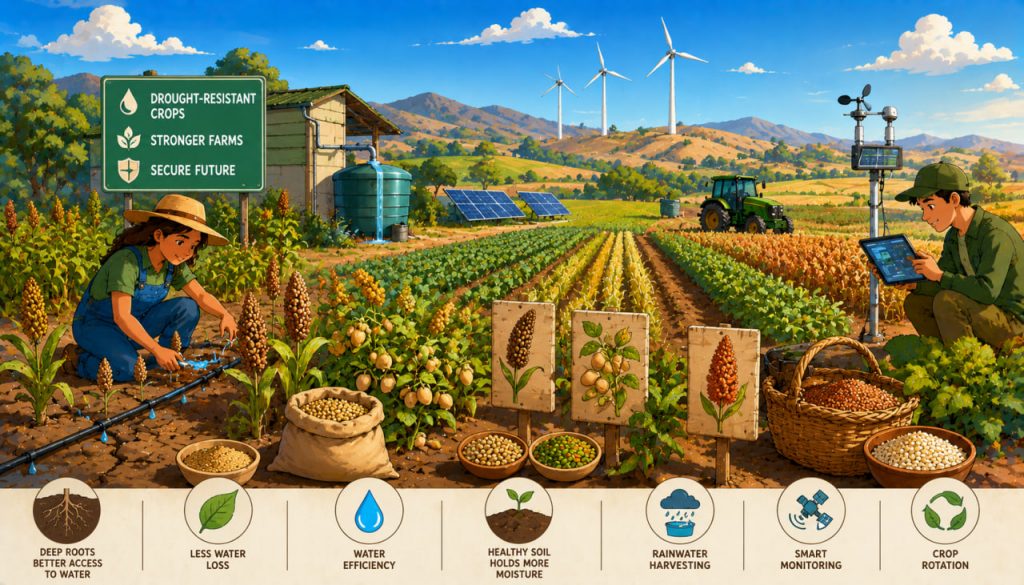
These crops often possess characteristics such as deeper root systems, reduced water loss through leaves, or improved efficiency in using available soil moisture.
How Scientists Develop Drought-Tolerant Varieties
Plant breeders use several methods to improve crop resilience.
Traditional breeding involves selecting plants with desirable traits and crossing them over many generations.
Today, researchers also use advanced technologies such as:
- Marker-assisted breeding
- Genomic analysis
- Precision phenotyping
- Gene editing
- Biotechnology in some regions
The goal is not simply to produce plants that survive drought, but to maintain stable yields, nutritional quality, and disease resistance under water-limited conditions.
Developing a new crop variety can take many years, requiring extensive field testing across different climates.
Benefits for Farmers
Switching to drought-resistant crops offers numerous advantages beyond simply surviving dry weather.
Potential benefits include:
- More stable harvests
- Lower irrigation demand
- Reduced production risk
- Better resilience during heat waves
- Improved long-term farm sustainability
- Greater food security
In regions where freshwater resources are becoming increasingly limited, reducing irrigation requirements can also lower production costs and conserve valuable water supplies.
Drought Resistance Is Only Part of the Solution
Although drought-tolerant crops play a major role, successful climate adaptation requires multiple complementary strategies.
Farmers increasingly combine improved crop varieties with sustainable farming practices such as:
- Drip irrigation
- Rainwater harvesting
- Conservation tillage
- Crop rotation
- Cover crops
- Mulching
- Soil organic matter improvement
- Precision agriculture
Healthy soils rich in organic matter retain water more effectively, allowing crops to better withstand periods of limited rainfall.
Improving soil health can be just as important as selecting the right crop variety.
Precision Agriculture and Smart Farming
Modern technology is transforming how farmers manage water resources.
Precision agriculture uses data from:
- GPS systems
- Soil moisture sensors
- Weather stations
- Satellite imagery
- Drones
- Artificial intelligence
These technologies allow farmers to apply water only where and when it is needed.
As a result, irrigation becomes more efficient while reducing water waste.
Many farms now use automated irrigation systems that respond directly to real-time soil moisture measurements.
Challenges of Transitioning to New Crops
Adopting drought-resistant crops is not always straightforward.
Farmers must consider:
- Local climate conditions
- Soil characteristics
- Market demand
- Consumer preferences
- Seed availability
- Farming equipment
- Financial costs
Some drought-tolerant crops may require different harvesting methods or processing infrastructure.
Governments, agricultural extension services, and research institutions therefore play an important role by providing technical guidance, education, and financial support during the transition.
Global Examples of Climate Adaptation
Many countries are already implementing drought adaptation strategies.
Examples include:
- Drought-tolerant maize in parts of sub-Saharan Africa
- Heat-resistant wheat varieties in Australia
- Improved rice varieties in South Asia
- Water-efficient irrigation systems in Israel
- Sorghum expansion in semi-arid regions
These efforts demonstrate that combining improved crop genetics with better water management can significantly increase agricultural resilience.
No single approach fits every region, making local adaptation essential.
Expert Perspective
Plant scientist Dr. Gebisa Ejeta, recipient of the World Food Prize, is internationally recognized for developing improved sorghum varieties adapted to drought-prone environments. His work has demonstrated that carefully selected and improved crops can substantially increase food security in regions facing frequent water shortages.
Organizations such as the Food and Agriculture Organization (FAO) and the Consultative Group on International Agricultural Research (CGIAR) likewise emphasize that climate-resilient crop breeding, combined with sustainable soil and water management, will be critical for feeding a growing global population under changing climatic conditions.
The Future of Climate-Resilient Agriculture
Agriculture is entering a new era in which resilience is becoming as important as productivity.
Future developments may include:
- More drought-tolerant crop varieties
- AI-assisted crop management
- Advanced weather forecasting
- Climate-adaptive farming systems
- Improved soil restoration techniques
- Water-efficient irrigation technologies
- Greater use of satellite monitoring
As climate conditions continue to evolve, successful agriculture will increasingly depend on innovation, scientific research, and sustainable resource management.
The transition toward drought-resistant crops is not simply about adapting to today’s climate—it is about building food systems capable of meeting the challenges of tomorrow.
Interesting Facts
- Agriculture accounts for about 70% of global freshwater withdrawals, making efficient water use a major priority.
- Sorghum is one of the world’s most drought-tolerant cereal crops.
- Some plant roots can grow several meters deep to access underground moisture.
- Healthy soils rich in organic matter can retain significantly more water than degraded soils.
- Drip irrigation can greatly improve water-use efficiency compared with traditional surface irrigation, depending on crop type and local conditions.
- Satellite imagery is increasingly used to detect crop water stress before it becomes visible to the human eye.
- Climate-resilient farming practices often improve both productivity and long-term environmental sustainability.
Glossary
- Drought-Resistant Crop — A crop variety capable of maintaining growth and producing harvests under limited water availability.
- Climate-Resilient Agriculture — Farming systems designed to adapt to changing climate conditions while maintaining productivity and sustainability.
- Precision Agriculture — The use of sensors, satellite data, GPS, and digital technologies to optimize farming operations.
- Drip Irrigation — An irrigation system that delivers water directly to plant roots, minimizing evaporation and waste.
- Marker-Assisted Breeding — A plant breeding technique that uses genetic markers to identify desirable traits more efficiently.
- Soil Organic Matter — Decomposed plant and animal material in soil that improves fertility, structure, and water retention.
- Crop Rotation — The practice of growing different crops in succession to improve soil health and reduce pests.
- Water Stress — A condition in which plants receive insufficient water to support normal growth and development.