Power outages can happen unexpectedly due to storms, natural disasters, equipment failures, or maintenance work. In recent years, many homeowners have started looking for reliable backup power solutions to keep essential devices running when the electrical grid goes down.
Two of the most popular options are portable generators and portable power stations (often mistakenly called “large power banks”). While both can provide electricity during an outage, they work very differently and are designed for different situations.
This guide explains the differences between generators and portable power stations, their advantages and disadvantages, and how to choose the right solution for your home, travel, or emergency preparedness.
What Is a Portable Generator?
A portable generator is a machine that converts mechanical energy into electricity.
Most household generators are powered by:
- Gasoline
- Diesel
- Propane
- Natural gas (on some models)
Generators produce alternating current (AC), allowing them to power many common household appliances directly.
They are commonly used for:
- Home backup power
- Construction sites
- Outdoor events
- Farms
- Emergency response
- Remote work locations
Generators can provide large amounts of electricity for extended periods as long as fuel is available.
What Is a Portable Power Station?
A portable power station is a large rechargeable battery system that stores electricity for later use.
Unlike small phone power banks, power stations can operate much larger devices and often include:
- AC wall outlets
- USB-A ports
- USB-C Power Delivery ports
- 12V vehicle outputs
- DC outputs
Modern power stations usually use lithium-ion or lithium iron phosphate (LiFePO₄) batteries.
Many models can also recharge using:
- Household electricity
- Solar panels
- Car charging outlets
- Some generators
Power stations produce no exhaust fumes and operate almost silently, making them suitable for indoor use.
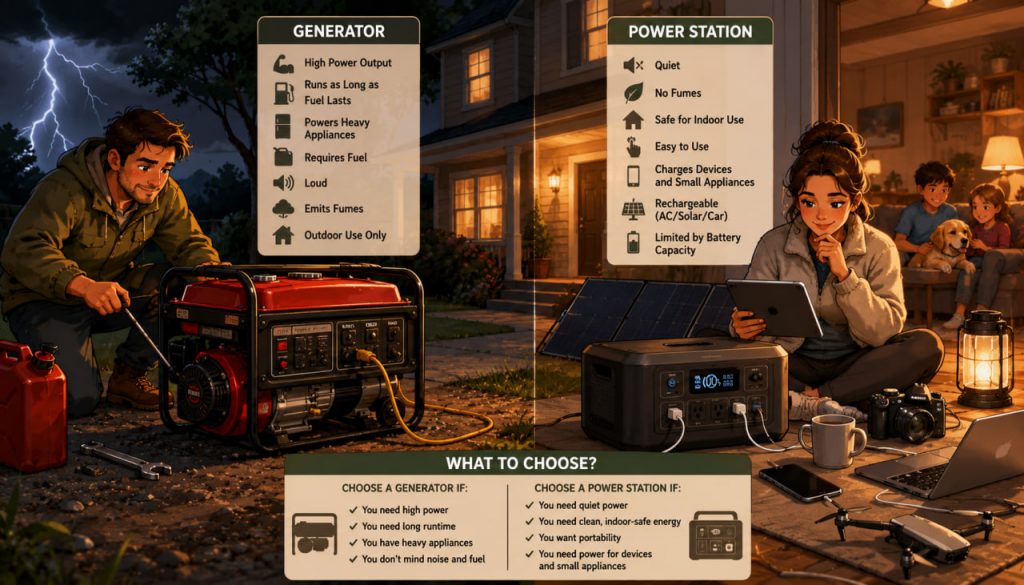
Key Differences Between Generators and Power Stations
Although both provide backup electricity, they serve different purposes.
Portable Generator
- Produces electricity continuously while fuel is available
- Higher power output
- Suitable for heavy appliances
- Requires fuel
- Produces engine noise
- Emits exhaust gases
- Must be operated outdoors
Portable Power Station
- Stores a limited amount of electricity
- Quiet operation
- No fuel required
- No emissions during use
- Safe for indoor operation
- Lower maximum power output
- Requires recharging after use
The best choice depends on how much power you need and for how long.
Which Devices Can They Power?
Both systems can power many everyday devices, but their capabilities differ.
Portable power stations are commonly used for:
- Smartphones
- Tablets
- Laptops
- LED lighting
- Wi-Fi routers
- CPAP machines
- Cameras
- Small televisions
Larger power stations may also support:
- Mini refrigerators
- Portable coolers
- Electric blankets
- Small kitchen appliances
Generators can additionally operate:
- Full-size refrigerators
- Freezers
- Water pumps
- Space heaters (depending on wattage)
- Air conditioners (on sufficiently powerful models)
- Power tools
- Multiple household circuits
Always compare the device’s power requirements with the rated output of the generator or power station before use.
Noise and Safety
One of the biggest differences is how they operate.
Generators:
- Produce engine noise
- Require regular maintenance
- Burn fuel
- Emit carbon monoxide
- Must never be used indoors, in garages, or near open windows
Portable power stations:
- Operate almost silently
- Produce no exhaust emissions
- Require minimal maintenance
- Can be safely used indoors under normal operating conditions
Carbon monoxide poisoning from improper generator use remains one of the greatest safety risks during power outages.
Battery Capacity vs. Continuous Power
Many buyers confuse battery capacity with power output.
Battery capacity is measured in watt-hours (Wh).
Power output is measured in watts (W).
For example:
- A 1,000 Wh power station stores approximately 1 kilowatt-hour of energy.
- A 2,000 W generator can continuously deliver up to about 2,000 watts while fuel lasts.
One describes how much energy is stored.
The other describes how much power can be delivered at one time.
Understanding this difference is essential when comparing products.
Solar Charging: A Growing Advantage
Many modern power stations support solar charging.
When paired with compatible solar panels, they can recharge without access to the electrical grid.
Benefits include:
- Renewable energy
- Quiet operation
- Reduced fuel dependence
- Lower operating costs over time
However, charging speed depends on:
- Weather
- Sunlight intensity
- Panel size
- Battery capacity
Solar charging is particularly useful for camping, RV travel, and long-duration emergencies.
Maintenance Requirements
Portable generators require regular maintenance.
Typical tasks include:
- Engine oil changes
- Air filter replacement
- Spark plug inspection
- Fuel stabilization during storage
- Periodic engine testing
Portable power stations require much less maintenance.
Owners should:
- Recharge the battery periodically during storage.
- Keep the battery within recommended temperature ranges.
- Follow the manufacturer’s charging guidelines.
- Avoid deep discharge if recommended.
Proper maintenance helps maximize the lifespan of either backup power solution.
Which One Is Best for Your Home?
There is no universal answer.
A portable power station is often the better choice if you need:
- Quiet operation
- Indoor safety
- Phone and laptop charging
- Medical device backup
- Camping power
- Occasional emergency use
A generator is often more appropriate if you need:
- Long-duration backup power
- Whole-house support
- Heavy electrical loads
- Refrigerator and freezer operation
- Construction equipment power
Many households choose to own both: a portable power station for immediate indoor use and a generator for extended outages.
Expert Perspective
Electrical safety experts, including guidance from the U.S. Consumer Product Safety Commission (CPSC) and the Federal Emergency Management Agency (FEMA), consistently emphasize that portable generators should never be operated indoors or in enclosed spaces because they produce carbon monoxide, an odorless gas that can be deadly. They also recommend installing battery-operated or battery-backup carbon monoxide detectors in homes where generators may be used during emergencies.
This expert guidance highlights an important principle: choosing the right backup power source is only part of emergency preparedness—using it safely is equally important.
Common Buying Mistakes
Many first-time buyers choose the wrong backup power system because they focus only on price.
Common mistakes include:
- Buying too little power capacity.
- Ignoring surge power requirements.
- Forgetting fuel storage needs.
- Overlooking battery recharge times.
- Underestimating appliance wattage.
- Assuming all power stations are equivalent to generators.
- Forgetting about long-term maintenance.
Before purchasing, calculate the total power requirements of the devices you actually need during an outage.
The best backup power solution is the one that matches your real energy needs—not the largest or most expensive model.
Interesting Facts
- Some modern portable power stations use LiFePO₄ batteries, which can often withstand several thousand charge cycles under proper conditions.
- Carbon monoxide is colorless and odorless, making generator safety especially important during emergencies.
- Solar-compatible power stations can often be recharged directly from portable solar panels without access to the electrical grid.
- Many refrigerators do not run continuously; they cycle on and off, reducing their average energy consumption over time.
- Large portable power stations can sometimes function as temporary backup systems for home internet equipment, allowing communication to continue during short outages.
- Hybrid emergency setups that combine generators, battery storage, and solar charging are becoming increasingly popular in areas prone to extended power interruptions.
Glossary
- Portable Generator – A fuel-powered machine that produces electricity by converting mechanical energy into electrical energy.
- Portable Power Station – A rechargeable battery system that stores electricity and supplies power through AC, USB, and DC outputs.
- Watt (W) – A unit that measures the rate at which electrical power is delivered or consumed.
- Watt-hour (Wh) – A unit that measures stored electrical energy.
- LiFePO₄ (Lithium Iron Phosphate) – A lithium battery chemistry known for its long lifespan, thermal stability, and improved safety compared with many other lithium-ion batteries.
- Surge Power – The brief, higher amount of power required when certain electrical devices first start operating.
- Carbon Monoxide (CO) – A poisonous, colorless, and odorless gas produced by incomplete combustion of fuels.
- Backup Power – An alternative source of electricity used when the main electrical supply becomes unavailable.