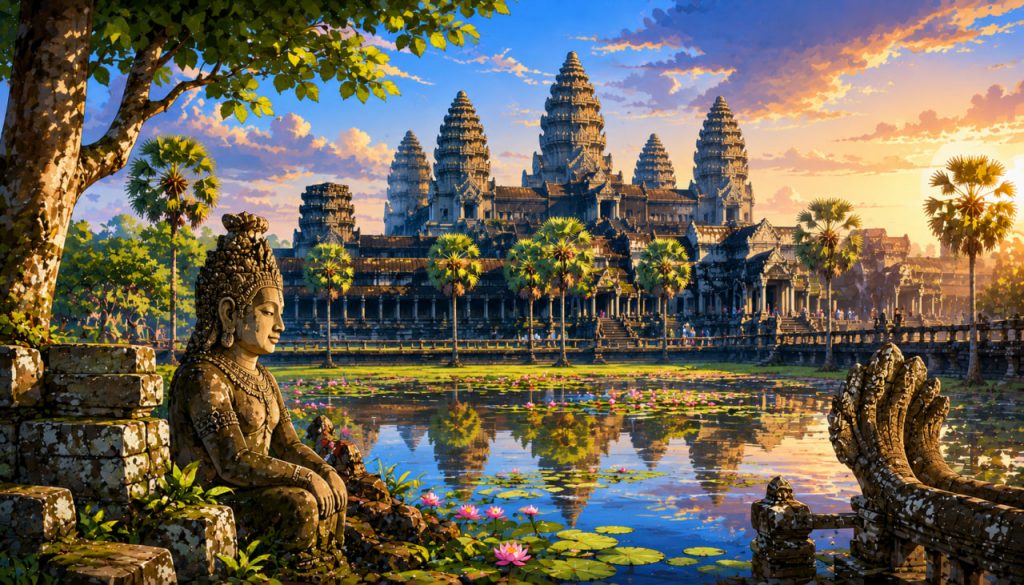
Angkor Wat is one of the most extraordinary monuments ever built by human civilization. Located near Siem Reap in Cambodia, this vast temple complex is admired for its scale, symmetry, stone carvings, spiritual symbolism, and remarkable engineering. It is often described as one of the greatest architectural masterpieces of Southeast Asia.
Built in the early 12th century during the height of the Khmer Empire, Angkor Wat was originally dedicated to the Hindu god Vishnu. Over time, it gradually became associated with Buddhism and remains an active spiritual and cultural symbol today. UNESCO describes Angkor as one of the most important archaeological sites in Southeast Asia, covering about 400 square kilometers and containing the remains of Khmer capitals from the 9th to the 15th centuries.
Angkor Wat is not only an ancient temple. It is a masterpiece of architecture, religion, astronomy, hydraulic engineering, and cultural memory.
Where Is Angkor Wat Located?
Angkor Wat is located in northwestern Cambodia, close to the modern city of Siem Reap.
It is part of the larger Angkor Archaeological Park, which contains many famous temple sites, including:
- Angkor Wat
- Angkor Thom
- Bayon Temple
- Ta Prohm
- Preah Khan
- Banteay Srei
- Phnom Bakheng
The region was once the heart of the Khmer Empire, one of the most powerful civilizations in medieval Asia.
Unlike a single isolated monument, Angkor was part of a large urban and ceremonial landscape.
Angkor Wat should be understood as part of a much bigger ancient city system, not just as one temple.
Who Built Angkor Wat?
Angkor Wat was built during the reign of King Suryavarman II, who ruled the Khmer Empire in the early 12th century.
The temple was likely constructed as his state temple and possibly as a funerary monument.
Unlike many Khmer temples that were dedicated to Shiva, Angkor Wat was dedicated to Vishnu, one of the principal deities of Hinduism.
This religious choice influenced much of the temple’s symbolism, sculpture, and layout.
The construction required:
- Skilled architects
- Stone carvers
- Engineers
- Laborers
- Religious specialists
- Hydraulic planners
- Administrative organization
Angkor Wat reflects the power, wealth, and technical sophistication of the Khmer Empire at its peak.
Why Is Angkor Wat So Large?
Angkor Wat is often called the largest religious monument in the world.
Its layout includes:
- A huge rectangular moat
- Long causeways
- Outer galleries
- Concentric enclosures
- Central towers
- Extensive bas-relief carvings
The temple was designed as a symbolic representation of the Hindu universe.
Its central towers are commonly interpreted as representing Mount Meru, the sacred mountain at the center of Hindu and Buddhist cosmology.
The surrounding moat may symbolize the cosmic ocean.
This combination of architecture and cosmology made Angkor Wat more than a place of worship.
It was a stone model of the universe.
The Genius of Khmer Architecture
Angkor Wat is famous for its visual harmony.
The temple appears balanced from almost every angle because its design relies on symmetry, rhythm, proportion, and carefully planned sightlines.
Key architectural features include:
- Lotus-shaped towers
- Long galleries
- Steep stairways
- Stone corridors
- Intricate columns
- Massive sandstone blocks
- Carefully aligned entrances
Many stones were fitted together with remarkable precision.
The temple’s scale is impressive, but its details are equally important.
Every gallery, doorway, and tower contributes to the overall sense of order and sacred geometry.
The Famous Bas-Reliefs
One of Angkor Wat’s greatest treasures is its long series of bas-relief carvings.
These stone panels depict religious, historical, and mythological scenes.
Famous subjects include:
- The Churning of the Ocean of Milk
- Battles from Hindu epics
- Armies and processions
- Celestial dancers known as apsaras
- Deities and mythological beings
- Scenes of heaven and hell
The carvings are not simply decoration.
They communicate religious ideas, royal power, moral lessons, and cosmological order.
Angkor Wat’s walls are like a vast stone book carved for eternity.
From Hindu Temple to Buddhist Sacred Site
Angkor Wat was originally a Hindu temple.
Over the centuries, it gradually became a Buddhist site.
Today, Buddhist monks and visitors continue to treat Angkor Wat as a sacred place.
This religious transformation is one reason the monument remained important long after the political center of the Khmer Empire shifted.
Many ancient temples around the world were abandoned completely, but Angkor Wat retained spiritual significance.
The broader region of Angkor mirrors the night sky; specific temples are aligned to match the stars within the Draco constellation. Furthermore, planetary alignments—such as alignments with Mars and Saturn at dawn—have been identified in the temple’s site lines.
There are many interesting things related to astronomy and the complex. I recommend exploring them.
The Water System Behind Angkor
The Khmer Empire was famous for its sophisticated water management.
The Angkor region included:
- Reservoirs
- Canals
- Moats
- Embankments
- Irrigation systems
- Water temples
These systems helped support agriculture, especially rice cultivation, and may have also served religious and political purposes.
Modern research using technologies such as LiDAR has revealed extensive urban features and water infrastructure hidden beneath forest cover around Angkor. These discoveries show that the city was far larger and more complex than earlier generations imagined.
Angkor’s greatness depended not only on temples, but also on water engineering.
Why Did Angkor Decline?
The decline of Angkor was complex and gradual.
Historians and archaeologists point to several possible factors:
- Political instability
- Changing trade routes
- Military pressure
- Religious transformation
- Environmental stress
- Water system failure
- Severe droughts and floods
Recent research suggests that climate variability may have placed enormous pressure on Angkor’s water infrastructure.
When systems designed for regular monsoon patterns faced extreme droughts and intense rains, they may have become harder to maintain.
Angkor did not simply “vanish”; it changed, declined, and transformed over time.
Expert Perspective
Archaeologist Dr. Damian Evans, whose research has used airborne LiDAR to study Angkor’s hidden urban landscape, has helped show that Angkor was not just a collection of temples but part of a vast low-density urban network. His work revealed roads, canals, reservoirs, occupation mounds, and planned landscapes that were difficult to see from the ground.
This research changed how many scholars understand Angkor.
Instead of viewing it only as a ceremonial center, experts increasingly see it as a complex urban civilization supported by engineering, agriculture, religion, and administration.
Modern archaeology shows that Angkor Wat was one brilliant part of a much larger civilization.
Why Angkor Wat Is Important Today
Angkor Wat is deeply connected to Cambodian identity.
It appears on Cambodia’s national flag and remains one of the country’s most recognized symbols.
The temple attracts millions of visitors and supports local tourism, education, archaeology, and conservation.
However, popularity also creates challenges.
Conservation teams must manage:
- Stone erosion
- Weathering
- Vegetation growth
- Tourism pressure
- Water management
- Structural stability
- Cultural respect
UNESCO notes that Angkor has required a wide-ranging safeguarding program to protect the site and its surroundings.
Protecting Angkor Wat means preserving both a world monument and a living cultural heritage.
Interesting Facts
- Angkor Wat was originally dedicated to the Hindu god Vishnu.
- The name Angkor Wat is often translated as “temple city” or “city of temples.”
- Angkor Archaeological Park covers about 400 square kilometers, including forested areas.
- The temple is famous for its sunrise views, when the towers are reflected in surrounding water.
- Angkor Wat appears on the national flag of Cambodia.
- Many carvings at Angkor Wat show scenes from Hindu mythology, including the famous Churning of the Ocean of Milk.
- The larger Angkor region contains many other major temples, including Bayon and Ta Prohm.
Glossary
- Angkor Wat – A major temple complex in Cambodia built during the Khmer Empire and now one of the world’s most famous monuments.
- Khmer Empire – A powerful Southeast Asian empire that ruled much of the region from the 9th to the 15th centuries.
- Vishnu – A major Hindu deity associated with preservation and cosmic order.
- Bas-Relief – A type of sculpture in which figures are carved slightly raised from a flat stone surface.
- Apsara – A celestial dancer or spirit often depicted in South and Southeast Asian art.
- Mount Meru – A sacred mountain in Hindu and Buddhist cosmology, symbolizing the center of the universe.
- LiDAR – A remote sensing technology that uses laser pulses to map landscapes, even beneath vegetation.
- Hydraulic Engineering – The design and management of water systems such as canals, reservoirs, moats, and irrigation networks.