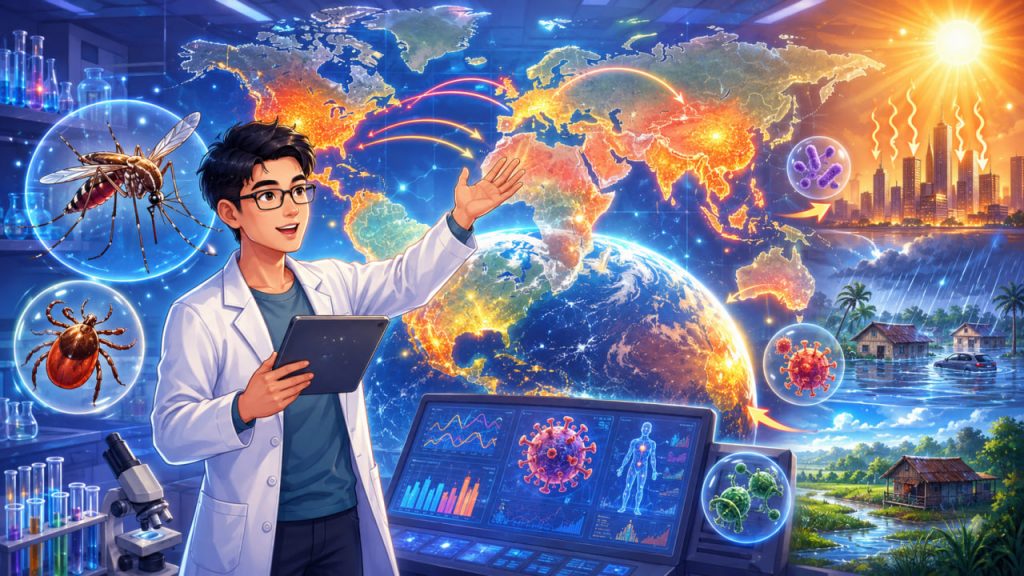
Global warming is usually discussed through heatwaves, melting glaciers, droughts, wildfires, and rising sea levels. But climate change also affects something much closer to everyday life: the spread of infectious diseases.
As temperatures rise and weather patterns shift, mosquitoes, ticks, bacteria, viruses, and waterborne pathogens can behave differently. Some disease-carrying insects expand into new regions. Warmer seasons can last longer. Floods may contaminate drinking water. Droughts can concentrate people and animals around limited water sources, increasing contact and infection risks.
Climate change does not create every epidemic by itself. Disease outbreaks are shaped by many factors, including sanitation, vaccination, healthcare access, urban planning, poverty, travel, and public health systems. However, warming can change the conditions that allow infections to spread, making some outbreaks more likely, longer-lasting, or harder to control.
How Warming Changes Disease Patterns
Infectious diseases depend on relationships between pathogens, hosts, vectors, and the environment.
Climate affects many parts of this chain, including:
- Temperature
- Humidity
- Rainfall
- Flooding
- Drought
- Seasonal length
- Animal migration
- Human displacement
When these conditions change, disease risks can shift as well.
For example, warmer temperatures may allow mosquitoes to survive in regions where winters were previously too cold. Heavy rainfall can create stagnant water where mosquitoes breed. Flooding can spread sewage into water supplies.
Climate change does not act alone, but it can amplify existing disease risks.
Mosquito-Borne Diseases May Expand
Mosquitoes are among the most climate-sensitive disease vectors.
The CDC notes that climate is one factor affecting vector-borne diseases, including illnesses spread by mosquitoes, ticks, and fleas. Warmer weather, along with lifestyle and healthcare access, can increase risk for vector-borne infections.
Important mosquito-borne diseases include:
- Malaria
- Dengue fever
- Zika virus
- Chikungunya
- West Nile virus
- Yellow fever
Temperature influences mosquito survival, biting frequency, reproduction, and the speed at which pathogens develop inside mosquitoes.
However, extreme heat can also reduce mosquito survival in some settings. This is why disease risk does not simply rise everywhere equally.
The biggest concern is not only more mosquitoes, but mosquitoes appearing in new places and active seasons lasting longer.
Dengue Fever and a Warmer World
Dengue is one of the most important climate-sensitive diseases.
It is transmitted mainly by Aedes mosquitoes, which thrive in warm urban environments and breed in small containers of standing water.
Warmer temperatures can shorten the time needed for dengue virus to develop inside mosquitoes, potentially increasing transmission.
Urbanization, poor drainage, water storage practices, and international travel also contribute strongly to dengue spread.
This is why climate action must be paired with mosquito control, better housing, surveillance, and public education.
Dengue shows how climate, cities, and public health systems interact.
Malaria: A Disease Shaped by Climate and Society
Malaria is transmitted by Anopheles mosquitoes.
The World Health Organization reports that vector-borne diseases account for more than 17% of all infectious diseases and cause more than 700,000 deaths annually. WHO also reports that malaria causes hundreds of millions of cases each year, with most deaths occurring among young children.
Climate influences malaria risk by affecting mosquito habitat, parasite development, and seasonal transmission.
Warming may increase malaria suitability in some highland and temperate regions. At the same time, strong public health systems, insecticide-treated nets, medicines, and mosquito control can reduce malaria even in suitable climates.
Malaria risk depends on both climate conditions and the strength of disease prevention programs.
Ticks Are Moving Too
Ticks are another major concern.
Warmer winters and longer warm seasons can help some tick populations survive and expand.
Tick-borne diseases include:
- Lyme disease
- Tick-borne encephalitis
- Anaplasmosis
- Babesiosis
- Rocky Mountain spotted fever
Changes in temperature, humidity, vegetation, and animal hosts all influence tick distribution.
As people spend more time outdoors in expanding tick habitats, exposure risk can increase.
A changing climate can redraw the map of tick-borne disease risk.
Floods and Waterborne Diseases
Warming increases the likelihood of heavier rainfall in many regions because warmer air can hold more moisture.
Floods can damage sanitation systems, overwhelm sewage infrastructure, and contaminate drinking water.
This may increase risks of:
- Cholera
- Diarrheal diseases
- Leptospirosis
- Gastrointestinal infections
- Skin infections
- Hepatitis A in some settings
A review on climate change and waterborne diseases notes that evidence suggests climate change may alter the incidence of waterborne diseases, especially diarrheal illnesses.
The highest risks often occur where water treatment, sanitation, and healthcare systems are weak.
Clean water infrastructure is one of the strongest defenses against climate-related infection risks.
Heat, Food Safety, and Bacterial Growth
Higher temperatures can also affect foodborne illness.
Many bacteria grow faster in warm conditions.
Examples include:
- Salmonella
- Campylobacter
- Vibrio bacteria
- Certain toxin-producing bacteria
Warmer weather can increase risk when food is stored, transported, or prepared improperly.
Rising sea surface temperatures may also influence Vibrio bacteria in coastal waters, which can cause gastrointestinal illness or wound infections.
Food safety becomes especially important during heatwaves and power outages, when refrigeration may fail.
As temperatures rise, safe food storage becomes even more important.
Climate Change and Zoonotic Diseases
Zoonotic diseases are infections that spread between animals and humans.
Climate change can alter animal habitats, migration routes, food availability, and contact between wildlife, livestock, and people.
A scientific review on zoonotic infectious diseases notes that disease ecology constantly changes in response to environmental shifts and that vector-borne pathogens are changing especially rapidly with climate change.
However, zoonotic outbreaks are complex. Land use change, deforestation, wildlife trade, farming practices, and human settlement patterns often play major roles.
Climate change is one part of a larger ecological disruption that can influence spillover risks.
Expert Perspective
The World Health Organization recognizes climate change as a major threat to human health and projects additional yearly deaths in the 2030s from climate-sensitive health impacts, including diseases such as malaria.
Climate scientist and public health expert Dr. Jonathan Patz, known for his work on climate change and health, has long emphasized that warming affects infectious disease risk through multiple pathways: vector ranges, water safety, food systems, extreme weather, and social vulnerability.
This expert perspective is important because it avoids oversimplification. Climate change does not automatically cause every epidemic, but it changes the background conditions in which epidemics emerge and spread.
How Public Health Can Adapt
The good news is that societies are not helpless.
Effective adaptation includes:
- Strong disease surveillance
- Mosquito and tick control
- Vaccination where available
- Clean water systems
- Climate-resilient healthcare
- Early warning systems
- Better housing and sanitation
- Public education
- Rapid outbreak response
Preparedness matters.
Countries with strong public health infrastructure can reduce disease risks even under challenging climate conditions.
The future burden of climate-sensitive diseases will depend not only on warming, but also on how well societies prepare.
Why Prevention Matters Now
Climate change increases uncertainty.
Some regions may face new diseases. Others may experience longer transmission seasons. Some places may see reduced risk for specific pathogens but increased risk for others.
This complexity makes prevention essential.
Reducing greenhouse gas emissions helps limit long-term warming. Strengthening healthcare systems helps protect people from current and future outbreaks.
Climate action and public health preparedness are two sides of the same protection strategy.
Interesting Facts
- Vector-borne diseases account for more than 17% of all infectious diseases worldwide.
- Mosquitoes are affected by temperature, rainfall, humidity, breeding sites, and human behavior.
- Some disease vectors can expand into higher altitudes or more northern regions as temperatures rise.
- Flooding can increase infection risks by contaminating water supplies and damaging sanitation systems.
- Warmer coastal waters can support some bacteria that cause foodborne or wound infections.
- Climate change can lengthen the active season for some mosquitoes and ticks.
- Strong public health systems can greatly reduce disease risk even where climate conditions become more favorable for transmission.
Glossary
- Epidemic – A sudden increase in disease cases above what is normally expected in a population or region.
- Vector-Borne Disease – An illness spread by organisms such as mosquitoes, ticks, or fleas.
- Vector – A living organism that transmits a pathogen from one host to another.
- Pathogen – A microorganism, such as a virus, bacterium, or parasite, that can cause disease.
- Zoonotic Disease – A disease that can spread between animals and humans.
- Malaria – A mosquito-borne parasitic disease transmitted by Anopheles mosquitoes.
- Dengue Fever – A viral disease transmitted mainly by Aedes mosquitoes.
- Waterborne Disease – An illness caused by pathogens transmitted through contaminated water.