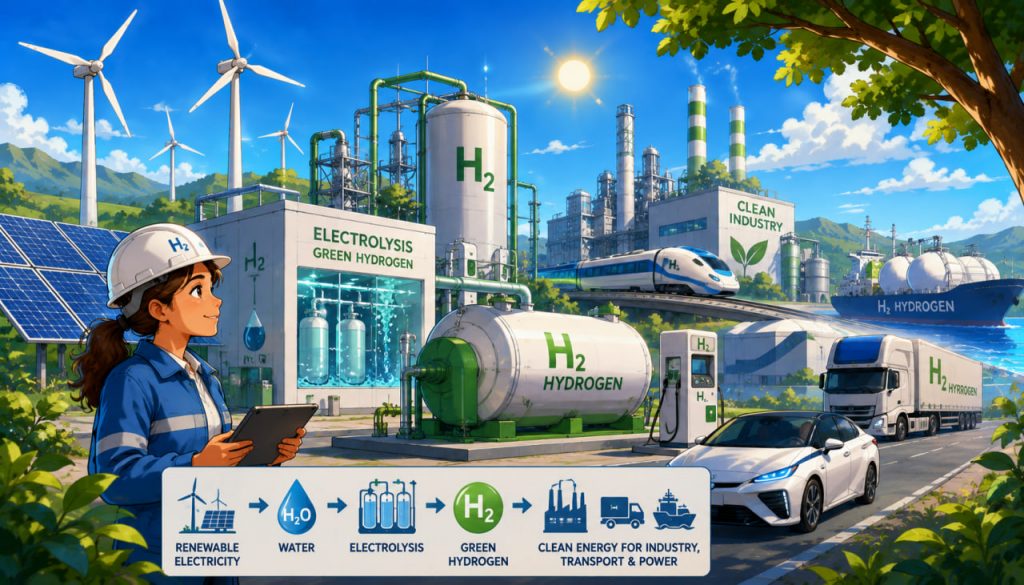
Hydrogen is often presented as the fuel of the future. It can power fuel cells, store renewable electricity, support cleaner steel production, and replace fossil fuels in selected industrial processes.
However, hydrogen is not a naturally available primary energy source like sunlight or wind. It must first be produced using energy from another source. Hydrogen is better understood as an energy carrier: a substance used to store, transport, and deliver energy.
Its environmental value therefore depends on how it is produced, transported, and ultimately used. Hydrogen made with renewable electricity can have a much smaller carbon footprint than hydrogen produced from unabated natural gas or coal.
How Hydrogen Stores and Releases Energy
Hydrogen is the lightest chemical element. On Earth, it is usually bound inside compounds such as water, natural gas, and biomass rather than found freely as hydrogen gas.
Energy is required to separate it from these compounds.
Once produced, hydrogen can release its stored energy in two main ways:
- It can be burned in an engine, furnace, or turbine.
- It can react with oxygen inside a fuel cell to generate electricity.
A hydrogen fuel cell produces electricity electrochemically, with water and heat as the main products at the point of use.
Clean exhaust does not automatically mean clean energy. Emissions created during hydrogen production must also be included.
The Different “Colours” of Hydrogen
Hydrogen itself is colourless. Terms such as green, grey, and blue describe production pathways rather than different physical forms of the gas.
Grey hydrogen is generally produced from natural gas without capturing the resulting carbon dioxide.
Black or brown hydrogen is produced from coal and is typically highly emissions-intensive.
Blue hydrogen is made from fossil fuels while capturing and storing part of the carbon dioxide. Its climate performance depends on capture rates, methane leakage, and the energy used by the process.
Green hydrogen is produced through water electrolysis using renewable electricity.
Pink hydrogen usually refers to hydrogen produced using nuclear electricity.
The labels are convenient, but lifecycle emissions are more informative than colour alone.
How Green Hydrogen Is Produced
Electrolysis uses electricity to split water into hydrogen and oxygen inside a device called an electrolyzer.
When the electricity comes from wind, solar, hydropower, geothermal, or another low-emissions source, the resulting hydrogen can have a relatively low carbon footprint.
The main electrolyzer technologies include:
- Alkaline electrolyzers
- Proton-exchange membrane electrolyzers
- Solid-oxide electrolyzers
Each has different costs, operating temperatures, material requirements, and abilities to respond to changing electricity supply.
Electricity is usually the largest cost component in renewable hydrogen production. Regions with abundant, inexpensive renewable power therefore have an important advantage.
Why Hydrogen Is Attractive for Renewable Energy
Solar and wind output varies with weather and time of day. Electrolyzers can use surplus renewable electricity to produce hydrogen when generation exceeds immediate demand.
That hydrogen can then be stored and used later for industrial heat, fuel production, or electricity generation.
Hydrogen may be especially valuable for:
- Long-duration or seasonal energy storage
- Remote industrial facilities
- Backup power
- Balancing renewable-heavy energy systems
- Transporting renewable energy between regions
Fuel cells and reversible systems can convert hydrogen back into electricity, although every conversion introduces energy losses.
Hydrogen storage is most compelling when batteries, direct grid connections, or other simpler options cannot meet the required duration or scale.
The Best Use May Be Heavy Industry
Hydrogen is already widely used in oil refining and chemical production, particularly for ammonia and fertilizers. Most existing hydrogen is still produced from fossil fuels.
Low-emissions hydrogen could replace conventional hydrogen in these established markets. It may also help decarbonize industries where direct electrification is difficult.
Promising applications include:
- Low-carbon steel production
- Ammonia and fertilizer manufacturing
- Methanol and chemical production
- High-temperature industrial processes
- Synthetic aviation and shipping fuels
Steelmaking is particularly important. Hydrogen can replace coal in certain direct-reduction processes by removing oxygen from iron ore without creating carbon dioxide from the reduction reaction.
Replacing today’s fossil-based industrial hydrogen is generally a more immediate opportunity than creating completely new consumer markets.
Cars, Trucks, Ships, and Aircraft
Hydrogen fuel-cell vehicles can be refuelled quickly and may offer long range. They are being explored for buses, heavy trucks, trains, forklifts, and other vehicles with demanding duty cycles.
For ordinary passenger cars, battery-electric vehicles often have an efficiency advantage because electricity travels more directly from the grid to the wheels. Hydrogen vehicles require electricity to produce hydrogen, energy to compress or liquefy it, transportation, and conversion back into electricity inside the vehicle.
Hydrogen may prove more useful in sectors where batteries become too heavy, charging time is operationally difficult, or very long range is necessary.
Shipping and aviation may use hydrogen indirectly through ammonia, methanol, or synthetic hydrocarbons rather than storing pure hydrogen onboard.
The Efficiency Challenge
Producing hydrogen and later converting it back into useful energy involves several stages.
Energy may be lost during:
- Electrolysis
- Compression or liquefaction
- Storage
- Transportation
- Fuel-cell or turbine conversion
Using renewable electricity directly in an electric motor, heat pump, or industrial process is usually more efficient when technically practical.
This leads to an important rule: electrify directly where possible, and use hydrogen where direct electrification is unusually difficult.
Hydrogen should not be viewed as a universal replacement for electricity, natural gas, petrol, and batteries simultaneously.
Storage and Transportation Are Difficult
Hydrogen has high energy content by weight but very low energy density by volume.
It must often be:
- Compressed to high pressure
- Cooled into a liquid at extremely low temperatures
- Converted into ammonia or another carrier
- Stored inside specialized materials
Hydrogen molecules are extremely small and can escape through seals or affect certain metals. Pipelines, tanks, valves, compressors, and sensors must therefore be designed specifically for safe hydrogen service.
Ammonia is easier to transport than pure hydrogen in some situations, but it is toxic and requires additional conversion or direct-use technologies.
Infrastructure remains one of the main barriers to large-scale deployment.
Safety: Flammable but Manageable
Hydrogen is highly flammable and can ignite across a wide range of concentrations in air. Its flame may also be difficult to see.
At the same time, hydrogen is not uniquely impossible to manage. Petrol, natural gas, batteries, and ammonia also require specialized safety systems.
Safe hydrogen facilities use:
- Leak detectors
- Effective ventilation
- Pressure-relief systems
- Flame detection
- Suitable materials
- Controlled ignition sources
- Staff training
- Emergency procedures
Because hydrogen rises and disperses rapidly outdoors, its behaviour differs from heavier fuels. Safety design must account for the actual environment rather than treating every fuel identically.
The Market in 2026
Global hydrogen production remains dominated by unabated fossil fuels. Low-emissions production reached almost one million tonnes in 2025 and is expected to exceed 1% of worldwide hydrogen production in 2026.
Investment is growing, but the sector has developed more slowly than earlier optimistic forecasts suggested. Capital spending on low-emissions hydrogen projects reached nearly $7 billion in 2025 and could approach $10 billion in 2026, with electrolysis receiving the majority of that investment.
Announced projects frequently face delays caused by high costs, uncertain customers, infrastructure shortages, financing difficulties, and changing policy support.
Expert Perspective
The International Energy Agency sees low-emissions hydrogen as important for industrial decarbonization and energy security, while warning that deployment remains limited relative to total hydrogen demand. Low-emissions hydrogen represented less than 1% of worldwide use in 2024.
The U.S. Department of Energy likewise describes hydrogen as a flexible energy carrier rather than a primary energy source. Its benefits depend on the resources used for production and the application in which it replaces another fuel.
The specialist view is increasingly selective: hydrogen can be essential in hard-to-electrify sectors, but using it everywhere would waste energy and infrastructure.
Interesting Facts
- Hydrogen is the most abundant element in the universe, but free hydrogen gas is uncommon on Earth.
- Fuel cells generate electricity without conventional combustion.
- Electrolysis produces oxygen as well as hydrogen.
- Renewable electricity is usually the largest cost component of green hydrogen.
- Low-emissions hydrogen was expected to exceed 1% of global production for the first time in 2026.
- Hydrogen can be converted into ammonia, methanol, and synthetic fuels.
- Liquid hydrogen must be stored at extremely low temperatures.
- Most hydrogen used today serves industrial processes rather than transportation.
Glossary
- Hydrogen — A light chemical element that can store and deliver energy after being separated from other compounds.
- Energy Carrier — A substance or system used to transport or store energy produced elsewhere.
- Electrolysis — The use of electricity to split water into hydrogen and oxygen.
- Electrolyzer — Equipment in which electrolysis takes place.
- Fuel Cell — A device that converts hydrogen and oxygen into electricity, water, and heat.
- Green Hydrogen — Hydrogen produced through electrolysis using renewable electricity.
- Blue Hydrogen — Fossil-based hydrogen produced with carbon-capture technology.
- Lifecycle Emissions — All emissions associated with production, transport, use, and disposal.
- Ammonia — A compound of nitrogen and hydrogen used in fertilizers and considered a possible hydrogen carrier.
- Direct Electrification — Using electricity directly instead of converting it into another fuel first.
- Hard-to-Electrify Sector — An industry or transport activity where direct use of electricity is technically or economically difficult.