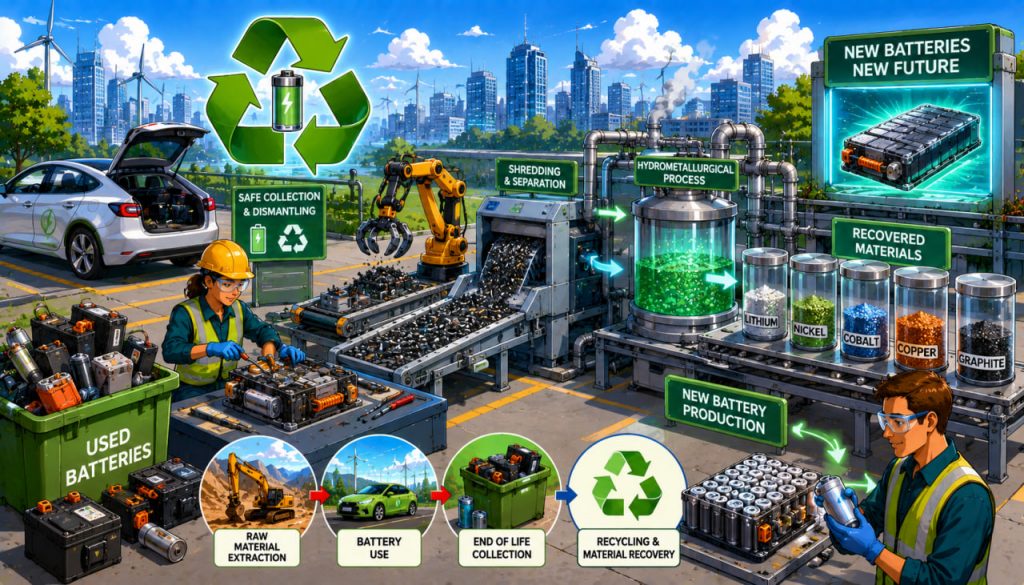
Lithium-ion batteries power smartphones, laptops, electric vehicles, power tools, and renewable-energy storage systems. Their rapid expansion has created a new industrial challenge: what happens when millions of battery packs become damaged, outdated, or unable to hold enough charge?
Discarding them is dangerous and wasteful. Used batteries may contain valuable lithium, nickel, cobalt, copper, graphite, aluminium, and steel. When properly recovered, these materials can return to battery manufacturing instead of being lost in landfills or replaced entirely by newly mined resources.
End-of-life batteries are becoming a strategic mineral reserve hidden inside cities, vehicles, warehouses, and electronic waste. That is why battery recycling is increasingly described as urban mining—or even a new gold mine.
Why Lithium Batteries Cannot Go Into Ordinary Waste
Lithium-ion batteries can retain considerable electrical energy after a device stops working. Crushing, puncturing, overheating, or short-circuiting them may trigger thermal runaway, a chain reaction that releases intense heat and can cause fire.
This creates risks in household bins, garbage trucks, sorting facilities, warehouses, and recycling plants. A small battery concealed inside a discarded electronic device may be damaged by compacting or shredding equipment.
Batteries also contain materials that should not be released into soil or water. Although lithium-ion chemistry varies, cells may include flammable electrolytes and compounds containing nickel, cobalt, manganese, iron, phosphorus, or other substances.
Safe collection is the first and often most difficult stage of battery recycling.
Consumers should use authorized collection points rather than placing rechargeable batteries in mixed household waste. Damaged, swollen, leaking, or unusually hot batteries require especially careful handling.
Why Used Batteries Are Becoming So Valuable
The global battery market has expanded extraordinarily quickly. According to the International Energy Agency, lithium-ion battery deployment across all applications increased more than sixfold between 2020 and 2025. Electric vehicles and stationary storage systems together account for approximately 90% of the market.
This growth is increasing demand for lithium, graphite, nickel, cobalt, and other battery materials. Lithium was included on the final 2025 United States list of critical minerals because of its importance to rechargeable batteries and concerns surrounding secure supply.
Recycling can reduce dependence on new mines and geographically concentrated processing industries. The IEA estimates that scaling up critical-mineral recycling could reduce the need for new mining supply by 25% to 40% by the middle of the century under an ambitious circular-economy pathway.
This does not mean mining will disappear. Battery demand is growing too quickly for recycled materials to meet every requirement in the near term. However, each tonne recovered from old batteries can become part of a more secure secondary supply chain.
What Happens Inside a Battery Recycling Facility?
The recycling process begins with identification, discharge, sorting, and safe dismantling.
Large electric-vehicle packs may be opened into modules and cells. The batteries are then mechanically processed, often inside controlled environments designed to limit fire and exposure risks.
Shredding and separation produce a concentrated powder called black mass. It may contain lithium, nickel, cobalt, manganese, graphite, and other active materials from the battery electrodes.
Recyclers then use one or more processing methods to recover individual materials.
Pyrometallurgical Recycling
Pyrometallurgy uses high-temperature furnaces to melt battery materials.
It is robust and can process mixed feedstocks, but it requires substantial energy. Metals such as cobalt, nickel, and copper can be recovered effectively, while lithium and aluminium may enter slag and require additional processing.
The main advantages are operational simplicity and the ability to handle batteries with different chemistries. Its disadvantages include high energy use, emissions-control requirements, and possible loss of lower-value materials.
Hydrometallurgical Recycling
Hydrometallurgy uses liquid chemical solutions to dissolve and separate metals.
After batteries are shredded, black mass is treated with acids or other reagents. Lithium, nickel, cobalt, and manganese can then be precipitated or extracted as purified compounds.
This method generally operates at lower temperatures than smelting and can achieve high recovery rates. However, it requires careful management of chemicals, wastewater, and multiple purification stages.
Many modern recycling plants combine mechanical processing with hydrometallurgy to recover battery-grade materials.
Direct Recycling: Preserving More of the Battery’s Value
Direct recycling aims to recover cathode or anode materials without breaking them completely into individual chemical elements.
Instead of destroying the original structure and rebuilding it from purified metals, recyclers attempt to restore the material so it can be used again in a battery.
The U.S. ReCell research programme has explored direct cathode recycling because preserving the engineered structure may reduce energy consumption, processing steps, and overall cost compared with conventional recovery routes.
Direct recycling is promising, but it requires accurate sorting. Materials from different battery chemistries cannot always be mixed without reducing the quality of the recovered product.
Battery Chemistry Is Changing the Economics
Not every lithium-ion battery contains the same materials.
Nickel-manganese-cobalt batteries can contain valuable nickel and cobalt. Lithium iron phosphate batteries contain no nickel or cobalt, making them cheaper and often safer, but potentially less profitable to recycle through traditional business models.
As lithium iron phosphate batteries gain market share, recyclers must recover value from lithium, graphite, copper, aluminium, and complete electrode materials rather than depending mainly on cobalt.
This creates an important challenge: battery recycling must remain economically viable even when the safest and most popular chemistries contain fewer expensive metals.
Designing batteries for easier disassembly, identification, and material recovery could make an enormous difference.
The Supply Problem Comes Before the Waste Wave
Battery recycling plants need a steady flow of material, but most electric vehicles sold in recent years have not yet reached the end of their useful lives.
For now, manufacturing scrap remains a major source of recycling feedstock. The IEA projects that factory scrap will still represent about two-thirds of available battery-recycling material in 2030. End-of-life electric-vehicle and storage batteries are expected to become the dominant source after 2035 and exceed 90% of available feedstock by 2050.
This timing mismatch can create temporary overcapacity. Recycling factories may be built before enough retired batteries are available locally.
At the same time, waiting too long could leave countries unprepared when the first enormous wave of electric-vehicle batteries reaches retirement.
Can Electric-Vehicle Batteries Be Reused First?
A battery removed from an electric vehicle may still retain enough capacity for less demanding applications.
After testing and safety assessment, suitable packs may be repurposed for:
- Solar-energy storage
- Commercial backup power
- Microgrids
- Low-speed vehicles
- Off-grid buildings
- Electricity-demand management
Second-life use can delay recycling and extract additional value from the battery. However, not every pack is suitable. Differences in age, chemistry, damage, software, and cell condition can make testing and integration expensive.
Reuse should therefore be treated as one stage in the battery lifecycle, not an alternative to eventual recycling.
New Regulations Are Creating a Circular Market
Europe is introducing some of the world’s most detailed battery-recycling requirements.
EU rules establish a lithium-based battery recycling-efficiency target of 65% by the end of 2025, with higher requirements planned for 2030. They also set material-recovery targets of 50% for lithium by the end of 2027 and 80% by the end of 2031. Recovery targets for cobalt, copper, nickel, and lead rise from 90% in 2027 to 95% in 2031.
The regulation also introduces minimum recycled-content requirements for selected battery materials. By 2031, specified batteries are expected to contain at least 16% recycled cobalt and 6% recycled lithium and nickel, with higher targets scheduled for 2036.
Such rules can create dependable demand for recovered materials and encourage manufacturers to design products with recycling in mind.
Expert Perspective
The International Energy Agency argues that battery recycling is becoming central to mineral security, but emphasizes that the industry needs stronger collection systems, traceability, processing capacity, and markets for recycled materials. Its analysis also shows that China is expected to retain more than 70% of global pretreatment and material-recovery capacity toward 2030.
The U.S. Department of Energy is also supporting commercial-scale processing and battery manufacturing projects. It has awarded $1.82 billion to facilities involving lithium, graphite, battery components, and recycled materials.
The expert view is clear: used batteries are not merely waste. They are an emerging industrial resource that requires coordinated collection, safe transport, advanced processing, and product standards.
Is Battery Recycling Really the New Gold Mine?
The comparison is partly justified.
Retired batteries contain strategically important materials concentrated in manufactured products. Recycling them can reduce waste, support domestic industry, lower exposure to supply disruptions, and decrease the environmental pressure associated with new extraction.
Yet the business is not effortless. Collection is expensive, battery designs vary, transport is regulated, fire risk is real, and commodity prices can change rapidly.
The real gold is not lithium alone. It is the ability to keep valuable materials circulating through the economy instead of losing them after a single use.
Interesting Facts
- Electric vehicles and stationary storage represent around 90% of current lithium-ion battery demand.
- Battery-manufacturing scrap will remain a major recycling input before large numbers of electric vehicles reach retirement.
- Black mass is not one substance; it is a mixture of valuable electrode materials produced during battery processing.
- Some retired electric-vehicle batteries can serve in stationary storage before being recycled.
- Lithium iron phosphate batteries contain no nickel or cobalt, changing the economics of material recovery.
- EU recovery requirements for lithium are scheduled to rise from 50% in 2027 to 80% in 2031.
- Recycling could reduce future demand for newly mined critical minerals, but it cannot replace primary extraction immediately.
- Direct recycling attempts to preserve valuable electrode structures rather than reducing everything to basic chemicals.
Glossary
- Lithium-Ion Battery — A rechargeable battery in which lithium ions move between positive and negative electrodes.
- Urban Mining — Recovering valuable materials from discarded products, buildings, vehicles, and electronic waste.
- Black Mass — A powdered mixture containing active battery materials after cells are shredded and separated.
- Pyrometallurgy — Recovery of metals through high-temperature processing.
- Hydrometallurgy — Recovery and purification of metals using liquid chemical processes.
- Direct Recycling — Restoring battery electrode materials while preserving much of their original engineered structure.
- Cathode — The positive electrode of a lithium-ion battery during discharge.
- Anode — The negative electrode of a lithium-ion battery during discharge.
- Thermal Runaway — A self-accelerating heating process that can lead to battery fire or explosion.
- Second-Life Battery — A used battery repurposed for a less demanding application before final recycling.
- Circular Economy — A system designed to keep materials and products in use for as long as possible.