Geothermal power has traditionally depended on rare locations where underground heat, permeable rock, and naturally circulating water occur together. Iceland, parts of Italy, Indonesia, Kenya, New Zealand, and the western United States benefit from these conditions, but most regions do not.
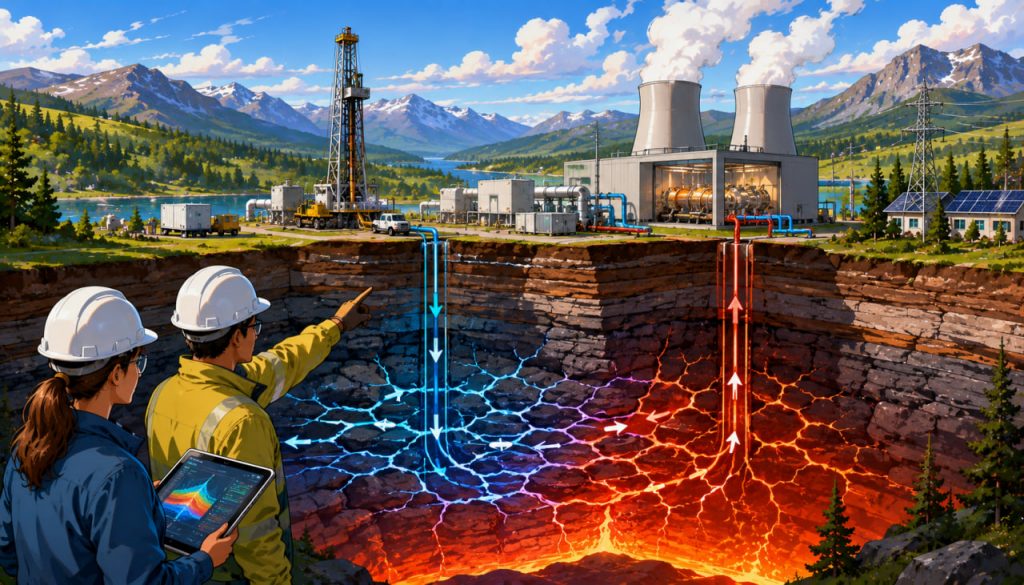
Next-generation geothermal technology aims to remove that geographical limitation. Enhanced geothermal systems, or EGS, use deep drilling and controlled rock stimulation to create underground pathways through which water can circulate, absorb heat, and return to the surface.
The process is sometimes described as rock “fractionation,” but rock fracturing or reservoir stimulation is the more accurate term. It could make geothermal electricity available far beyond volcanic areas, although cost, water use, drilling risk, and induced seismicity remain serious engineering challenges.
How Conventional Geothermal Energy Works
A conventional geothermal power plant uses naturally occurring hot water or steam found in permeable underground formations.
Production wells bring the heated fluid to the surface. Its energy may drive a turbine directly or heat a secondary liquid with a lower boiling point. Afterward, the cooled geothermal fluid is usually returned underground through an injection well.
The difficulty is that naturally suitable reservoirs are uncommon. A location may contain hot rock but lack enough water, connected fractures, or permeability to support commercial energy production.
EGS attempts to engineer the missing reservoir instead of waiting for nature to provide one.
What Is an Enhanced Geothermal System?
An enhanced geothermal system begins by drilling one or more wells into hot rock, often several kilometres below the surface.
Fluid is injected under carefully controlled pressure. This pressure opens existing fractures or creates new pathways in the rock. Water can then circulate between an injection well and one or more production wells.
The returning hot water transfers its heat to a surface power plant before being reinjected.
The U.S. Department of Energy describes EGS as human-made geothermal reservoirs designed to access enormous heat resources where natural permeability or fluid flow is insufficient.
The system does not burn fuel, and the underground heat is available continuously. That gives geothermal power an important advantage over weather-dependent generation.
Is Geothermal Fracturing the Same as Oil and Gas Fracking?
The technologies share several tools, including horizontal drilling, hydraulic stimulation, subsurface imaging, and pressure-controlled injection.
However, their objectives differ.
Oil and gas hydraulic fracturing is designed to release hydrocarbons trapped inside rock. EGS stimulation is designed to create a durable heat-exchange network through which water can circulate.
Geothermal projects also operate under different temperature, pressure, fluid-circulation, and long-term performance requirements. The reservoir must remain sufficiently permeable without allowing the injected water to travel directly to the production well before absorbing enough heat.
EGS has borrowed expertise from the oil and gas industry, but it is not simply a conventional fracking operation connected to a turbine.
Why Horizontal Drilling Changes the Economics
Older geothermal experiments often used widely separated vertical wells. Modern developers increasingly use directional and horizontal drilling to expose a much larger section of hot rock.
A single horizontal well can intersect many fractures. Several parallel wells can create a more controlled underground heat exchanger, similar in layout to modern unconventional oil and gas developments.
This approach may reduce geological uncertainty and improve the amount of heat collected from each drilling site. It also allows multiple wells to share roads, pipelines, electrical equipment, and surface facilities.
The International Energy Agency reports that advanced drilling, reservoir engineering, and subsurface technologies are helping developers reach deeper and previously inaccessible geothermal resources.
Why EGS Could Be a Major Energy Innovation
Geothermal plants can operate day and night, regardless of wind or cloud cover. They can therefore provide firm electricity that complements solar and wind power.
The IEA estimates that the technical electricity potential of next-generation geothermal systems is second only to solar photovoltaic energy among renewable technologies. Its theoretical resource base is far greater than current global electricity demand, although only a fraction will become technically and economically accessible.
Potential applications include:
- Continuous electricity generation
- District heating
- Industrial process heat
- Data-centre power
- Green hydrogen production
- Combined renewable microgrids
- Heating for agriculture and greenhouses
Because most equipment is located underground or within a compact surface plant, geothermal facilities can also have a relatively small land footprint.
The Risk of Induced Earthquakes
Injecting fluid into fractured rock changes underground pressure. This can cause existing fractures or faults to move, producing induced seismicity.
Most recorded events around geothermal stimulation are very small. However, larger earthquakes have occurred in connection with some projects. The 2017 magnitude 5.5 earthquake near the Pohang EGS project in South Korea became an important warning about the consequences of stimulating rock near a critically stressed fault.
Risk reduction methods include:
- Detailed fault mapping
- Baseline seismic surveys
- Dense monitoring networks
- Gradual injection
- Limits on pressure and flow rate
- Automatic shutdown thresholds
- Real-time traffic-light systems
- Avoiding unsuitable geological structures
Research shows that the amount and rate of injected fluid, local stress conditions, and fault orientation can strongly influence seismic response.
Induced seismicity is manageable at many sites, but it cannot be dismissed or evaluated only after drilling begins.
Water Use and Underground Fluid Loss
EGS generally circulates water in a loop, but the system may not recover every litre that is injected. Some fluid can enter small fractures beyond the main reservoir.
Water demand can become a significant concern in dry regions, especially during initial stimulation. Developers may use treated wastewater, brackish water, or other non-potable sources where technically and environmentally appropriate.
Engineers must also prevent geothermal fluids from contaminating shallow groundwater. Multiple layers of steel casing and cement are used to isolate deep wells from freshwater aquifers.
Long-term monitoring is necessary because high temperature, pressure, minerals, and repeated thermal cycling can gradually damage well components.
Heat Depletion and Thermal Breakthrough
Underground heat is vast, but an individual reservoir can still cool when water is extracted too aggressively.
If fractures connect the injection and production wells too directly, cool injected water may return before absorbing enough heat. This is known as thermal breakthrough.
Reservoir designers must create sufficient fracture surface area while controlling fluid pathways. Computer models estimate how water, heat, stress, and rock chemistry will interact over decades.
Recent research suggests that simplified models can overestimate geothermal performance when they fail to account for interactions between neighbouring fractures.
A successful EGS project therefore requires more than creating cracks. It must create the correct network of fractures.
Why Deep Drilling Is Still Expensive
Drilling is often the largest and riskiest part of a geothermal project.
Rock becomes hotter and may become harder to drill as depth increases. High temperatures can damage electronic sensors, drilling motors, seals, cement, and other equipment.
A developer may spend millions before confirming that a reservoir can deliver enough heat and fluid flow. Faster drilling, improved drill bits, better underground imaging, and reusable well designs could lower this risk.
In February 2026, the U.S. Department of Energy announced up to $171.5 million for next-generation geothermal field tests and resource-confirmation drilling, demonstrating that commercial expansion still requires substantial technical development.
EGS Versus Closed-Loop Geothermal
Not every advanced geothermal system fractures rock.
Closed-loop systems circulate fluid through sealed underground pipes. The working fluid absorbs heat through the pipe walls without flowing directly through fractures.
Closed-loop systems may reduce water loss and induced-seismicity risk, but they can transfer less heat because the fluid has limited contact with the surrounding rock.
EGS offers direct contact with a much larger heated surface. Closed-loop systems offer greater control over the circulating fluid. Different geology and energy needs may favour different designs.
Expert Perspective
The IEA views next-generation geothermal as a potentially transformative source of clean, continuous power. Its January 2026 analysis noted that investment was rising as developers used deeper drilling, induced fractures, and closed-loop technologies to reach previously inaccessible heat.
The U.S. National Laboratory of the Rockies explains that EGS creates or improves permeability by opening existing fractures or producing new ones in low-permeability hot rock.
The expert consensus is that the underground heat resource is not the main limitation. The challenge is accessing it reliably, safely, and at a competitive cost.
Can Rock Fracturing Make Geothermal Available Everywhere?
Not literally everywhere.
Successful projects still require accessible heat, drillable geology, suitable water management, grid connections, regulatory approval, and community support. Some sites will be too deep, too seismically sensitive, or too expensive.
Yet EGS could dramatically widen the geothermal map. In February 2026, the U.S. Energy Information Administration reported that studies had estimated as much as 150 GW of economically viable EGS generation in coming decades under favourable development conditions.
Rock fracturing could turn geothermal from a geographically limited resource into a major source of round-the-clock clean energy—but only where careful engineering proves that the underground reservoir can be controlled.
Interesting Facts
- Enhanced geothermal reservoirs may be created in hot rock that contains little naturally circulating water.
- Horizontal wells allow developers to contact more hot rock from one surface location.
- The same drilling workforce that developed oil and gas fields can transfer many skills to geothermal projects.
- EGS electricity can operate continuously and support grids with large amounts of wind and solar power.
- Most stimulation-related seismic events are too small to be felt, although unsuitable sites can produce more serious events.
- The DOE’s Utah FORGE site is used to test drilling, stimulation, monitoring, and reservoir-management methods for EGS.
- Next-generation geothermal may also provide industrial heat without first converting the energy into electricity.
- A geothermal reservoir must balance high fluid flow with slow thermal decline.
Glossary
- Enhanced Geothermal System — An engineered underground reservoir created or improved to extract heat from rock with insufficient natural permeability.
- Rock Fracturing — The controlled opening or creation of cracks in underground rock.
- Hydraulic Stimulation — Injection of fluid under pressure to improve fluid flow through a reservoir.
- Permeability — The ability of rock to allow liquids or gases to move through it.
- Injection Well — A well used to send cooled water or another fluid underground.
- Production Well — A well that brings heated geothermal fluid back to the surface.
- Induced Seismicity — Earth movement triggered by human activity such as underground fluid injection.
- Thermal Breakthrough — The premature arrival of cooled injected water at a production well.
- Closed-Loop Geothermal System — A system in which fluid circulates through sealed underground pipes without entering the surrounding rock.
- Firm Power — Electricity that can be supplied reliably whenever it is needed.