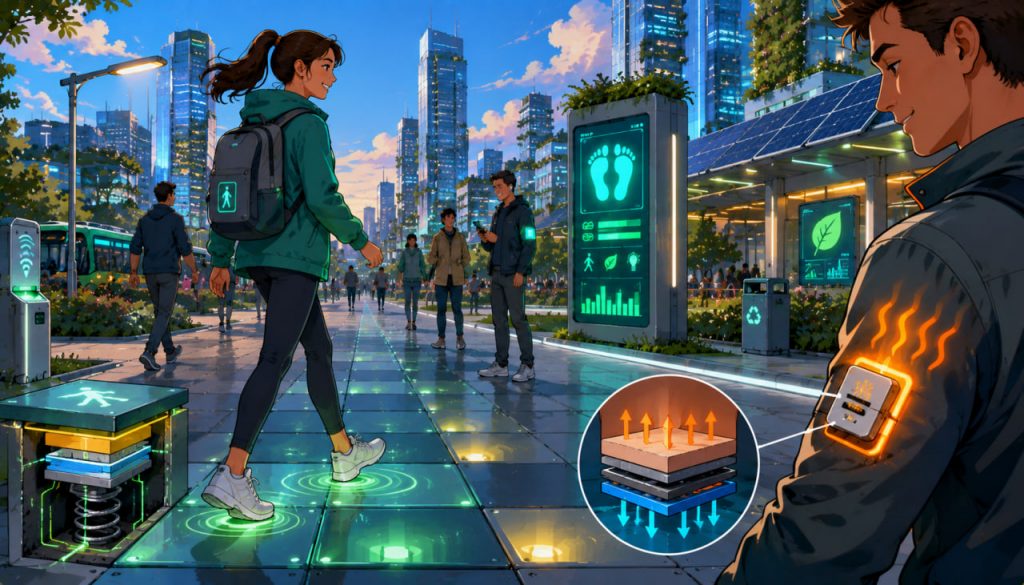
Every day, millions of people walk through railway stations, airports, shopping centres, schools, stadiums, and office buildings. Their footsteps create small amounts of mechanical energy, while their bodies constantly release heat into the surrounding environment.
Smart-city engineers are exploring ways to capture part of this otherwise unused energy. Piezoelectric floors can convert pressure and vibration into electricity, while thermoelectric materials can generate power from the temperature difference between human skin and cooler air.
The idea sounds futuristic: streets powered by pedestrians and wearable devices charged by body heat. The reality is more modest but still valuable. Human energy harvesting will not power entire cities, yet it could operate sensors, lights, displays, and low-power electronics without frequent battery replacement.
How Piezoelectric Energy Harvesting Works
Piezoelectric materials generate an electrical charge when they are compressed, bent, or vibrated.
When someone steps on a piezoelectric floor tile, the pressure slightly deforms the material inside. This mechanical stress separates electrical charges, producing a small voltage. Electronic circuits collect, regulate, and store the energy in a battery or capacitor.
Common piezoelectric materials include ceramics such as lead zirconate titanate, crystals such as quartz, and flexible polymers such as polyvinylidene fluoride.
A single footstep produces only a small amount of usable electricity. However, thousands of footsteps in a busy public space can create a continuous stream of small energy pulses.
The technology works best where pedestrian traffic is dense, predictable, and concentrated within a limited area.
Where Footstep Energy Could Be Useful
Piezoelectric floors are unlikely to supply electricity to nearby apartment buildings. Their most practical role is powering local, low-energy applications.
Potential uses include:
- Pedestrian-counting sensors
- Interactive floor lighting
- Emergency guidance lights
- Wireless environmental sensors
- Digital information displays
- Public transport monitoring
- Building-occupancy systems
- Small advertising installations
A railway entrance or stadium corridor may receive far more footsteps than a quiet residential pavement. Installing energy-harvesting tiles in selected high-traffic zones is therefore more realistic than covering every street.
Research reviews continue to identify piezoelectric harvesters as promising tools for collecting energy from vibration and mechanical movement, particularly for sensors and Internet of Things devices.
The Energy Output Is Smaller Than It Appears
Promotional demonstrations can make a glowing floor tile look as though one footstep produces substantial power. In reality, the energy is often enough to illuminate LEDs briefly but not to operate large equipment continuously.
Part of each step’s mechanical energy is lost through flooring materials, springs, electrical conversion, storage, and control electronics. A tile must also remain comfortable and stable. If it moves too much, pedestrians may find it unpleasant or unsafe.
The total benefit depends on:
- Number of pedestrians
- Pressure applied per step
- Tile design
- Conversion efficiency
- Electronic losses
- Installation location
- Maintenance requirements
Piezoelectric floors are distributed sensor-power systems, not replacements for solar farms, wind turbines, or the electricity grid.
Can Roads Generate Power From Vehicles?
Cars, buses, and trucks apply much greater forces than pedestrians, so roads appear to offer an even larger opportunity.
Piezoelectric devices can theoretically collect energy from pavement deformation and traffic vibration. However, road installations face severe conditions: heavy loads, rain, temperature changes, road salt, dust, repeated impacts, and expensive maintenance closures.
There is also an important energy-accounting issue. If an energy-harvesting surface creates extra resistance or deformation, vehicles may consume slightly more fuel or electricity to cross it. The recovered electricity must exceed these additional losses and the environmental cost of manufacturing the system.
For this reason, traffic monitoring and self-powered roadside sensors may be more realistic applications than large-scale electricity generation.
Turning Body Heat Into Electricity
Body heat requires a different technology.
Thermoelectric generators convert a temperature difference directly into electrical energy through the Seebeck effect. When one side of a thermoelectric material is warm and the other is cooler, charge carriers move and create voltage.
A wearable generator can place its warm side against the skin while exposing the other side to cooler air. It has no moving parts and can generate power even when the wearer is sitting still.
NIST describes thermoelectric effects as the direct conversion between thermal and electrical energy, with applications in waste-heat recovery, remote sensing, electronics, and other energy systems.
Why the Temperature Difference Matters
The body is warm, but the temperature difference between skin and surrounding air is usually small.
A thermoelectric device generally produces more electricity when the temperature difference is larger. It may work better outdoors on a cool day than underneath thick clothing in a warm room.
Heat must also escape from the outer surface. Without effective cooling, both sides of the generator approach the same temperature and power output falls.
This is why researchers are developing flexible heat sinks, breathable fabrics, three-dimensional structures, and materials that maintain close contact with curved skin.
A 2023 study demonstrated a flexible wearable generator capable of powering sensors and Bluetooth communication with a temperature difference of only four kelvins. Another research prototype integrated thermoelectric networks into a jacket and achieved milliwatt-level output during everyday wear.
Self-Powered Wearable Health Sensors
The most promising body-heat applications are devices that already consume very little power.
Examples include:
- Heart-rate sensors
- Skin-temperature monitors
- Hydration sensors
- Motion trackers
- Medical patches
- Location beacons
- Workplace safety monitors
- Smart clothing
NIST research has examined both body heat and human movement as possible energy sources for wearable medical sensors and body-area networks.
A thermoelectric patch might not eliminate the battery entirely. Instead, it could extend battery life, reduce charging frequency, or maintain essential sensing functions when the main battery is low.
Energy harvesting becomes especially valuable when replacing a battery is inconvenient, expensive, or medically undesirable.
New Flexible Thermoelectric Materials
Rigid thermoelectric modules are uncomfortable on moving skin. Modern research therefore focuses on soft, stretchable, washable, and breathable devices.
Scientists are experimenting with silver selenide, bismuth telluride, conductive polymers, carbon materials, ionic thermoelectric cells, and woven structures.
A 2025 Nature Communications study presented a three-dimensional flexible thermoelectric fabric designed to improve both mechanical flexibility and energy generation. In 2026, researchers reported an ultrathin ionic thermoelectric architecture intended to improve performance when only a weak temperature gradient is available.
These advances could eventually place energy-harvesting elements inside wristbands, uniforms, medical clothing, shoes, and protective equipment.
Piezoelectric Shoes and Human Movement
Footsteps can also be harvested directly inside footwear.
Flexible piezoelectric or triboelectric elements placed in insoles can convert bending and pressure into electrical pulses. The output may support step counters, gait-analysis sensors, emergency transmitters, or health-monitoring electronics.
NIST has studied the statistical characteristics of kinetic energy generated by ordinary human movement to help engineers design power-management systems for wearable sensors.
Comfort remains essential. A shoe generator that is heavy, stiff, or inefficient may consume more human effort than its electricity is worth.
The Smart-City Advantage Is Data, Not Megawatts
Cities are installing growing numbers of connected sensors to measure air quality, pedestrian movement, temperature, noise, structural vibration, traffic, and equipment condition.
Replacing millions of small batteries creates labour, waste, and reliability problems. Local energy harvesting could allow some sensors to operate for years with minimal servicing.
A piezoelectric tile could power the sensor that counts its own footsteps. A thermoelectric patch could operate a worker-safety monitor. A bridge vibration harvester could support a structural-health sensor.
The greatest value may come from avoiding cables and battery replacements rather than selling electricity to the grid.
Expert Perspective
A 2025 review of energy-harvesting technologies highlighted piezoelectric systems as versatile options for collecting vibration energy but emphasized that useful deployment requires efficient power management, suitable materials, storage, and careful matching between the harvester and its application.
Research on wearable thermoelectrics reaches a similar conclusion. Body heat can support low-power electronics, but output remains limited by small temperature differences, thermal contact, comfort, durability, and material performance.
Experts do not expect people to become walking power stations. They see human energy harvesting as a practical method for making small connected devices more autonomous.
Are These Technologies Worth the Cost?
They can be worthwhile when electricity demand is low, wiring is difficult, batteries are inconvenient, and the installation also provides useful data or public engagement.
They are less attractive when ordinary grid power or a small solar panel can perform the same task more cheaply.
Smart cities should evaluate the full lifecycle: manufacturing, installation, repair, energy output, battery savings, accessibility, recycling, and durability.
Used selectively, piezoelectric and thermoelectric systems can become valuable pieces of urban infrastructure. Used mainly as decorative technology, they risk costing more energy and money than they recover.
Interesting Facts
- Piezoelectric materials can act as both energy generators and pressure sensors.
- Thermoelectric generators have no turbines, pumps, or other moving mechanical parts.
- Body-heat generators can continue working while a person remains motionless.
- A larger difference between skin and air temperature generally improves thermoelectric output.
- Flexible thermoelectric clothing has already demonstrated milliwatt-level power generation in laboratory research.
- Footstep-powered flooring is most useful in locations with concentrated pedestrian traffic.
- Energy harvesting can extend battery life even when it cannot power a device independently.
- Smart-city sensors often require far less electricity than lamps, motors, or household appliances.
Glossary
- Piezoelectric Effect — The generation of electrical charge when certain materials are compressed or deformed.
- Thermoelectric Generator — A solid-state device that converts a temperature difference into electricity.
- Seebeck Effect — The creation of electrical voltage across a material exposed to a temperature difference.
- Energy Harvesting — Collecting small amounts of energy from movement, heat, light, vibration, or radio waves.
- Internet of Things — A network of connected sensors and devices that collect and exchange data.
- Capacitor — A component that temporarily stores electrical charge.
- Power Management Circuit — Electronics that regulate, combine, and store small or variable electrical outputs.
- Triboelectric Effect — Electrical charge produced when certain materials contact and separate.
- Temperature Gradient — A difference in temperature between two locations.
- Self-Powered Sensor — A sensor that obtains some or all of its operating energy from its surroundings.