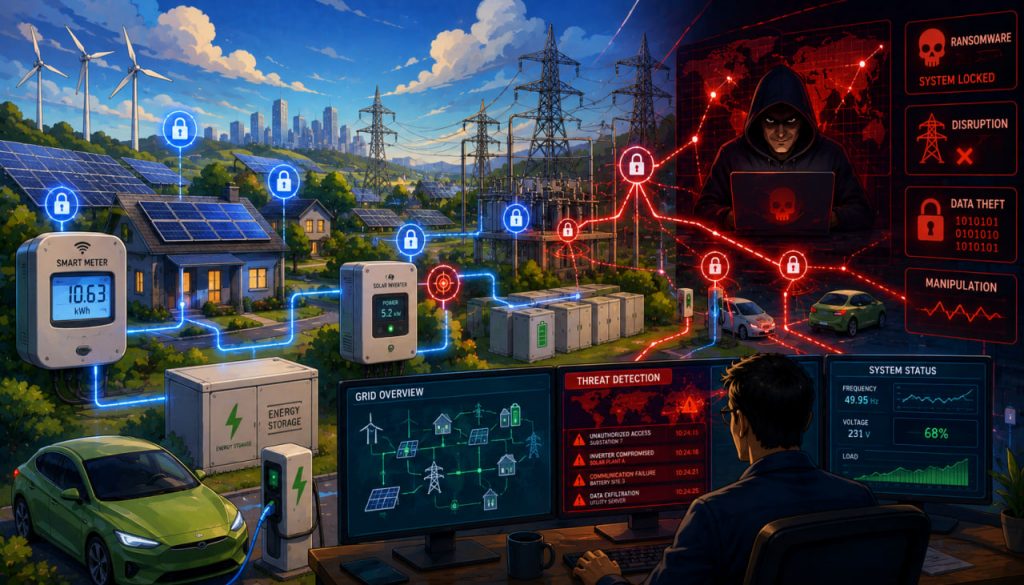
Renewable energy is transforming electricity systems. Solar panels, wind farms, batteries, smart meters, electric vehicles, heat pumps, and virtual power plants can make energy cleaner, more flexible, and more resilient.
They also introduce millions of digitally connected devices into infrastructure that must operate continuously.
A traditional power grid relied mainly on large power stations and one-way electricity flows. A smart grid exchanges electricity and information in both directions, using automated controls to balance generation, consumption, storage, and network conditions.
The same connectivity that makes renewable energy easier to manage can create new opportunities for cyberattack.
What Is a Smart Energy Grid?
A smart grid combines physical electricity infrastructure with communications networks, sensors, software, and automated control systems.
It can monitor voltage, frequency, equipment condition, customer demand, weather, and renewable generation in near real time. Grid operators use this information to match supply with demand and respond to disturbances.
Smart-grid components may include:
- Digital substations
- Smart electricity meters
- Solar and battery inverters
- Wind-turbine controllers
- Electric-vehicle chargers
- Home energy-management systems
- Utility control centres
- Cloud platforms
- Virtual power plants
- Industrial control systems
The US Department of Energy explains that modern grids must accommodate distributed energy resources and two-way flows of both electricity and information. These capabilities improve flexibility but also increase exposure to cyber and physical risks.
Why Renewable Energy Expands the Attack Surface
Large conventional power stations are usually operated by professional organizations with dedicated technical teams and controlled facilities.
Distributed renewable-energy systems are different. Thousands of rooftop solar installations, batteries, chargers, and smart appliances may be connected through home routers, mobile applications, vendor clouds, and third-party aggregators.
Each connected component can become a potential entry point.
Possible weaknesses include:
- Default or reused passwords
- Outdated firmware
- Insecure remote access
- Weak encryption
- Poorly protected cloud accounts
- Vulnerable mobile applications
- Unsupported equipment
- Compromised suppliers
- Insufficient network separation
The Department of Energy warns that the rapid deployment of solar power and other distributed energy resources creates emerging cybersecurity challenges, especially as automated devices become increasingly connected to grid operations.
One vulnerable household inverter is unlikely to destabilize a national grid. Thousands of remotely controlled devices manipulated simultaneously could become a serious operational problem.
How Criminals Could Attack Renewable-Energy Systems
Attackers might target energy infrastructure for money, disruption, espionage, political pressure, or preparation for a future conflict.
They could attempt to steal login credentials through phishing, exploit unpatched software, compromise a remote-maintenance account, or enter through a poorly secured supplier.
Once inside, criminals might:
- Disable renewable generation
- Disconnect batteries or chargers
- Change inverter settings
- Manipulate measurements
- Interrupt communications
- Lock operators out of systems
- Steal customer and operational data
- Demand ransom
- Conceal equipment faults
- Use compromised devices as part of a botnet
The most dangerous attacks would not necessarily destroy equipment immediately. Quiet manipulation of measurements or control signals could confuse operators and delay an effective response.
Smart Inverters Are Both Valuable and Sensitive
Solar panels generate direct-current electricity. Smart inverters convert it into alternating current and help maintain appropriate voltage and frequency.
Modern inverters can also respond to commands from utilities or aggregators. They may adjust active power, provide reactive power, support voltage, or disconnect during unsafe grid conditions.
These capabilities help integrate large amounts of solar electricity. However, compromised settings could cause a group of devices to behave incorrectly.
For example, an attacker controlling a large fleet might disconnect many systems at once or repeatedly change their output. The resulting disturbance could complicate grid balancing and, under unfavorable conditions, contribute to voltage or frequency instability.
NREL research notes that widespread distributed-energy deployment expands the threat landscape toward the grid edge, where cybersecurity protections may be less mature. Its experimental work examines how malicious inverter commands can create transient effects in electrical systems.
Virtual Power Plants Create Concentrated Digital Risk
A virtual power plant connects many small resources—such as home batteries, solar systems, thermostats, and electric vehicles—and operates them as a coordinated fleet.
This can provide valuable grid services without constructing one enormous physical power station.
Yet aggregation also creates concentration risk. Compromising the central platform or a trusted software update could potentially give an attacker influence over thousands of devices.
Security must therefore cover:
- The individual device
- The customer’s local network
- Communication channels
- Cloud infrastructure
- Aggregator software
- Utility interfaces
- Software-update mechanisms
- Identity and access management
A virtual power plant should be designed so that the failure of one platform or account cannot automatically produce uncontrolled behavior across the entire fleet.
Wind Farms and Remote Maintenance
Modern wind turbines contain sensors, controllers, networking equipment, and software for condition monitoring and remote operation.
Remote access helps technicians diagnose faults and reduce maintenance costs, particularly at offshore or geographically isolated wind farms. The same access must be carefully protected.
A compromised maintenance account could allow an intruder to interfere with monitoring, alter settings, or disrupt groups of turbines.
Attackers could also manipulate sensor readings so that operators receive incorrect information about temperature, vibration, wind speed, or equipment condition.
This does not mean that criminals can easily take physical control of every wind turbine. Industrial systems generally include multiple safety layers. However, cybersecurity must operate alongside mechanical protection rather than being treated as a separate office-computer problem.
Smart Meters and Consumer Privacy
Smart meters automatically record electricity consumption and communicate with energy suppliers.
They can support accurate billing, faster outage detection, flexible tariffs, and demand-response programmes. But detailed consumption patterns may reveal when a property is occupied, when appliances are used, and how daily routines change.
Attackers might attempt to:
- Steal customer information
- Manipulate billing records
- Disconnect customers
- Use meters as access points
- Disrupt communication networks
- Commit electricity fraud
ENISA has documented that smart-grid communications increase the potential attack surface and has highlighted earlier incidents involving meter manipulation as an example of the need for stronger device and protocol security.
Privacy protection should include data minimization, encryption, controlled access, secure retention, and clear limits on secondary use.
Batteries and Electric Vehicles Can Affect Grid Stability
Large batteries respond quickly and can help stabilize electricity networks. Electric vehicles may also become flexible grid resources through controlled charging or vehicle-to-grid technology.
However, rapid response creates cyber-physical sensitivity.
A coordinated attack could attempt to make many devices charge simultaneously during peak demand or disconnect at an inconvenient moment. Manipulated charging could overload local distribution equipment or increase electricity costs.
High-power consumer devices are attracting growing attention from European security specialists. A 2025 ENISA-associated forum specifically highlighted demonstrations of how vulnerable high-power Internet-connected equipment could potentially be used to disrupt electricity systems.
Safe systems need local power limits and protective controls that remain effective even when an external platform sends incorrect instructions.
Ransomware Can Disable Energy Operations
Ransomware may not need to communicate directly with turbines or substations to cause disruption.
If attackers encrypt scheduling systems, engineering workstations, customer databases, communication tools, or maintenance records, operators may suspend some activities while investigating whether operational networks are also affected.
An organization can lose visibility and confidence even when physical equipment remains functional.
This is why business IT and operational technology must be separated. A compromised email account should not provide a direct route into equipment controlling electricity.
CISA identifies the energy sector as critical infrastructure and emphasizes resilience across electricity, oil, and natural-gas systems because disruption can affect nearly every other part of society.
The Supply Chain Is a Major Weakness
Renewable-energy equipment may contain hardware, firmware, cloud services, communication modules, and software libraries supplied by numerous companies.
A utility may secure its own network while remaining exposed through:
- A vendor’s remote-support account
- A malicious software update
- Counterfeit components
- An abandoned cloud service
- A vulnerable open-source library
- Poor security at a subcontractor
- Hidden administrative credentials
NREL’s analysis of the distributed-energy digital supply chain identifies gaps across device production, software development, system integration, operation, and end-of-life management.
Manufacturers should provide signed updates, vulnerability-reporting channels, defined support periods, secure default settings, and transparent component inventories.
Cybersecurity by Design
Security cannot be added effectively after millions of devices have already been installed.
Cybersecure renewable-energy systems should include:
- Unique credentials from the factory
- Multifactor authentication
- Encrypted communications
- Digitally signed firmware
- Secure update mechanisms
- Role-based access control
- Network segmentation
- Continuous monitoring
- Reliable event logs
- Safe local operating limits
- Tested recovery procedures
The Department of Energy recommends building distributed-energy systems to be cybersecure by design, making protection part of engineering, procurement, installation, and operation.
NREL has also developed standards, certification approaches, and cybersecurity frameworks for assessing connected distributed-energy resources.
Resilience Requires Safe Failure
Preventing every intrusion is unrealistic. Smart grids must also remain safe when components are compromised or communications disappear.
A resilient device should enter a predictable local mode rather than obeying obviously dangerous commands. Critical systems should continue operating manually when cloud platforms are unavailable.
Important protections include:
- Independent physical safety systems
- Offline configuration backups
- Redundant communications
- Manual operating procedures
- Microgrid islanding capability
- Rapid isolation of compromised equipment
- Regular recovery exercises
CISA recommends resilient-power systems that combine distributed generation, storage, and backup resources, particularly for critical facilities. Properly designed microgrids can maintain essential services during wider grid disruptions.
Renewables can therefore create both vulnerabilities and resilience. The outcome depends on architecture and management.
Expert Perspective
The European Union Agency for Cybersecurity argues that electricity and information-technology specialists must work together. Smart-grid security requires governance, supply-chain management, incident response, continuity planning, personnel training, physical protection, and network security—not merely antivirus software.
US energy laboratories take a similar position. NREL researchers use cyber ranges and simulated power systems to investigate how attacks affect physical grid behavior and to test defenses without placing real infrastructure at risk.
Renewable energy does not inherently make power grids unsafe. Poorly secured digital integration does.
Interesting Facts
- Solar panels themselves are not usually internet-connected; the inverter and monitoring equipment provide most digital functionality.
- A virtual power plant may coordinate thousands of geographically separated devices.
- Smart-grid attacks can target data accuracy rather than directly switching equipment off.
- Batteries can respond to grid commands within fractions of a second.
- One compromised device may be insignificant, while a synchronized fleet can create a much larger disturbance.
- Smart meters can help detect outages but also generate sensitive consumption data.
- Renewable-energy systems may depend on cloud platforms located in another country.
- Equipment can remain mechanically functional even when operators lose digital visibility.
- Microgrids may separate from the wider network and continue supplying local critical loads.
- Signed firmware helps devices verify that an update came from an authorized source.
- Cyber ranges allow researchers to test attacks against realistic simulated grids.
- The safest smart grid combines centralized coordination with reliable local protection.
Glossary
- Cybersecurity — Protection of digital systems, networks, devices, and data from unauthorized access or disruption.
- Renewable Energy — Energy from replenishing sources such as sunlight, wind, water, and geothermal heat.
- Smart Grid — An electricity network using digital communications, sensors, and automated control.
- Distributed Energy Resource — A smaller energy system connected near consumers, such as rooftop solar, a battery, or a controllable charger.
- Attack Surface — All points through which an attacker could attempt to enter or influence a system.
- Smart Inverter — A power-electronic device that converts electricity and provides controllable grid-support functions.
- Virtual Power Plant — A coordinated network of distributed generation, storage, and flexible electrical loads.
- Operational Technology — Hardware and software that monitors or controls physical equipment and processes.
- Industrial Control System — A system used to operate machinery, substations, factories, or infrastructure.
- SCADA — Supervisory control and data acquisition technology used to monitor and control distributed equipment.
- Firmware — Software embedded inside a physical device.
- Ransomware — Malware that blocks access to systems or data and demands payment.
- Network Segmentation — Dividing a network into controlled zones to restrict unauthorized movement.
- Multifactor Authentication — Login security requiring more than one form of verification.
- Cybersecure by Design — An approach that incorporates security from the beginning of product and system development.
- Supply-Chain Attack — Compromise introduced through a vendor, component, software update, or service provider.
- Data Integrity — Assurance that information remains accurate and has not been improperly changed.
- Microgrid — A local electricity network capable of coordinating generation, storage, and consumption.
- Islanding — Operation of a microgrid independently from the wider electricity network.
- Cyber-Physical System — A system in which digital commands directly influence physical equipment or processes.