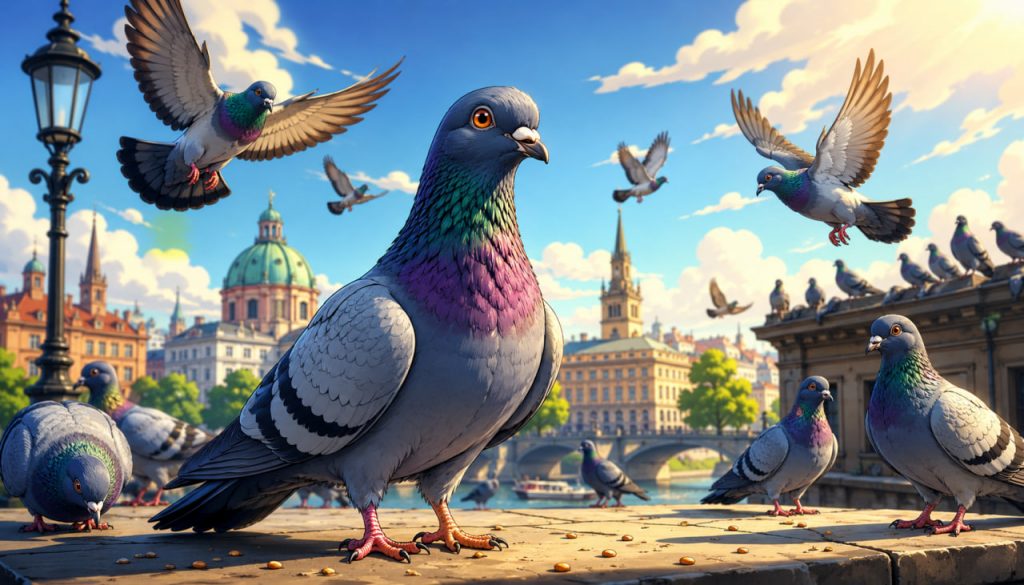
Pigeons are among the most familiar birds on Earth. They gather in city squares, nest on buildings, travel in flocks, and live remarkably close to people. Because they are so common, they are often overlooked or unfairly dismissed as simple urban pests.
In reality, pigeons are intelligent, adaptable birds with impressive visual abilities, strong social behavior, and an extraordinary sense of direction. They have served as messengers, inspired scientific research, and lived alongside humans for thousands of years.
The ordinary city pigeon is not a separate urban species. It is generally a feral descendant of domesticated Rock Pigeons.
What Are Pigeons?
Pigeons and doves belong to the bird family Columbidae. The two names do not represent a strict scientific division. Larger species are often called pigeons, while smaller and more delicate-looking species are commonly called doves.
The familiar city pigeon is usually the Rock Pigeon, scientifically known as Columba livia. Wild Rock Pigeons originally nested on cliffs and rocky ledges. Modern buildings provide similar elevated surfaces, sheltered cavities, and flat platforms, making cities highly suitable habitats.
Rock Pigeons typically have compact bodies, small heads, short legs, and pointed wings. The classic form has a bluish-gray body, two dark wing bars, and green or purple iridescence on the neck. However, domestication has produced a wide range of white, brown, black, reddish, and patterned birds.
Why Are Pigeons So Successful in Cities?
Pigeons thrive in urban environments because cities reproduce several features of their ancestral habitat.
Tall buildings resemble cliffs. Window ledges, bridges, roofs, ventilation spaces, and abandoned structures provide nesting opportunities. Public squares and railway stations offer open areas where pigeons can gather and watch for danger.
Food is another major advantage. Wild Rock Pigeons mainly eat seeds and grains, but urban birds have adapted to consume discarded human food and deliberately offered birdseed. Cornell Lab of Ornithology describes them as a worldwide urban species frequently found around streets, squares, and food sources.
Their flexibility is essential to their success. Pigeons can tolerate human activity, traffic, noise, artificial light, and highly modified landscapes.
They succeed not because cities are easy environments, but because pigeons are exceptionally adaptable.
How Pigeons Navigate
Homing pigeons are famous for returning to their lofts after being transported far away.
Their navigation system does not appear to depend on one single sense. Scientists have investigated several possible sources of information, including:
- The position of the Sun
- Earth’s magnetic field
- Familiar visual landmarks
- Atmospheric odors
- Low-frequency sounds
- Learned routes
Evidence indicates that smell can play an important role in helping homing pigeons determine their location. Birds may learn regional odor patterns and use them as a kind of environmental map. Once closer to home, they can rely more heavily on visible landmarks and familiar routes.
The pigeon hippocampus, a brain region involved in memory and spatial processing, has also received considerable scientific attention. Research suggests that the two sides of the pigeon hippocampal system may contribute differently to navigation and spatial recognition.
Pigeon Intelligence and Learning
Pigeons are valuable subjects in studies of animal cognition.
They have excellent vision and can learn to distinguish between shapes, colors, patterns, objects, and categories. Researchers have used them to investigate memory, attention, decision-making, visual recognition, and reinforcement learning.
Studies suggest that pigeons share some fundamental object-recognition mechanisms with other vertebrates. This makes them useful for comparing how different brains process visual information.
Pigeons can also perform tasks involving numerical differences, visual categories, and relationships between learned stimuli. Scientists continue to debate how closely these abilities resemble human abstract thinking, but the evidence clearly shows that pigeons are capable of sophisticated learning.
A recent study examining performance across several cognitive tasks found evidence supporting a broader structure of cognitive ability in pigeons rather than completely unrelated skills.
A small bird brain is not necessarily a simple brain.
Social Life and Communication
Pigeons are social birds that frequently feed, rest, travel, and avoid predators in groups.
Their most familiar sound is cooing. Males often use repeated coos, bowing movements, inflated neck feathers, and circular walking patterns during courtship. Pigeons also produce quieter sounds around the nest and may use wing noises as part of communication or alarm behavior.
Pairs can form lasting bonds, although their relationships may vary with conditions. Both parents participate in caring for the young.
Newly hatched pigeons are called squabs. Unlike many familiar garden birds, young pigeons remain hidden in the nest until they are relatively large and well feathered. This is one reason people rarely notice baby pigeons in cities.
How Pigeons Feed Their Young
Pigeons produce a nutrient-rich substance commonly called crop milk.
It is not milk in the mammalian sense. It is produced in the crop, a specialized part of the digestive system where food can be temporarily stored.
Both male and female pigeons can produce crop milk and feed it to their chicks. During the first stage of life, squabs depend heavily on this substance before gradually receiving more ordinary food.
This shared parental responsibility helps explain why pigeon pairs can successfully raise young in demanding environments.
Pigeons and Human History
Humans have kept pigeons for food, communication, sport, religious symbolism, and companionship.
Selective breeding produced birds with enhanced homing abilities as well as many ornamental breeds with unusual feathers, colors, body shapes, and flight patterns.
Before modern electronic communication, trained pigeons could carry lightweight messages over long distances. They were particularly valuable when roads, radio systems, or telephone lines were unavailable or damaged.
Military pigeons were used during both World Wars. The Smithsonian records numerous examples of pigeons serving as battlefield messengers under dangerous conditions.
One of the best-known messenger pigeons was Cher Ami, remembered for service during the First World War. Historical research has also shown how stories surrounding famous animals can evolve into a mixture of documented events and public legend.
Are Pigeons Dangerous to People?
Pigeons can carry microorganisms and parasites, but their presence does not automatically create a serious health threat.
Risk is more likely where large quantities of droppings accumulate, particularly in enclosed or poorly ventilated locations. Dried material can become airborne when disturbed, so heavily contaminated areas should be cleaned using appropriate protective procedures.
Direct feeding may cause local populations to grow beyond what an area can support. Concentrated feeding can also increase waste, competition, and conflict with residents.
The most effective urban management usually focuses on reducing food availability, preventing access to nesting spaces, maintaining clean buildings, and using humane population-control methods.
Fear and cruelty are not effective substitutes for proper sanitation and building management.
Pigeons as Part of Urban Ecosystems
Pigeons do not live separately from nature simply because they inhabit cities.
They consume plant material and human food waste. Their eggs, chicks, and adults may become prey for urban raptors, particularly Peregrine Falcons. Their presence therefore influences other species and contributes to the food web.
The Smithsonian has used the relationship among food waste, pigeons, and urban falcons as an example of how cities function as ecosystems rather than biological deserts.
Pigeons also give people an accessible opportunity to observe flocking, courtship, competition, navigation, and predator avoidance without leaving the city.
Expert Perspective
Comparative cognition researcher Thomas Zentall has argued, based substantially on pigeon studies, that several mental processes once considered uniquely human have meaningful parallels in other animals. His work emphasizes that apparently complex performance can emerge in species with very different brain structures.
This does not mean pigeons think exactly like humans. It means their behavior deserves careful scientific study rather than assumptions based on appearance or reputation.
Pigeons demonstrate that intelligence can evolve in multiple forms and operate through very different kinds of brains.
Different Pigeon Species
The urban Rock Pigeon is only one member of a large and varied bird family.
Other examples include wood pigeons, fruit doves, imperial pigeons, crowned pigeons, and the Band-tailed Pigeon of western North America.
Not all pigeons live in cities. Many inhabit forests, mountains, islands, deserts, and coastal regions. Some feed mainly on seeds, while others depend heavily on fruit.
The extinct Passenger Pigeon was once extraordinarily abundant in North America. Intensive hunting and habitat destruction caused its rapid decline, and the last known individual died in 1914. Its loss remains one of the clearest warnings that even an extremely numerous species can disappear.
Interesting Facts
- City pigeons are mainly descendants of domesticated Rock Pigeons.
- Pigeons can use visual landmarks and environmental odors during navigation.
- Both parents produce crop milk for their chicks.
- Young pigeons remain in the nest until they look almost fully grown.
- Pigeons have been widely studied in experiments involving memory and visual learning.
- Their neck feathers can reflect green, purple, and bronze colors depending on the light.
- Trained pigeons carried military messages before modern communication systems became reliable.
- Buildings provide artificial substitutes for the cliffs used by wild Rock Pigeons.
- Some domestic pigeon breeds look dramatically different from their wild ancestors.
- The Passenger Pigeon became extinct despite once existing in enormous numbers.
Glossary
- Pigeon — A bird belonging to the family Columbidae, which also includes birds commonly called doves.
- Rock Pigeon — The species from which most domestic and urban pigeons descended.
- Feral — Describing a domesticated animal or its descendants living independently in the wild.
- Homing Pigeon — A domesticated pigeon selectively bred for its ability to return to its home loft.
- Loft — A structure where domestic pigeons are housed.
- Iridescence — A changing display of color produced when light reflects from microscopic feather structures.
- Crop — A section of a bird’s digestive tract used for temporary food storage.
- Crop Milk — A nutrient-rich substance produced in the crop and fed to young pigeons.
- Squab — A young pigeon, particularly one still in or recently out of the nest.
- Columbidae — The scientific family containing pigeons and doves.
- Hippocampus — A brain region involved in spatial processing, learning, and memory.
- Flocking — The behavior of birds gathering and moving together as a group.
- Urban Ecosystem — A community of organisms interacting with one another and with the human-built environment.
- Selective Breeding — Human-controlled reproduction used to strengthen desired characteristics in animals.