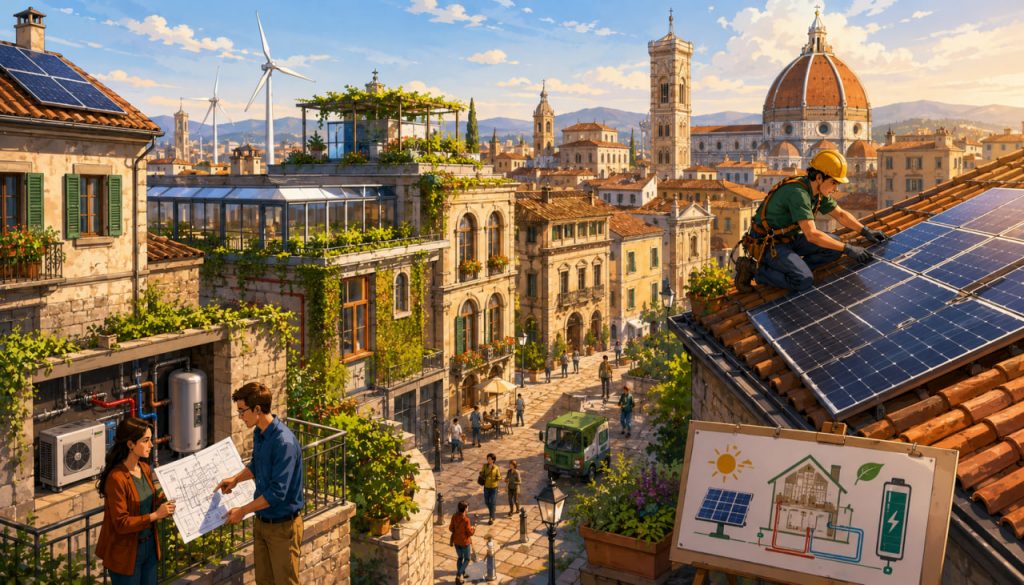
Historic city centres contain centuries of architecture, craftsmanship, cultural memory, and urban identity. They also contain homes, offices, hotels, museums, shops, and public buildings that require electricity, heating, cooling, and modern infrastructure.
This creates a difficult question: how can cities reduce fossil-fuel consumption without covering historic roofs and facades with visually intrusive equipment?
The answer is not to freeze historic districts in time or to install renewable technologies without restraint. Successful integration combines conservation, energy efficiency, sensitive design, modern engineering, and careful urban planning.
Why Historic City Centres Need an Energy Transition
Older districts are sometimes treated as exceptions to climate policy. Yet excluding them entirely can leave large numbers of buildings dependent on gas, oil, or inefficient electrical systems.
Historic buildings may also face rising energy costs, overheating, moisture problems, and greater exposure to extreme weather. If they become uncomfortable or too expensive to operate, they risk abandonment or inappropriate alteration.
UNESCO’s Historic Urban Landscape approach treats heritage districts as living environments rather than isolated monuments. It encourages cities to integrate conservation with social, economic, and environmental development.
Protecting heritage includes keeping historic buildings useful, inhabited, maintainable, and resilient.
Start With Energy Efficiency, Not Solar Panels
Renewable generation should rarely be the first intervention.
Before adding equipment, specialists should investigate where energy is being lost and how the building actually performs. Traditional masonry, timber, lime plaster, roof spaces, windows, ventilation, and moisture behave differently from modern construction.
Useful measures may include:
- Repairing roofs, gutters, windows, and doors
- Reducing uncontrolled drafts
- Improving heating controls
- Adding appropriate roof or floor insulation
- Installing efficient lighting and appliances
- Insulating pipes and hot-water systems
- Using shutters, curtains, and solar shading
- Introducing heat recovery where technically suitable
Historic England emphasizes that good maintenance is fundamental to both preservation and energy performance. Retrofit measures must be assessed carefully because unsuitable insulation or impermeable materials can trap moisture and damage traditional construction.
Reducing demand allows a smaller renewable-energy system to provide a greater share of the remaining energy.
Solar Panels Can Be Hidden Without Becoming Ineffective
Conventional photovoltaic panels are highly visible because of their dark color, reflective surface, regular geometry, and metal framing.
However, visibility can often be reduced through intelligent positioning. Panels may be placed on:
- Rear roof slopes
- Inner courtyard roofs
- Flat roofs hidden behind parapets
- Modern extensions
- Garages and service buildings
- Nearby non-historic structures
- Ground-mounted systems outside important sightlines
Historic England advises examining roof orientation, public visibility, structural loading, reflectivity, color, finish, wiring routes, and the pattern of the proposed array. It also notes that some prominent historic roofs will be unsuitable, while many other heritage buildings can accommodate carefully designed installations.
The most sensitive installation is often not the one with the largest theoretical output, but the one that produces useful energy without damaging the building’s defining character.
Building-Integrated Photovoltaics
Building-integrated photovoltaics, or BIPV, replace ordinary construction elements instead of being mounted visibly above them.
Examples include:
- Solar roof tiles
- Photovoltaic slates
- Colored solar glass
- Electricity-generating skylights
- Solar facade panels
- Photovoltaic canopies
- Semi-transparent solar screens
Solar tiles can imitate the scale and rhythm of traditional roofing more closely than large conventional modules. Colored or textured products may coordinate with clay tiles, slate, copper, zinc, or stone.
However, visual similarity alone is insufficient. Products must also be durable, weatherproof, repairable, fire-safe, and compatible with the historic roof structure.
Research reviewed by ICOMOS highlights that active solar technologies can function as architectural materials while supporting climate goals, provided they respect the building’s typology and historic characteristics.
BIPV currently tends to be more expensive and less easily replaceable than standard panels, so it is most valuable where architectural sensitivity justifies the additional cost.
Solar Energy Does Not Have to Sit on Every Historic Roof
A historic building can consume renewable electricity without generating all of it onsite.
Alternative models include:
- Shared neighborhood solar systems
- Municipal renewable-energy contracts
- Community-owned solar farms
- Panels on schools, warehouses, stations, and car parks
- Renewable electricity purchased through the grid
- Energy communities connecting several local buildings
This allows protected monuments and highly visible roofscapes to remain unchanged while less sensitive sites produce energy for the surrounding district.
UNESCO notes that small-scale solar installations may be located directly on historic buildings or placed nearby, but each project requires contextual planning and usually approval from the relevant heritage authorities.
District-scale planning is often more effective than deciding separately whether every building should have panels.
Heat Pumps in Historic Buildings
Heat pumps can reduce fossil-fuel use by collecting heat from air, ground, water, or waste-energy sources.
Air-source systems are comparatively easy to install, but their outdoor units can create visual, acoustic, and spatial problems in narrow historic streets.
Sensitive locations may include:
- Rear courtyards
- Roof spaces hidden by parapets
- Basements with carefully designed ventilation
- Service alleys
- Existing plant rooms
- Underground technical spaces
Ground-source heat pumps can be less visible after installation, but drilling may threaten archaeology, foundations, underground structures, or historic landscapes.
Historic buildings also need heating systems designed around their fabric. A heat pump works most efficiently with relatively low water temperatures, while some older buildings depend on small radiators operating at high temperatures.
Possible solutions include improving insulation carefully, enlarging radiators, using fan-assisted emitters, or installing shared heat pumps serving several buildings.
District Heating Can Protect Historic Streetscapes
Dense historic centres are strong candidates for district heating because many buildings can share one central energy source.
A network may distribute heat produced from:
- Large heat pumps
- Geothermal energy
- Wastewater
- Data-centre heat
- Solar thermal systems
- Sustainable biomass
- Industrial waste heat
- Thermal storage
Individual buildings then require less visible exterior equipment.
The revised European Energy Efficiency Directive supports the gradual integration of renewable energy and recovered heat into district heating and cooling networks.
The challenge lies beneath the streets. Installing pipes in historic centres can disturb archaeology, old utilities, paving stones, tree roots, and daily business activity. Projects therefore require surveys, archaeological supervision, phased construction, and careful restoration of public spaces.
Small Wind Turbines Are Rarely the Best Choice
Wind turbines are highly dependent on location.
Historic city centres often contain turbulent airflow created by narrow streets, irregular rooflines, towers, and surrounding buildings. Small rooftop turbines may produce much less electricity than expected while introducing vibration, noise, structural loading, and visual disruption.
They may be suitable on certain exposed modern structures or at the edge of a heritage zone, but they are usually less practical than solar power, district energy, or renewable electricity generated outside the centre.
Large wind projects near protected landscapes require assessment of important views, skylines, and the wider setting of heritage sites. UNESCO’s renewable-energy guidance emphasizes evaluating these impacts early rather than after a project has already been designed.
Reversibility Is a Key Conservation Principle
A renewable-energy intervention should ideally be removable without destroying significant historic material.
This principle favors:
- Existing service routes
- Limited drilling
- Reusable fixing systems
- Accessible wiring
- Independent support frames
- Avoidance of decorative stonework
- Documentation of every alteration
Technology changes quickly. A solar module, inverter, battery, or heat pump may be replaced several times during the life of a centuries-old building.
The historic structure should not be permanently sacrificed for equipment with a much shorter service life.
Permissions and Heritage Impact Assessments
Protected buildings and conservation areas usually require special approval before visible renewable-energy equipment can be installed.
Historic England states that photovoltaic installations on listed buildings and scheduled monuments require consent, while projects in conservation areas may also require planning permission. Exact rules differ by country and municipality.
A heritage impact assessment should examine:
- Important views and roofscapes
- Original materials
- Architectural proportions
- Archaeological risk
- Structural capacity
- Reflectivity and glare
- Nighttime appearance
- Maintenance access
- Fire and electrical safety
- Reversibility
Early cooperation among architects, engineers, conservation specialists, planners, owners, and residents is much more effective than presenting heritage authorities with a finished design.
Smart Technology Can Reduce Visible Intervention
Digital controls can improve energy performance without dramatically altering appearance.
Smart systems may adjust heating, cooling, ventilation, lighting, shading, and hot-water production according to occupancy and weather.
Sensors can monitor temperature, humidity, indoor air quality, moisture, and energy consumption. This is especially useful in museums, archives, churches, and traditional masonry buildings, where excessive humidity changes may damage both structures and collections.
The objective should not be to fill historic buildings with unnecessary electronics. It is to use discreet monitoring and control systems to reduce waste while identifying problems before they cause physical damage.
Expert Perspective
UNESCO’s guidance argues that renewable-energy development and heritage protection should not be treated as opposing goals. It recommends early assessment, examination of alternatives, protection of significant views and attributes, and meaningful participation by local communities.
ICOMOS guidance similarly supports a case-by-case approach based on heritage significance, location, scale, materials, visibility, reversibility, and long-term maintenance.
The best projects do not make renewable technology invisible at any cost. They make it architecturally disciplined, technically effective, and appropriate to its cultural setting.
Interesting Facts
- Approximately one-third of World Heritage properties are located in urban areas.
- Solar tiles can replace part of a roof covering rather than being mounted above it.
- Historic buildings can use renewable electricity generated several kilometres away.
- Rear roof slopes may receive almost as much sunlight as more publicly visible surfaces.
- Dark panels are not always the most suitable choice for red-tile or light-stone buildings.
- Traditional shutters can reduce cooling demand without changing a facade’s historic character.
- District heating can remove the need for individual boilers and external heat-pump units.
- Poorly selected insulation can damage historic masonry by trapping moisture.
- Archaeological remains may be more restrictive than the visible architecture when installing underground energy systems.
- Solar glare can affect important views even when panels are located outside a protected site.
- Smart controls may reduce energy use without any visible exterior alteration.
- A reversible installation allows future technology to be upgraded while preserving historic material.
Glossary
- Renewable Energy — Energy obtained from naturally replenishing sources such as sunlight, wind, water, and geothermal heat.
- Historic City Centre — An urban district valued for its architecture, streets, archaeological remains, culture, or historical development.
- Photovoltaics — Technology that converts light directly into electricity.
- Building-Integrated Photovoltaics — Solar components designed to replace conventional roofing, glazing, or facade materials.
- Solar Thermal System — Equipment that uses sunlight to heat water or another fluid.
- Heat Pump — A system that transfers heat from a cooler source to a warmer building or network.
- District Heating — Centralized production and distribution of heat to multiple buildings through a pipe network.
- Heritage Significance — The historical, architectural, archaeological, artistic, or communal value of a place.
- Historic Urban Landscape — A UNESCO approach that treats urban heritage as part of a wider social, environmental, and spatial system.
- Heritage Impact Assessment — Evaluation of how a proposed project may affect culturally significant features.
- Conservation Area — A legally designated district protected for its special architectural or historic character.
- Reversibility — The ability to remove an intervention without permanently damaging important historic material.
- Roofscape — The visual composition created by roofs, towers, chimneys, and other upper parts of buildings.
- Embodied Carbon — Greenhouse gas emissions associated with producing, transporting, constructing, and disposing of materials.
- Thermal Storage — Storage of heat or cold for later use.
- Archaeological Risk — The possibility that construction may damage buried historical remains.
- Reflectivity — The degree to which a surface reflects light.
- Adaptive Reuse — Giving a historic building a new function while retaining its significant character.