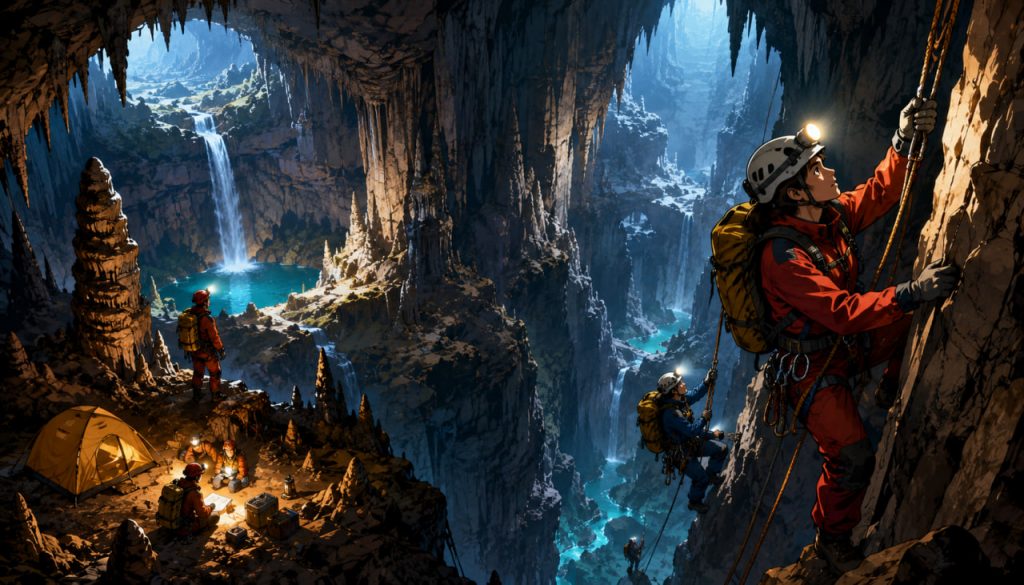
The deepest caves on Earth are not simply holes descending into the ground. They are enormous underground systems containing vertical shafts, flooded passages, waterfalls, narrow tunnels, subterranean rivers, and chambers hidden beneath entire mountain ranges.
Exploring them can require weeks underground, kilometers of rope, diving equipment, permanent camps, and teams capable of surviving darkness, cold, exhaustion, and sudden flooding.
Cave depth is measured as the vertical difference between the highest and lowest surveyed points in a connected natural cave system. This means the deepest cave is not necessarily the one with the longest passage or the largest chamber.
How the World’s Deepest Caves Form
Most extremely deep caves develop in karst landscapes made from soluble rocks such as limestone.
Rainwater absorbs carbon dioxide from the air and soil, becoming weakly acidic. As it enters cracks in limestone, it slowly dissolves the rock and widens fractures into shafts, tunnels, and underground drainage systems.
This process can continue for hundreds of thousands or millions of years. Water generally follows gravity downward until it reaches saturated rock or emerges through springs at a lower elevation.
Mountainous karst regions are especially favorable because they offer a large vertical distance between high entrances and low underground water outlets.
Which Cave Is Currently Considered the Deepest?
Rankings can change when explorers discover new connections or survey teams correct earlier measurements.
A specialist list compiled for the National Speleological Society’s geology and geography community and updated in July 2026 ranks Veryovkina Cave first at approximately 2,212 metres, followed by Krubera-Voronja Cave at about 2,199 metres. The same list includes a major new Mexican system, Palomora–Agua Pajarito, at 2,046 metres.
However, some recent sources use revised measurements that place Krubera slightly ahead. This disagreement reflects changing survey data rather than a completely settled ranking.
The safest description is that Veryovkina and Krubera are the two deepest known cave systems, both exceeding two kilometres in vertical extent.
Veryovkina Cave
Veryovkina Cave lies in the Arabika Massif of the Western Caucasus, in Abkhazia, internationally recognized as part of Georgia.
Its entrance is relatively small, but the system descends through a sequence of shafts, wet passages, chambers, and horizontal tunnels. Explorers took decades to find the route leading into its deepest levels.
In 2018, a team reached a terminal sump more than 2.2 kilometres below the entrance. Reaching the lowest camp required around four days of descent through thousands of metres of ropes and difficult passages.
Veryovkina is also famous for a near-disastrous flood. During a 2018 expedition, heavy rain sent an enormous pulse of water into its lower sections. Cavers abandoned equipment and climbed upward as passages and camps began filling.
This event demonstrated that weather at the surface can become a life-threatening force more than two kilometres underground.
Krubera-Voronja Cave
Krubera Cave is located in the same Arabika Massif as Veryovkina.
For many years, it held the undisputed world depth record. In 2006, it became the first explored cave known to exceed two kilometres in depth.
Krubera contains narrow passages, major vertical drops, underground streams, and flooded sections that require cave diving. It has several entrances, and modern depth estimates depend partly on which connected entrance and submerged endpoint are included.
The cave is also biologically important. Scientists have found highly specialized invertebrates living at extraordinary depths, showing that life can survive in cold, dark environments with extremely limited food.
Sarma Cave
Sarma Cave is another giant system in the Arabika Massif.
Its surveyed depth is approximately 1,830 metres, making it one of the deepest known caves in the world.
Sarma descends through multiple levels connected by shafts and passages. Underground water and submerged areas restrict further exploration, leaving open the possibility that deeper sections remain undiscovered.
The concentration of Veryovkina, Krubera, Sarma, and other major caves in one mountain region is not accidental. The Arabika Massif combines thick limestone, high elevation, heavy precipitation, and deep underground drainage.
Palomora–Agua Pajarito
A major development in the current ranking is the Palomora–Agua Pajarito system in Oaxaca, Mexico.
The July 2026 deep-cave compilation lists it at approximately 2,046 metres, making it the third known cave system to exceed two kilometres in vertical extent.
Its inclusion shows how quickly cave records can change. A connection between previously separate passages or entrances can transform the measured depth of an entire system.
Mexico already contains several exceptionally deep caves, particularly in the limestone mountains of Oaxaca.
Snezhnaya Cave System
The Illyuzia–Mezhonnogo–Snezhnaya system reaches approximately 1,760 metres in depth.
Its name is associated with the large mass of snow and ice found near one of its entrances. Deeper inside, explorers encounter powerful underground waterways and huge chambers.
Unlike a simple vertical shaft, Snezhnaya is a complicated hydrological system. Mapping it requires following water routes, crossing chambers, descending waterfalls, and investigating possible connections between separate entrances.
The Deepest Caves Outside the Caucasus
Europe contains several record-breaking systems beyond Georgia.
Gouffre Mirolda in France exceeds 1,700 metres in depth. Lamprechtsofen in Austria is also more than 1,700 metres deep and is unusual because major parts of it were explored upward from a low entrance.
Sistema Huautla in Mexico reaches approximately 1,560 metres and contains more than 100 kilometres of surveyed passages. It is one of the deepest and most extensive cave systems in the Western Hemisphere.
Sistema Cheve, also in Oaxaca, may have an underground water route with an even greater potential vertical range. Dye-tracing experiments indicate that water entering the system may emerge far below, but explorers have not yet followed a continuous human-accessible passage through the entire distance.
Why Exploring Deep Caves Is So Difficult
Cavers cannot simply descend to the bottom and return in one day.
Deep expeditions may require underground camps stocked with food, fuel, ropes, dry clothing, medical supplies, batteries, and communication equipment.
Major hazards include:
- Sudden flooding
- Falling rocks
- Hypothermia
- Exhaustion
- Equipment failure
- Rope damage
- Narrow passages
- Underground waterfalls
- Deep flooded sumps
- Delayed rescue
A serious accident one kilometre underground may require hundreds of rescuers and many days of coordinated work.
Every piece of equipment carried downward must eventually be carried back upward through the same difficult terrain.
How Scientists Measure Cave Depth
Modern cave surveys use laser distance meters, compasses, inclinometers, depth gauges, and high-precision satellite measurements at entrances.
Teams create a connected series of survey points through the cave. Software then calculates the horizontal and vertical relationship between them.
Flooded passages create additional difficulties. Cave divers or underwater robots may measure the depth of terminal sumps, but water levels can change.
Errors in entrance elevation can also alter the final ranking. This is why a cave’s official depth may later be revised upward or downward.
What Scientists Learn From Deep Caves
Deep caves preserve valuable information about geology, climate, groundwater, evolution, and the limits of life.
Sediments and mineral formations can record past rainfall and temperature. Underground rivers reveal how water moves through mountain aquifers.
Cave organisms may evolve without eyes or pigment and develop unusual ways of surviving on very little energy.
Researchers also study microbes that live without sunlight. These organisms may offer clues about life in extreme environments and about where life could exist on other planets or moons.
Expert Perspective
The International Union of Speleology emphasizes that caves are closely connected to groundwater, biodiversity, geology, archaeology, and climate records. Protecting them is therefore important not only for exploration but also for science and water security. Its cave-protection guidance has identified the Arabika systems among the world’s most exceptional deep caves.
Professional cave explorers also stress that a depth record is never purely an individual achievement. It depends on surveyors, divers, surface teams, scientists, rescuers, and generations of explorers who gradually map the system.
The deepest caves are discovered through long-term cooperation rather than a single dramatic descent.
Why the Rankings Will Continue to Change
Much of the underground world remains unmapped.
Some passages are blocked by rock, water, ice, or constrictions too narrow for a person. Others may connect to nearby caves but have not yet been physically or hydrologically linked.
Robotic vehicles, underwater drones, improved mapping systems, and better communications may allow future teams to explore areas that are currently unreachable.
The next world-record cave may already be partly known but not yet connected from its highest entrance to its lowest passage.
Interesting Facts
- Only a small number of known caves exceed 1,500 metres in vertical depth.
- Veryovkina and Krubera both descend more than two kilometres.
- Several of the world’s deepest caves lie in the same Caucasus limestone massif.
- Cave depth and cave length are completely different measurements.
- Surface storms can cause sudden floods deep underground.
- Some expeditions establish camps more than two kilometres below the entrance.
- Cave organisms can survive without sunlight and with very limited food.
- Underwater passages may prevent explorers from reaching a cave’s true endpoint.
- A newly discovered connection can dramatically change a cave’s measured depth.
- Accurate cave maps may require years or decades of repeated expeditions.
Glossary
- Cave Depth — The vertical difference between the highest and lowest surveyed points in a connected cave.
- Speleology — The scientific study and exploration of caves.
- Karst — A landscape formed by the dissolution of rocks such as limestone, dolomite, or gypsum.
- Limestone — A calcium-carbonate rock in which many major caves develop.
- Shaft — A steep or nearly vertical cave passage.
- Sump — A cave passage completely filled with water.
- Terminal Sump — A flooded passage that marks the current limit of exploration.
- Cave Diving — Diving through flooded underground passages.
- Aquifer — Rock or sediment that stores and transmits groundwater.
- Dye Tracing — Introducing a detectable dye into water to determine where underground flow reappears.
- Survey Station — A fixed reference point used when mapping a cave.
- Speleothem — A mineral formation such as a stalactite, stalagmite, or flowstone.
- Hypothermia — A dangerous fall in body temperature.
- Endemic Species — A species naturally found only in a particular location.
- Vertical Range — The total difference in elevation within a cave system.