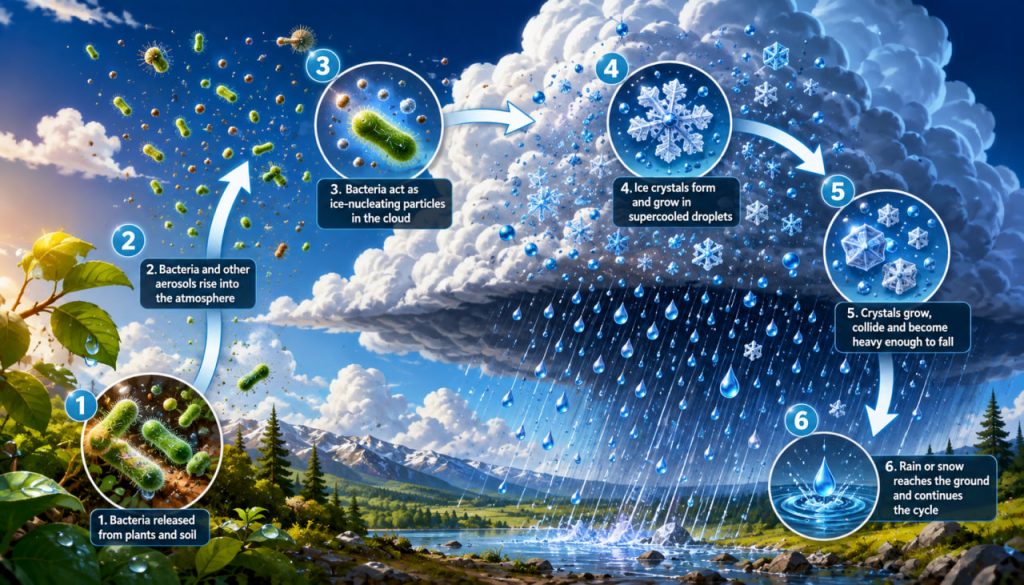
Clouds may look like simple collections of water droplets, but they are also complex airborne ecosystems filled with dust, sea salt, pollen, fungal fragments, and microorganisms.
Among these microscopic passengers are bacteria capable of helping supercooled water freeze. By acting as biological ice-nucleating particles, they may influence how ice crystals form inside clouds and, under suitable conditions, contribute to rain, snow, or hail.
Bacteria do not create storms from nothing, and their presence does not guarantee rainfall. Instead, certain microbes can accelerate one critical step in precipitation formation: the conversion of liquid cloud droplets into ice.
Why Clouds Need Aerosol Particles
Water vapor does not normally condense or freeze efficiently in perfectly clean air. It usually needs tiny suspended particles that provide surfaces on which droplets or ice crystals can begin forming.
These airborne particles are known collectively as aerosols.
Some aerosols act as cloud condensation nuclei, helping water vapor become liquid droplets. Others function as ice-nucleating particles, or INPs, enabling supercooled droplets to freeze at temperatures warmer than they would without assistance.
Pure or exceptionally clean water droplets can remain liquid far below 0°C. In the atmosphere, homogeneous freezing generally becomes important near −38°C, whereas suitable particles can initiate ice formation at much warmer subzero temperatures.
Mineral dust is a major atmospheric ice nucleator, but biological material can be exceptionally effective under relatively warm cloud conditions.
The Bacteria That Freeze Water
The best-known ice-nucleating bacterium is Pseudomonas syringae, a species commonly associated with plant surfaces.
Certain strains produce specialized proteins in their outer membranes. These proteins organize nearby water molecules into arrangements that resemble the structure of ice, lowering the energy barrier required for freezing.
Some bacterial ice nucleators can initiate freezing at temperatures close to −2°C, although effectiveness varies greatly among strains, cells, and environmental conditions.
This makes them unusually powerful compared with many non-biological particles, which typically become active only at colder temperatures.
Researchers have detected P. syringae and other ice-active bacteria in cloud water, rain, snow, and hail. Laboratory experiments also show that some strains can survive ultraviolet radiation, cold temperatures, and other stresses associated with atmospheric transport while retaining ice-nucleating activity.
How Bacteria Reach the Clouds
Cloud bacteria usually begin their journey on the ground.
They may originate from:
- Plant leaves
- Soil
- Forest surfaces
- Agricultural fields
- Rivers and lakes
- Ocean spray
- Decaying vegetation
Wind, turbulence, splashing rain, sea spray, and disturbances to vegetation can launch cells and biological fragments into the atmosphere.
Warm rising air can then carry these particles higher. If they enter a cloud, they may become incorporated into liquid droplets.
Recent research has shown that raindrop impacts can release additional ice-nucleating particles from surfaces, potentially creating a feedback in which rain helps aerosolize material that may later participate in cloud processes.
Not all biological ice nucleators are complete living cells. Protein fragments, fungal material, pollen-derived nanoparticles, and pieces of decaying organisms may also retain the ability to trigger freezing.
From a Bacterium to an Ice Crystal
Imagine a bacterial cell suspended inside a supercooled cloud droplet.
The water remains liquid even though its temperature is below freezing. When the droplet encounters an effective ice-nucleating surface, water molecules begin assembling into an ordered crystal lattice.
The droplet freezes.
Once ice appears in a mixed-phase cloud containing both liquid droplets and ice crystals, the ice can grow rapidly. Because the equilibrium vapor pressure over ice is lower than over liquid water, water vapor tends to move toward ice crystals while nearby droplets may evaporate.
This mechanism, known as the Wegener–Bergeron–Findeisen process, allows ice crystals to enlarge.
As they grow, crystals may collide, stick together, collect supercooled droplets, and become snowflakes, graupel, or hail embryos. If they become heavy enough, they fall. They may reach the surface as snow or melt into rain while passing through warmer air.
Biological ice nucleation has even been detected in hailstone embryos, supporting the idea that biological particles sometimes participate in the earliest stages of hail formation.
Do Bacteria Really Cause Rain?
The phrase “bacteria make it rain” is memorable but oversimplified.
Precipitation requires a suitable cloud, adequate moisture, appropriate temperature, vertical motion, enough time for particles to grow, and atmospheric conditions that allow them to reach the ground.
A bacterial ice nucleus can assist cloud glaciation, but it cannot produce rain in clear, dry air.
The scientifically accurate claim is that ice-active bacteria can modify cloud microphysics and may increase the likelihood or timing of precipitation in certain mixed-phase clouds.
The magnitude of this effect remains difficult to quantify globally. Biological particles can be rare compared with mineral dust, and their concentrations vary dramatically by season, ecosystem, weather pattern, and altitude.
Research has also shown that ice-nucleating particles can be efficiently removed from the atmosphere by precipitation. This “scavenging” may limit their influence on later cloud development until new particles are emitted.
The Bioprecipitation Hypothesis
Scientists have proposed a fascinating ecological idea known as the bioprecipitation hypothesis.
According to this hypothesis, microorganisms living on plants are lifted into the atmosphere, help initiate precipitation, return to the surface in rain or snow, and colonize new vegetation.
For microbes such as Pseudomonas syringae, this cycle could provide a mechanism for long-distance dispersal.
The idea is plausible because ice-active bacteria have repeatedly been recovered from precipitation, and genetically diverse ice-nucleating bacteria have been identified in samples collected during multiple rain events.
However, scientists are still investigating whether bacterial effects on precipitation are strong enough to provide a consistent evolutionary advantage. Their atmospheric role may differ substantially between regions and individual storms.
Bacteria, Plants, and Frost Damage
The same ice-nucleating ability that may help clouds freeze can damage plants.
When P. syringae lives on a leaf, its proteins can induce ice formation at relatively mild subzero temperatures. The resulting crystals may injure plant tissues and make nutrients more accessible to the bacterium.
This is one reason P. syringae is important in agriculture as both a plant-associated microorganism and a model organism for biological ice nucleation.
The bacterium therefore occupies an unusual ecological position: it can contribute to frost injury at ground level while potentially influencing ice formation thousands of meters above the ground.
Other Biological Rainmakers
Bacteria are only part of the biological aerosol story.
Fungal spores, fragments from fungi, pollen, algae, plant debris, and microbial proteins can all act as ice nucleators under certain conditions.
Experiments have shown that fungi can release nanoscale ice-active material far smaller and more numerous than intact fungal spores. Pollen can also release tiny particles capable of freezing water.
Observational and modeling research increasingly suggests that biological particles may be especially relevant in clouds at relatively warm subzero temperatures, where many mineral particles are less active.
A 2025 study of orographic clouds in the eastern Mediterranean found that biological aerosol particles were major drivers of daily variability in measured ice-nucleating particles at the study site.
Expert Perspective: A Small but Important Piece of Cloud Physics
Atmospheric scientists emphasize that ice-nucleating particles are among the major uncertainties in understanding cloud behavior and climate.
A comprehensive scientific review led by atmospheric researcher Thomas Kanji and colleagues describes INPs as critical to cloud freezing, precipitation development, and cloud radiative properties, while stressing that their sources and atmospheric abundance remain incompletely understood.
The key lesson is that clouds are shaped not only by temperature and water vapor but also by the identity of microscopic particles circulating through the atmosphere.
Bacteria may be numerically small components of airborne aerosol, yet some possess an ice-forming efficiency powerful enough to influence cloud processes under the right conditions.
Interesting Facts
- Some bacterial ice nucleators can freeze water at temperatures only a few degrees below 0°C.
- Ice-active bacteria have been found in rain, snow, cloud water, and hail.
- Biological ice nucleators do not always need to be alive; membrane fragments and proteins may remain active.
- Certain fungal nanoparticles can nucleate ice even when intact fungal cells are absent.
- Rain can both remove ice-nucleating particles from the atmosphere and release new ones from surfaces through splash aerosols.
- Some bacteria may travel through clouds and return to Earth in precipitation.
- Ice nucleation affects not only rainfall but also cloud brightness, lifetime, and interaction with sunlight.
- The microorganisms associated with precipitation are genetically diverse rather than belonging to a single “rain bacterium.”
Glossary
- Aerosol — A tiny solid particle or liquid droplet suspended in the atmosphere.
- Bioaerosol — Airborne biological material such as bacteria, pollen, spores, or cellular fragments.
- Ice-Nucleating Particle — A particle that helps supercooled water begin freezing.
- Cloud Condensation Nucleus — A particle on which water vapor condenses to form a cloud droplet.
- Supercooled Water — Liquid water that remains unfrozen below 0°C.
- Ice Nucleation — The initial formation of an ordered ice crystal structure.
- Mixed-Phase Cloud — A cloud containing both liquid water droplets and ice particles.
- Cloud Glaciation — The conversion of liquid cloud water into ice.
- Wegener–Bergeron–Findeisen Process — Growth of ice crystals at the expense of supercooled liquid droplets in a mixed-phase cloud.
- Bioprecipitation — The proposed involvement of biological particles in precipitation formation and atmospheric dispersal.
- Pseudomonas syringae — A plant-associated bacterial species that includes highly efficient ice-nucleating strains.
- Heterogeneous Freezing — Freezing initiated by contact with a foreign particle or surface.
- Homogeneous Freezing — Freezing that occurs without a foreign nucleating surface.
- Cloud Microphysics — The study of microscopic processes controlling cloud droplets, ice crystals, and precipitation.