Air travel is often described as one of the safest forms of transportation. Modern aircraft are built to withstand powerful forces, pilots are trained for unstable weather, and flight routes are constantly monitored.
Yet many passengers have noticed a worrying question in the news: is turbulence getting worse?
The answer is increasingly clear. Climate change is expected to make some types of aviation turbulence more frequent, stronger, and harder to avoid, especially clear-air turbulence near jet streams.
This does not mean every flight will become dangerous. It does not mean planes are suddenly unsafe. But it does mean the atmosphere is changing in ways that matter for pilots, airlines, passengers, and aviation safety systems.
What Is Turbulence?
Turbulence is irregular air motion.
A plane flies through air the way a boat moves through water. When the air is smooth, the aircraft feels steady. When the air becomes chaotic, the aircraft can shake, drop, rise, or roll slightly.
Turbulence can be caused by:
- Thunderstorms
- Mountains
- Jet streams
- Strong wind shear
- Rapid temperature changes
- Wake turbulence from other aircraft
- Rising warm air
- Clear-air turbulence
Most turbulence is uncomfortable rather than dangerous. The aircraft itself is usually not at serious risk.
The bigger danger is inside the cabin. Passengers or crew members who are not buckled in can be thrown upward or sideways during sudden severe turbulence.
Turbulence is usually a human-injury risk, not an aircraft-structure risk.
Why Clear-Air Turbulence Is So Difficult
Clear-air turbulence, often called CAT, is one of the most challenging forms of turbulence.
It happens in cloudless air, often at cruising altitude, where planes fly between cities and continents. Because it is not always connected to visible storms, it can be difficult for pilots to see or radar systems to detect.
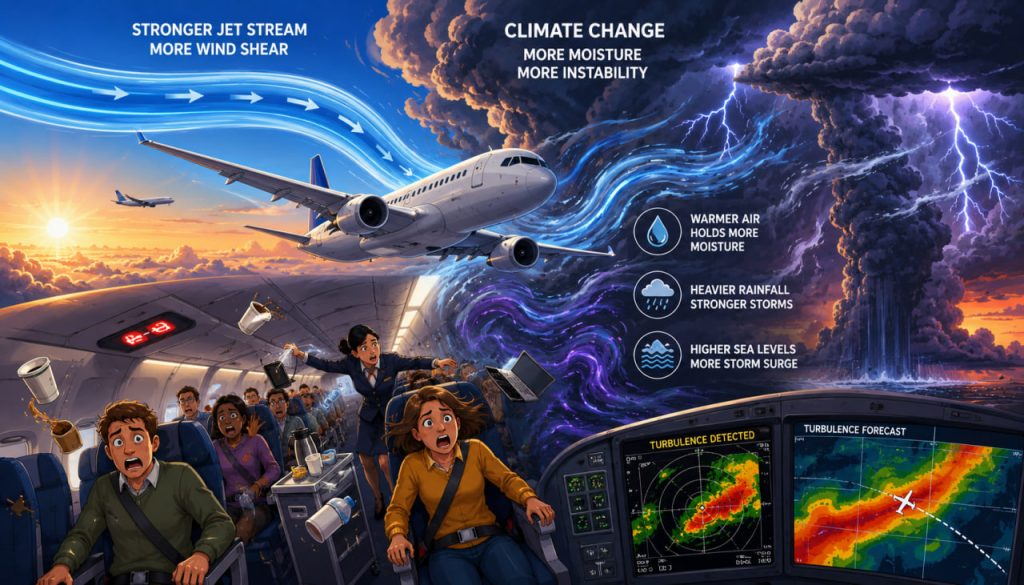
Clear-air turbulence is frequently associated with strong wind shear near jet streams. Wind shear means that wind speed or direction changes sharply over a short distance.
Imagine two layers of air moving at different speeds. Where they meet, the boundary can become unstable, creating chaotic motion. A plane crossing that invisible boundary can suddenly shake.
The danger of clear-air turbulence is surprise. If passengers and flight attendants are walking, serving food, or not wearing seat belts, injuries become more likely.
How Climate Change Affects the Jet Stream
The jet stream is a fast-moving river of air high in the atmosphere.
Commercial aircraft often fly near jet streams because they can help shorten flight times when used as tailwinds. But jet streams can also create turbulence when wind shear becomes strong.
Climate change affects temperature patterns in the atmosphere. Greenhouse gases warm the lower atmosphere while parts of the upper atmosphere can cool. This changes vertical temperature gradients and wind patterns near cruising altitudes.
The result can be stronger wind shear in key aviation corridors.
That matters because clear-air turbulence forms when atmospheric layers become unstable.
A major 2023 study found clear evidence that clear-air turbulence increased at aircraft cruising altitudes between 1979 and 2020. At a typical point over the North Atlantic, the strongest category of clear-air turbulence was 55% more frequent in 2020 than in 1979.
Why the North Atlantic Matters
The North Atlantic is one of the busiest flight corridors in the world.
Thousands of flights cross between North America and Europe every week. This region is also strongly influenced by the jet stream, making it especially important for turbulence research.
The same 2023 research found notable increases in severe clear-air turbulence over the North Atlantic and other major flight routes, including parts of Europe, the Middle East, and the South Atlantic.
This does not mean the North Atlantic is unsafe. It means airlines and forecasters must pay close attention to changing upper-atmosphere conditions.
Small percentage changes in turbulence can matter when millions of people fly every day.
Is Turbulence Becoming More Dangerous?
Turbulence becomes dangerous when it is strong, sudden, and catches people unprepared.
Modern aircraft are engineered for turbulence loads. Pilots can slow the aircraft to a safe turbulence penetration speed, change altitude, request routing adjustments, or avoid storm systems when possible.
But clear-air turbulence remains difficult because it can occur without visible warning.
The greatest risks are:
- Unbuckled passengers
- Standing crew members
- Loose objects
- Hot drinks and service carts
- Sudden altitude changes
- Panic and falls in the aisle
Serious injuries are still rare compared with the total number of flights. However, turbulence is one of the leading causes of weather-related in-flight injuries.
The simplest safety tool remains the most effective: keep your seat belt fastened whenever seated.
Does Climate Change Create More Storm Turbulence Too?
Climate change can also influence convective turbulence, the kind associated with thunderstorms and strong vertical air movement.
A warmer atmosphere can hold more water vapor and support more intense rainfall in many regions. Warmer surface conditions can also contribute to stronger instability under the right circumstances.
For aviation, this matters because thunderstorms are already major hazards. They can produce severe turbulence, lightning, hail, icing, wind shear, and powerful updrafts and downdrafts.
Pilots generally avoid thunderstorms because radar can identify many storm cells. Clear-air turbulence is more difficult because it is often invisible.
So while storm turbulence is important, the climate-turbulence discussion often focuses on CAT because it is both increasing and harder to detect.
Why Turbulence Forecasting Is Getting More Important
Aviation meteorology is becoming more advanced.
Forecasters use weather models, satellite data, aircraft reports, wind measurements, turbulence indices, and real-time pilot observations to identify risky airspace.
Airlines can adjust routes to avoid expected turbulence. Pilots can change altitude. Dispatchers can plan around unstable areas.
However, avoiding turbulence has trade-offs. A smoother route may be longer, requiring more fuel. More fuel means higher costs and potentially more emissions.
This creates a difficult feedback problem: climate change may increase turbulence, and avoiding turbulence may sometimes increase fuel burn unless managed efficiently.
Future aviation will need better forecasting, smarter routing, and cleaner technology at the same time.
Expert Perspective
Professor Paul Williams, an atmospheric scientist at the University of Reading, is one of the leading researchers studying climate change and aviation turbulence.
His work has helped show that clear-air turbulence is not just a passenger comfort issue. It is a growing operational challenge for aviation. Research from his team found that the skies aircraft fly through are bumpier today than four decades ago, with clear-air turbulence increasing in various regions as the climate has warmed.
The expert message is practical: aircraft are strong, but people inside the cabin are vulnerable when turbulence arrives without warning.
This is why better detection, better forecasting, and consistent seat belt habits matter.
Future Projections: What Scientists Expect
Climate models suggest that clear-air turbulence could increase further as the planet warms.
A 2017 global study projected increases in clear-air turbulence frequency and severity in several important aviation regions by the second half of this century, especially in areas influenced by jet streams.
More recent research reported by the American Geophysical Union also suggests that clear-air turbulence is likely to increase in many Northern Hemisphere jet-stream regions, with rising probability as warming increases.
The exact scale of future change will depend on climate changes, atmospheric dynamics, flight routes, forecasting technology, and how aviation adapts.
But the direction of the risk is hard to ignore.
A warmer climate is likely to mean bumpier skies in key flight corridors.
What Airlines Can Do
Airlines are not powerless.
They can reduce turbulence risks by improving:
- Turbulence forecasting
- Real-time data sharing
- Pilot reporting systems
- Cabin crew procedures
- Passenger seat belt communication
- Route planning
- Aircraft-based sensing technologies
- Training for sudden turbulence events
Some systems allow aircraft to share turbulence data automatically with other aircraft and dispatch centers. This can help flights behind them avoid the same unstable region.
In the future, lidar and other remote-sensing technologies may help detect clear-air turbulence ahead of the aircraft, although widespread operational use remains a technical challenge.
What Passengers Can Do
Passengers cannot control the atmosphere, but they can reduce personal risk.
The best habits are simple:
- Keep your seat belt fastened whenever seated.
- Follow crew instructions quickly.
- Avoid standing when the seat belt sign is on.
- Secure laptops, phones, bottles, and bags.
- Be careful with hot drinks.
- Help children stay buckled properly.
- Do not panic during normal turbulence.
Turbulence can feel dramatic, but aircraft are designed for it.
The cabin is safest when people and objects are secured.
Aviation in a Changing Climate
Turbulence is only one way climate change affects aviation.
Airports may face more flooding, heat can reduce aircraft performance during takeoff, storms can disrupt schedules, and wildfire smoke can affect visibility and operations.
Aviation also contributes to climate change through carbon dioxide emissions and non-CO2 effects such as contrails.
This makes the relationship between climate and aviation two-sided. Aviation must adapt to a changing atmosphere while also reducing its climate impact.
The future of flight will depend on cleaner fuels, more efficient aircraft, better operations, improved forecasting, and stronger safety culture.
Climate change is not ending air travel, but it is changing the conditions under which aviation operates.
Interesting Facts
- Clear-air turbulence can happen in cloudless skies.
- The North Atlantic is one of the world’s most important regions for studying aviation turbulence.
- Turbulence rarely threatens the aircraft itself, but it can injure unbuckled people.
- Jet streams can help planes fly faster when used as tailwinds.
- Strong wind shear near jet streams is a major cause of clear-air turbulence.
- Flight crews are at particular risk because they often move through the cabin during flight.
- Aircraft may change altitude to find smoother air.
- Turbulence forecasting is improving with better models and aircraft data.
- Climate change can affect aviation through turbulence, heat, storms, flooding, and changing winds.
- Wearing a seat belt while seated is the easiest way passengers can reduce turbulence injury risk.
Glossary
- Turbulence — Irregular air motion that can make an aircraft shake or move suddenly.
- Clear-Air Turbulence — Turbulence that occurs in cloudless air and can be difficult to detect visually or with radar.
- Jet Stream — A fast-moving band of wind high in the atmosphere.
- Wind Shear — A sharp change in wind speed or direction over a short distance.
- Cruising Altitude — The high-altitude phase of flight after climb and before descent.
- Convective Turbulence — Turbulence caused by rising warm air, often near thunderstorms.
- Turbulence Penetration Speed — A speed pilots may use to reduce stress on the aircraft during turbulent conditions.
- Lidar — A remote-sensing technology that uses laser light to measure conditions ahead or around an aircraft.
- Atmospheric Instability — A condition in which air layers are likely to move vertically or become disturbed.
- Contrails — Ice-crystal trails that can form behind aircraft under certain cold, humid conditions.