Fuel-free generators are attracting more attention as people look for cleaner, quieter, and more independent ways to produce electricity. The idea sounds powerful: a generator that does not require gasoline, diesel, gas, coal, or wood to operate.
In practical energy technology, a fuel-free generator usually means a system that produces electricity without burning fuel on site. Instead of consuming fuel, it uses available energy from the environment, stored energy, motion, heat differences, water flow, wind, sunlight, magnetic systems, or human movement.
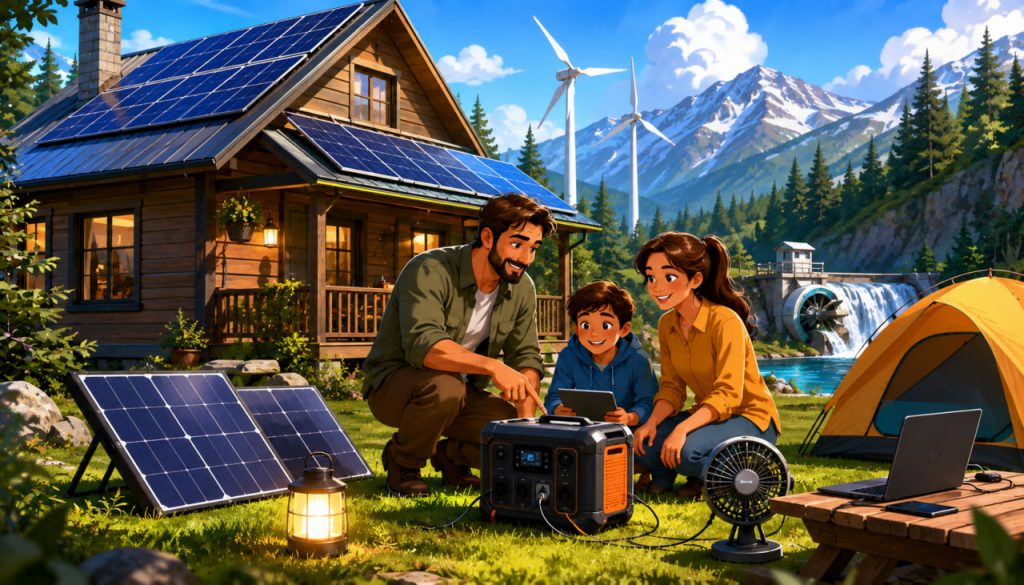
This makes fuel-free generators especially interesting for homes, farms, remote cabins, emergency backup, camping, off-grid systems, environmental monitoring, and small electronic devices.
The key idea is simple: a fuel-free generator does not create energy from nothing. It converts available energy into usable electricity.
What Is a Fuel-Free Generator?
A fuel-free generator is any power system that can generate or deliver electricity without a continuous supply of combustible fuel.
Traditional generators burn gasoline, diesel, propane, or natural gas. Fuel-free systems avoid that process.
Common examples include:
- Solar generator systems
- Wind turbine generators
- Micro-hydro generators
- Hand-crank generators
- Bicycle generators
- Thermoelectric generators
- Gravity-based storage systems
- Battery power stations charged from renewable sources
- Hybrid off-grid systems
In everyday language, many people call portable battery stations “solar generators.” Technically, the battery does not generate electricity by itself. It stores electricity and delivers it when needed. When connected to solar panels, however, the full system becomes a fuel-free power solution.
Why Fuel-Free Power Is Becoming Popular
Fuel-free generation is popular because it solves several practical problems.
A gasoline generator is powerful, but it needs fuel, oil, maintenance, ventilation, and safe storage. It also produces noise and exhaust.
A fuel-free system can be quieter, cleaner, and easier to use in sensitive environments.
For home users, this can mean backup power for phones, lights, routers, laptops, medical devices, security systems, or small appliances. For rural users, it can mean electricity where fuel delivery is expensive or unreliable.
Fuel-free power is most valuable when silence, safety, low maintenance, and independence matter.
Solar Generators: The Most Common Option
Solar generators are the most familiar type of fuel-free power system.
A solar setup usually includes solar panels, a charge controller, a battery, and an inverter. The panels convert sunlight into electricity. The battery stores it. The inverter turns stored direct current into household-style alternating current.
Solar systems can be small enough for camping or large enough to support an entire home.
Their main advantage is availability. Sunlight is free, clean, and widely accessible. The main limitation is weather and daylight. Solar output drops at night, during storms, in shade, and in winter conditions.
For most households, the best solar backup system includes enough battery capacity to cover essential loads rather than trying to power everything.
Wind Generators
Wind generators convert moving air into electricity.
They can be useful in open areas with steady wind, such as coastal regions, farms, hills, and remote sites. Small wind turbines can support batteries, lighting, communication equipment, water pumping, or hybrid off-grid systems.
Wind power works best where wind is consistent. In a dense city or sheltered backyard, a small turbine may produce much less energy than expected.
Wind generators are location-dependent. A great turbine in a poor wind location becomes a poor power source.
This is why wind systems are often paired with solar panels. Solar may perform better on calm sunny days, while wind may help during cloudy or stormy periods.
Micro-Hydro Generators
Micro-hydro is one of the most powerful fuel-free options when conditions are right.
A micro-hydro generator uses flowing water from a stream, river, irrigation channel, or small waterfall. Water turns a turbine, and the turbine drives a generator.
Unlike solar and wind, flowing water can produce power day and night if the water source is stable.
This makes micro-hydro extremely valuable for remote homes, mountain cabins, farms, and off-grid communities.
The limitation is obvious: you need moving water, legal permission, proper installation, and environmental care.
Where reliable water flow exists, micro-hydro can be one of the most consistent renewable power sources.
Thermoelectric Generators
Thermoelectric generators produce electricity from temperature differences.
They use materials that create voltage when one side is hot and the other side is cooler. This effect is useful in special situations where waste heat is available.
Thermoelectric systems can power sensors, small electronics, remote monitoring devices, and specialized equipment. They are also used in some camping stoves that charge small devices while producing heat for cooking.
Their power output is usually modest, but their simplicity is attractive. They have no moving parts and can operate quietly.
Thermoelectric technology is not usually the best choice for powering a whole home, but it is excellent for niche applications.
Human-Powered Generators
Human-powered generators convert muscle energy into electricity.
Examples include hand-crank radios, pedal-powered chargers, emergency flashlights, and bicycle generator systems.
These devices are useful because they work almost anywhere. They do not depend on sunlight, wind, water, or fuel.
Their limitation is output. A person cannot comfortably produce large amounts of electricity for long periods. Human-powered systems are best for small loads such as radios, lights, phones, emergency beacons, and basic communication equipment.
Human-powered generators are not about comfort power. They are about survival, communication, and independence.
Magnetic and Mechanical Concepts
Some fuel-free generator designs use magnets, flywheels, coils, rotors, and mechanical motion to improve efficiency, reduce friction, or store rotational energy.
Magnets are important in many real generators because moving magnetic fields can induce electric current in coils. This is the same basic principle behind many alternators and turbines.
Flywheel systems can store energy mechanically and release it later. They are used in some industrial and grid-stability applications.
The practical value of these systems depends on engineering quality, energy input, friction losses, material strength, and control electronics.
Magnets and motion can help convert energy efficiently, but the system still needs an energy source to start and continue useful output.
Fuel-Free Generators for Home Backup
For home backup, the most practical fuel-free system is usually a battery power station combined with solar panels.
This setup can support essential devices during outages without fumes, fuel storage, or engine noise.
Good backup targets include:
- LED lights
- Wi-Fi router
- Phones
- Laptops
- Small refrigerator
- Medical equipment
- Security cameras
- Communication devices
Large appliances such as electric heaters, ovens, air conditioners, and water heaters require much bigger systems.
Before buying, calculate the wattage of the devices you want to power and how many hours you need them to run.
The best home system is sized for real energy needs, not for wishful thinking.
How to Choose a Fuel-Free Generator
Start with the energy source available to you.
If you have good sun, choose solar. If you have steady wind, consider wind. If you have flowing water, micro-hydro may be excellent. If you need emergency portability, choose a battery station with solar charging. If you need survival gear, choose a hand-crank or compact manual generator.
Then check:
- Continuous power output
- Peak power output
- Battery capacity
- Charging speed
- Inverter quality
- Weather resistance
- Maintenance needs
- Expandability
- Safety protections
- Real-world operating conditions
Do not choose only by maximum watt rating. Runtime matters just as much.
Expert Perspective
Energy engineers often describe power systems through three basic questions: where the energy comes from, how efficiently it is converted, and how reliably it can be stored or delivered.
This perspective is useful for fuel-free generators. A good system is not mysterious. It has a clear energy source, a conversion method, storage if needed, and a realistic load plan.
The strongest fuel-free systems combine smart design with predictable natural energy: sunlight, wind, water, heat differences, or stored electricity.
The Future of Fuel-Free Generation
Fuel-free generators will likely become more common as batteries improve, solar panels become more efficient, and smart energy systems become easier to install.
Future homes may combine rooftop solar, balcony solar, home batteries, smart inverters, micro-wind units, energy-saving appliances, and intelligent load management.
Small devices may increasingly use ambient energy harvesting, such as vibration, body movement, light, heat, and radio-frequency energy.
The future is not one single miracle generator. It is a network of cleaner technologies working together.
Fuel-free power is most powerful when generation, storage, and efficiency are designed as one system.
P.S. I also saw startups online talking about new types of fuel-free generators using graphene elements and neutrino energy (Neutrinovoltaic), as well as other approaches not covered in the article. If you’re interested in this topic, let me know in the comments.
Interesting Facts
- Many modern “solar generators” are actually battery stations charged by solar panels.
- A fuel-free generator can be silent if it has no combustion engine.
- Micro-hydro can produce power day and night when water flow is stable.
- Hand-crank generators are still useful for emergency radios and survival kits.
- Thermoelectric generators can create electricity from heat differences.
- Magnets are used in many real generators because moving magnetic fields can induce current.
- The most reliable off-grid systems often combine more than one energy source.
- Reducing electricity consumption can be as important as increasing generation.
Glossary
- Fuel-Free Generator — A system that provides electricity without burning gasoline, diesel, gas, coal, or wood.
- Solar Generator — A battery-based power system that can be charged by solar panels.
- Inverter — A device that converts direct current into alternating current for household devices.
- Charge Controller — Electronics that regulate how batteries are charged from solar panels or other sources.
- Micro-Hydro Generator — A small system that generates electricity from flowing water.
- Wind Turbine — A generator that converts wind energy into electrical energy.
- Thermoelectric Generator — A device that produces electricity from a temperature difference.
- Flywheel — A rotating mechanical device that stores energy as motion.
- Energy Harvesting — Capturing small amounts of energy from the environment, such as light, heat, motion, or vibration.
- Continuous Power — The amount of power a system can provide steadily over time.
- Peak Power — The short burst of power a system can provide for startup loads.
- Off-Grid System — A power setup that operates independently from the main electrical grid.