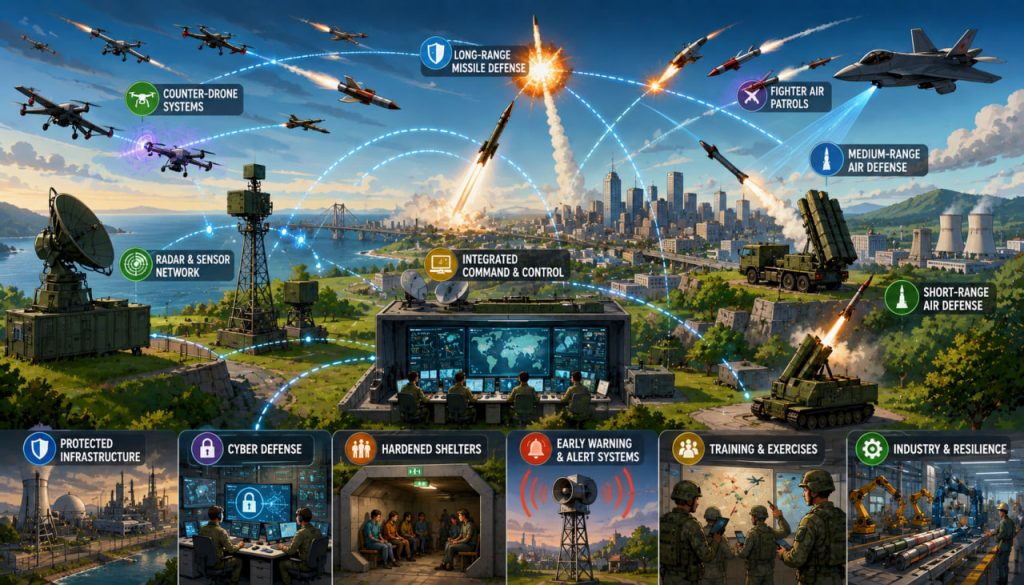
Drone and missile threats have changed the meaning of national defense. A country no longer has to prepare only for traditional aircraft or rare ballistic missile attacks. Modern threats can include cheap one-way attack drones, cruise missiles, ballistic missiles, hypersonic weapons, decoys, electronic warfare, cyberattacks, and large mixed salvos designed to overwhelm defenses.
If an AI system were asked how to protect a country from drones and missiles, the strongest answer would not be a single weapon or miracle technology. It would recommend a layered, networked, resilient national defense system that combines military readiness, civilian protection, intelligence, sensors, cybersecurity, logistics, and rapid decision-making.
The main principle is simple: no country can rely on one shield. It needs many shields working together.
Why Drones and Missiles Are So Difficult to Stop
Drones and missiles create different problems.
Small drones can be cheap, numerous, hard to detect, and launched in groups. Some fly low and slowly, making them difficult for traditional air-defense systems designed for faster aircraft. Missiles can travel at high speed, fly complex routes, or attack from long range.
The biggest challenge is saturation. An attacker may launch many drones and missiles at the same time, forcing defenders to decide quickly which threats are real, which are decoys, and which targets are most important.
CSIS analysis of modern drone and missile attacks highlights the growing problem of mixed salvos, where cruise missiles, ballistic missiles, and one-way attack drones are used together to strain air-defense networks.
The First AI Recommendation: Build Layered Defense
AI would recommend a layered defense system because different threats require different responses.
A complete national shield may include:
- Long-range missile defense
- Medium-range air defense
- Short-range air defense
- Counter-drone systems
- Fighter aircraft
- Radar networks
- Passive sensors
- Electronic protection
- Civil defense and shelters
- Backup command systems
Each layer covers weaknesses in another layer. Expensive interceptors should not be wasted on every small drone if cheaper defensive options are available. At the same time, high-end missiles may require advanced systems designed specifically for fast and complex threats.
NATO’s Integrated Air and Missile Defence policy describes a comprehensive, layered approach using different systems and technologies across ranges and altitudes to defend against unmanned aircraft, cruise missiles, ballistic missiles, hypersonic threats, and other air threats.
Sensors Matter as Much as Weapons
A missile or drone cannot be stopped if it is not detected in time.
That is why AI would prioritize sensor fusion. This means combining information from radar, satellites, aircraft, acoustic sensors, infrared systems, electronic intelligence, visual observation, and other sources into one shared picture.
A modern defense network should not depend on a single radar site. It should use many sensors, spread across the country, with backup communication channels.
CSIS describes “mesh sensing” as an important direction for air and missile defense, where distributed sensors help create a more complete and resilient picture of incoming threats.
For AI, this is a natural task. AI can compare large streams of sensor data, identify unusual patterns, reduce false alarms, and help human operators understand what is happening faster.
AI Should Support Humans, Not Replace Them
In national defense, speed matters. But so does judgment.
AI can help classify threats, estimate likely flight paths, prioritize alerts, and recommend defensive responses. It can also help manage logistics, maintenance, training simulations, and resource planning.
However, decisions involving force, escalation, and civilian safety should remain under responsible human control.
The best role for AI is to make human defenders faster, better informed, and less overwhelmed.
This is especially important during mass attacks, when operators may face hundreds of signals, uncertain information, and only minutes to respond.
Counter-Drone Defense Must Be Cheap and Scalable
One of the hardest problems is cost.
If a country uses very expensive missiles to destroy very cheap drones, the attacker can win economically. The defender may run out of interceptors faster than the attacker runs out of drones.
CSIS has noted this cost imbalance in drone warfare, where low-cost one-way attack drones can force defenders to use far more expensive air-defense resources.
AI would recommend a mix of defensive tools, including detection systems, electronic protection, short-range interceptors, mobile defenses, hardened infrastructure, and future technologies such as directed energy where appropriate.
The key is not simply to shoot everything down with the most expensive system. The key is to match the defensive tool to the threat.
Protect Critical Infrastructure First
A country cannot protect every object equally.
AI would recommend ranking critical infrastructure by importance and vulnerability. This may include:
- Power plants
- Electrical substations
- Water systems
- Hospitals
- Communication hubs
- Fuel storage
- Military bases
- Airports
- Ports
- Government command centers
- Food and logistics networks
The goal is to prevent cascading failure. For example, damage to power infrastructure can affect hospitals, water treatment, heating, communications, banking, transport, and emergency services.
National defense is not only about intercepting weapons. It is also about keeping society functioning after an attack.
Civil Defense Is Part of Air Defense
AI would also recommend strong civilian preparedness.
Even the best defense system cannot guarantee that every missile or drone will be stopped. Countries need public warning systems, shelters, evacuation plans, medical readiness, backup power, emergency communication, and clear instructions for civilians.
This includes educating people on what to do during air alerts, how to find shelter, how to prepare emergency supplies, and how to avoid dangerous debris after interceptions.
Civil defense reduces casualties and panic. It also makes the country more resilient.
Cybersecurity and Electronic Warfare Protection
Modern air defense depends on digital networks.
That makes cybersecurity essential. Command systems, radars, communication links, logistics databases, and power infrastructure must be protected against hacking, disruption, and deception.
NATO’s IAMD policy emphasizes resilience and survivability, including the need to withstand kinetic and non-kinetic disruption such as cyberattacks and electromagnetic warfare.
AI would recommend continuous monitoring of critical networks, redundant systems, secure communication channels, and regular stress testing.
A country must assume that attackers will try not only to strike targets physically, but also to confuse, blind, or overload the systems defending them.
Training and Exercises Are Essential
Technology alone is not enough.
Air-defense crews, civil authorities, emergency services, infrastructure operators, and political leaders must train together. They need realistic exercises that include drone swarms, mixed missile attacks, communication failures, cyber pressure, false alarms, and civilian evacuation challenges.
NATO’s 2025 Formidable Shield exercise included more than 100 targets, including ballistic missile threats, supersonic and subsonic missile threats, and unmanned aircraft systems, to train integrated defense cooperation.
AI can improve training by creating simulations, testing decision-making, identifying weak points, and helping planners compare different defense scenarios.
Build Industry Before the Crisis
A country cannot wait until an attack begins to build interceptors, radars, batteries, spare parts, drones, shelters, and repair crews.
AI would recommend developing national production capacity and strong supply chains before a crisis. This includes stockpiles, repair capability, trained personnel, and partnerships with allies.
Missile and drone defense is partly a battle of endurance. The side that can detect, repair, replace, adapt, and resupply faster has a major advantage.
A defense system is only as strong as the industrial base behind it.
Expert Perspective
NATO’s current air and missile defense thinking points toward integrated, layered, resilient systems that combine sensors, command-and-control, and different defensive tools. CSIS experts also emphasize that modern attacks increasingly involve large mixed salvos designed to overwhelm defenses, making distributed sensing, cost-effective interception, and defense integration more important than ever.
The expert lesson is clear: the future of national air defense belongs to countries that connect many systems into one intelligent shield, rather than relying on isolated weapons.
What AI Would Recommend Overall
AI would recommend a national strategy built around five priorities.
First, detect threats early with distributed sensors.
Second, connect all data into a unified command system.
Third, use layered defenses so each threat is matched with the right response.
Fourth, protect civilians and critical infrastructure.
Fifth, build long-term resilience through cybersecurity, training, production, and alliances.
The most effective defense is not a single technology. It is a system of systems.
A country is safest when its sensors, soldiers, engineers, emergency services, industries, allies, and citizens are all part of the same resilience strategy.
Interesting Facts
- Small drones can be strategically dangerous because they are often cheap, numerous, and difficult to detect.
- Expensive interceptors are not always the best answer to low-cost drones.
- Air defense works best when sensors and command systems are integrated across different regions and platforms.
- Civil defense can save lives even when military defenses fail to intercept every threat.
- Modern missile and drone attacks often combine different threat types to overload decision-making.
- AI is especially useful for analyzing large amounts of sensor data quickly.
- Strong repair crews and spare parts can be as important as frontline defense systems.
Glossary
- Drone — An unmanned aircraft that can be used for surveillance, delivery, attack, or other missions.
- Missile — A guided weapon designed to fly toward a target.
- Integrated Air and Missile Defense — A connected system of sensors, command centers, weapons, and procedures used to defend against air and missile threats.
- Layered Defense — A defense structure with multiple protective levels for different ranges and threat types.
- Sensor Fusion — The process of combining data from many sensors into one clearer operational picture.
- Counter-UAS — Systems and methods used to detect, track, and defeat unmanned aircraft systems.
- Interceptor — A defensive weapon used to destroy or stop an incoming missile, drone, or aircraft.
- Saturation Attack — An attack using many threats at once to overwhelm defenses.
- Critical Infrastructure — Essential systems such as power, water, communications, transport, healthcare, and fuel networks.
- Command and Control — The system used to make decisions, coordinate forces, and direct defensive actions.
- Electronic Warfare — The use of electromagnetic signals to disrupt, protect, or control communications and sensors.
- Resilience — The ability of a country or system to continue functioning during and after an attack.