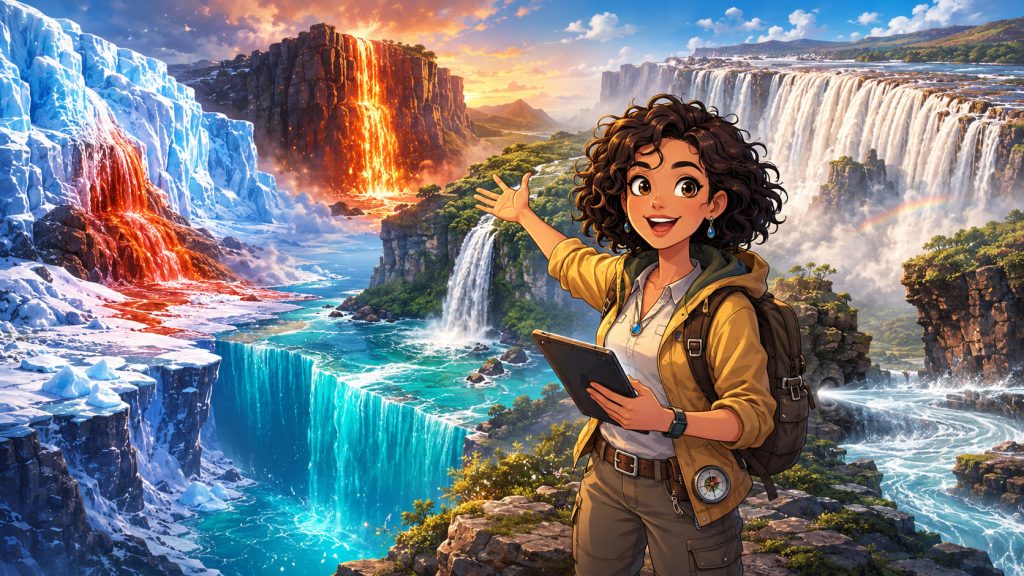
Waterfalls are among the most dramatic landscapes on Earth, but some are far stranger than the classic image of a river dropping over a cliff.
Around the world, there are waterfalls that disappear into caves, flow directly into the ocean, turn red because of iron-rich water, freeze into giant walls of ice, or become so wide that they look more like moving horizons than rivers.
These extraordinary places show how geology, climate, gravity, volcanic activity, and erosion can combine to create landscapes that seem almost unreal.
Blood Falls, Antarctica
One of the strangest waterfalls on Earth is Blood Falls, located in Antarctica’s McMurdo Dry Valleys.
The water emerging from beneath Taylor Glacier has a deep red-orange color that makes it look like blood flowing across the ice.
The color is caused by iron-rich salty water.
When this ancient brine reaches the surface and comes into contact with oxygen, the dissolved iron oxidizes, producing a rusty red appearance.
The water has been trapped beneath the glacier for a very long time and is extremely salty.
Blood Falls is unusual because it reveals a hidden subglacial environment beneath one of the coldest places on the planet.
It is also scientifically important because microorganisms have been found surviving in the isolated, dark, salty environment beneath the ice.
Eternal Flame Falls, United States
Eternal Flame Falls in New York State is famous for something few waterfalls can offer: a small natural flame burning behind the falling water.
The waterfall itself is modest, but a pocket in the rock behind it releases natural gas.
When the gas is ignited, a small flame can burn beneath the cascade.
The flame is not always continuously burning and may occasionally need to be relit, but the combination of fire and falling water makes the site remarkable.
The gas originates from organic material trapped in ancient rocks.
Few places on Earth bring fire and flowing water together so visibly in the same natural setting.
Horsetail Fall and the “Firefall” Effect
Horsetail Fall in Yosemite National Park can briefly appear to be made of fire.
For several days around late winter, the setting sun can illuminate the waterfall at just the right angle.
When weather conditions are favorable, the falling water glows bright orange and red against the dark cliff.
The phenomenon is often called the Yosemite Firefall.
Nothing is actually burning.
The effect depends on sunlight, clear skies, sufficient water flow, and the correct viewing angle.
Because all of these conditions must occur simultaneously, the dramatic appearance is far from guaranteed.
Underwater Waterfalls in Mauritius
Near the island of Mauritius, aerial photographs reveal what looks like an enormous waterfall plunging beneath the ocean.
There is no real underwater waterfall.
Instead, sand and sediment from a shallow ocean shelf are transported toward much deeper water.
Seen from above, the flowing sediment creates the optical illusion of water pouring over the edge of an underwater cliff.
The effect is especially dramatic because of the sharp transition between turquoise shallow water and dark blue ocean depths.
This is one of the planet’s most famous geological illusions.
It demonstrates how ocean currents, sediment, and underwater topography can create landscapes that appear completely different from what is physically happening.
Horizontal Falls, Australia
Horizontal Falls in Western Australia challenges the idea that waterfalls must fall downward.
In the Kimberley region, powerful tides force enormous quantities of seawater through narrow gaps between rocky coastal formations.
The difference in water level on either side creates fast-moving currents that resemble horizontal waterfalls.
The direction reverses with the tides.
This means the “waterfall” can effectively flow one way and then later flow in the opposite direction.
The phenomenon is produced by a combination of extreme tidal movement and narrow geological passages.
Victoria Falls: A Wall of Water
Victoria Falls, on the border between Zambia and Zimbabwe, is not the tallest or widest waterfall in every measurement, but its overall scale is extraordinary.
During high flow, a huge volume of water from the Zambezi River plunges into a narrow gorge.
The waterfall stretches for more than a kilometer and creates enormous clouds of mist.
Local names associated with the falls describe the spectacle as smoke or spray that thunders.
The mist can rise hundreds of meters into the air and supports a humid microclimate around the gorge.
Victoria Falls is unusual because of the combination of width, height, water volume, and the extremely narrow chasm into which the river disappears.
Angel Falls, Venezuela
Angel Falls is famous for being the world’s highest uninterrupted waterfall.
Water drops from the edge of Auyán-tepui, a massive flat-topped mountain in Venezuela.
Its total height is close to one kilometer.
Because the drop is so extreme, much of the falling water breaks into mist before reaching the bottom.
During periods of lower flow, strong winds can even push the water away from the cliff face.
The surrounding tepui landscape is itself unusual.
These ancient sandstone table mountains rise dramatically above tropical forests and contain ecosystems isolated from the surrounding lowlands.
Dettifoss, Iceland
Dettifoss is one of Europe’s most powerful waterfalls.
Located in northern Iceland, it carries glacier-fed water through a stark volcanic landscape.
The water is often gray or brown because it contains large quantities of sediment.
Unlike delicate waterfalls surrounded by lush vegetation, Dettifoss looks heavy, turbulent, and almost industrial in its power.
The contrast between glacial water, black volcanic rock, and barren surroundings gives the waterfall a particularly dramatic appearance.
Its unusual character reflects Iceland’s combination of glaciers and active volcanic geology.
Pamukkale’s Travertine Waterfalls, Türkiye
Pamukkale is not a traditional single waterfall.
Mineral-rich thermal water flows down a hillside and deposits calcium carbonate.
Over thousands of years, these deposits have created brilliant white terraces, pools, and cascading formations.
The landscape looks almost like a frozen waterfall made from white stone.
The terraces are made of travertine, a type of limestone formed by mineral precipitation from flowing water.
Pamukkale demonstrates how water can build landscapes rather than simply erode them.
Frozen Waterfalls of the Arctic and Mountains
In extremely cold climates, waterfalls can partially or completely freeze.
Instead of flowing water, cliffs become covered in giant columns, curtains, and walls of ice.
These formations constantly change.
Water can continue moving behind or inside the frozen exterior, creating unstable structures.
Frozen waterfalls are particularly common in mountainous regions where temperatures remain below freezing for extended periods.
They are spectacular but potentially dangerous because large sections of ice can collapse without warning.
Waterfalls That Flow Directly Into the Ocean
Some waterfalls end directly on beaches or in seawater.
McWay Falls in California is one famous example.
Water descends from a coastal cliff toward a small cove beside the Pacific Ocean.
Depending on tides and sediment conditions, the waterfall may reach the beach rather than falling directly into the sea.
Such waterfalls are known as tidefalls when their interaction with the ocean varies according to tides and shoreline conditions.
They are unusual because rivers and streams normally travel through larger drainage systems before reaching the sea.
Expert Perspective
Geologists view waterfalls as temporary features on geological timescales.
They form where resistant rock, softer rock, tectonic uplift, glaciers, volcanic activity, or sudden changes in terrain create sharp differences in elevation.
But waterfalls also destroy the landscapes that created them.
Falling water erodes rock at the base of cliffs, while rivers cut backward into the landscape.
A waterfall can therefore migrate upstream over thousands of years and may eventually disappear entirely.
This is why waterfalls are not static monuments.
They are active stages in the long-term evolution of rivers and landscapes.
Why Some Waterfalls Look So Different
The appearance of a waterfall depends on much more than height.
Rock type determines the shape of the cliff.
Water volume influences whether the waterfall appears delicate or massive.
Wind can turn falling water into mist.
Sediment changes the color.
Minerals create terraces and unusual deposits.
Temperature can transform liquid water into giant ice structures.
Even sunlight can completely alter the visual effect for a few minutes each day.
The world’s most unusual waterfalls are natural laboratories where geology, water, climate, and light interact in spectacular ways.
Interesting Facts
- Blood Falls in Antarctica gets its red color from iron-rich salty water oxidizing at the surface.
- Angel Falls is so tall that part of its water can become mist before reaching the ground.
- Horizontal Falls in Australia are created mainly by tidal currents rather than river water falling vertically.
- The “underwater waterfall” near Mauritius is an optical illusion produced by moving sand and sediment.
- Yosemite’s Firefall effect depends on the exact angle of the setting sun and suitable water flow.
- Victoria Falls creates enough mist to support unusually humid vegetation near its gorge.
- Pamukkale’s white terraces were built gradually by mineral-rich thermal water.
- Waterfalls can move upstream over geological time as erosion wears away the cliff.
- Some waterfalls freeze while water continues flowing behind the ice.
- Waterfall color can be influenced by sediment, minerals, algae, and dissolved metals.
Glossary
- Waterfall — A section of a river or stream where water drops steeply over an elevation change.
- Brine — Water containing an unusually high concentration of dissolved salt.
- Oxidation — A chemical reaction involving oxygen or electron transfer, often responsible for rust formation.
- Subglacial — Located beneath a glacier or ice sheet.
- Travertine — A type of limestone formed when mineral-rich water deposits calcium carbonate.
- Sediment — Small particles of rock, sand, clay, or organic material transported by water or wind.
- Tepui — A flat-topped sandstone mountain found mainly in the Guiana Highlands of South America.
- Tidal Current — Movement of seawater caused by rising and falling tides.
- Erosion — The gradual removal and transport of rock or soil by water, wind, ice, or other processes.
- Microclimate — A local climate that differs from conditions in the surrounding region.
- Tidefall — A coastal waterfall whose relationship with the sea changes depending on tides and shoreline conditions.
- Optical Illusion — A visual effect in which something appears different from its actual physical structure.