The idea of the sea completely drying up sounds like science fiction, but it is a powerful way to understand how deeply oceans influence life on Earth.
Seas and oceans are not simply giant reservoirs of water. They regulate climate, produce much of the oxygen in the atmosphere, transport heat around the planet, support vast food webs, and shape weather systems.
If the world’s seas disappeared, Earth would become hotter, drier, less stable, and eventually far less hospitable to life.
The First Change: Coastlines Would Vanish
If a sea dried up, the most obvious transformation would be geographic.
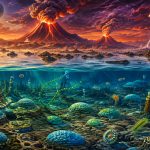
Former coastlines would turn into enormous exposed basins. Harbors, beaches, reefs, islands, and coastal ecosystems would suddenly stand above dry ground.
In shallow regions, the newly exposed seabed could stretch for hundreds of kilometers.
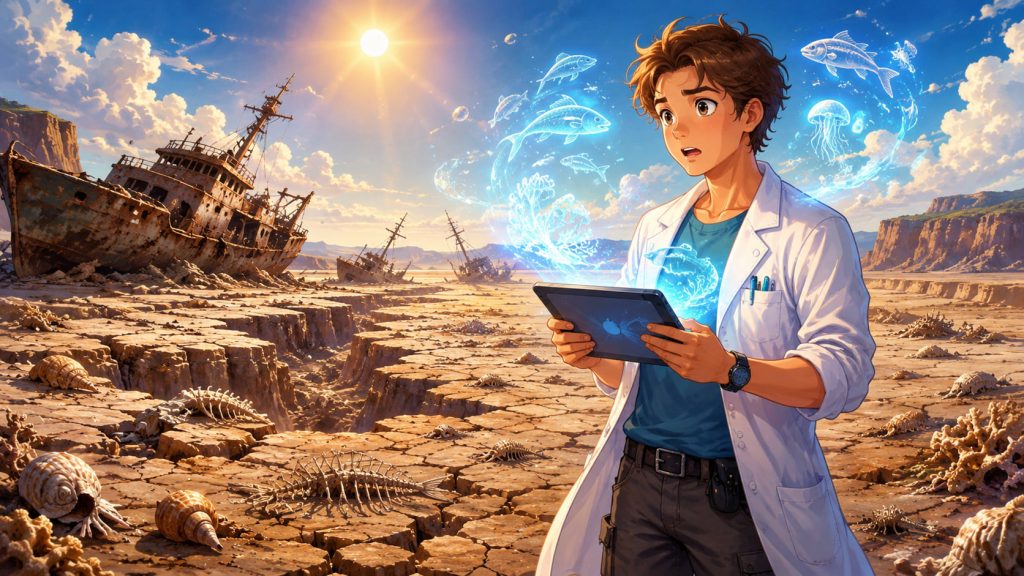
Old underwater canyons, ridges, sediment layers, shipwrecks, and geological formations would become visible.
The landscape would look unfamiliar, with steep drops where continental shelves once descended beneath the water.
Marine Ecosystems Would Collapse
The biological consequences would be immediate.
Fish, corals, shellfish, plankton, marine mammals, and countless microorganisms depend on seawater.
Without it, almost all marine ecosystems would collapse.
Some organisms might temporarily survive in shrinking pools, underground water systems, or isolated lakes, but most ocean species could not adapt fast enough.
The disappearance of the seas would represent one of the largest extinction events imaginable.
Coral reefs, kelp forests, seagrass meadows, mangroves, and coastal wetlands would disappear along with the species that depend on them.
The Planet Would Lose a Major Oxygen Producer
Forests are often called the lungs of the Earth, but the oceans also play a major role in oxygen production.
Microscopic marine organisms called phytoplankton perform photosynthesis.
Collectively, they contribute a very large share of the oxygen produced on Earth.
If the seas vanished, most phytoplankton would disappear.
Atmospheric oxygen would not suddenly collapse overnight because enormous quantities of oxygen are already stored in the atmosphere.
However, one of the planet’s most important oxygen-producing systems would be lost.
Over very long periods, this could significantly alter the chemistry of the atmosphere.
Earth’s Climate Would Become Far More Extreme
Water has an extraordinary ability to absorb and store heat.
The oceans act like a giant thermal buffer, absorbing heat during warm periods and releasing it gradually.
Without seas, this stabilizing effect would largely disappear.
Daytime temperatures in many areas could rise dramatically, while nighttime temperatures could fall more sharply.
Seasonal temperature differences would also become much stronger.
Coastal regions that currently experience mild climates would lose the moderating influence of nearby water.
Earth would behave more like a dry continental planet with severe temperature swings.
Ocean Currents Would Stop
Modern climate patterns depend heavily on ocean circulation.
Currents move warm water from tropical regions toward colder latitudes and transport cooler water back toward the equator.
Large circulation systems also redistribute nutrients and influence rainfall.
If the seas dried up, these currents would disappear completely.
Regions that currently depend on warm ocean currents could cool dramatically during certain seasons, while other areas could become much hotter.
Weather patterns across entire continents would be reorganized.
Rainfall Would Decline
Most atmospheric water ultimately comes from evaporation.
The oceans provide the largest source of water vapor entering the atmosphere.
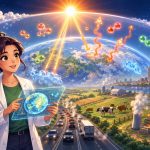
When sunlight heats the ocean surface, water evaporates, rises into the atmosphere, forms clouds, and eventually returns as rain or snow.
Without seas, the global water cycle would weaken dramatically.
Lakes, rivers, soil, and vegetation would still release some moisture, but they could not replace the oceans.
Many regions would experience severe declines in rainfall.
As drought expanded, forests and grasslands would shrink.
Rivers would weaken or disappear, and freshwater lakes would begin to contract.
Agriculture Would Face Enormous Pressure
Human agriculture depends on predictable rainfall, moderate temperatures, fertile soils, and accessible freshwater.
All of these would be affected.
Food-producing regions could experience more intense droughts, heat waves, dust storms, and seasonal instability.
Crop yields would fall in many areas.
Livestock would face shortages of water and vegetation.
Countries that depend heavily on fishing would lose an entire source of food almost immediately.
The global food system would become far less reliable.
The Exposed Seabed Could Become a Giant Salt Desert
Seawater contains dissolved salts and minerals.
If the water disappeared through evaporation, much of this material would remain behind.
Large portions of former seabeds could become covered with salt deposits.
This has already happened on smaller scales in real places where lakes and inland seas have shrunk.
Strong winds could lift salt-rich dust from exposed sediments and carry it over surrounding regions.
Such dust could damage crops, degrade soils, irritate respiratory systems, and contaminate freshwater supplies.
Former seabeds could become some of the harshest environments on the planet.
Dust Storms Could Become Much More Powerful
A dry ocean basin would contain enormous quantities of loose sediment.
Without water holding those particles in place, winds could transport them across continents.
Gigantic dust storms might become common around former marine basins.
Fine particles could remain suspended in the atmosphere for long periods.
This could affect visibility, air quality, cloud formation, and even regional temperatures.
Carbon Dioxide Would Behave Differently
The oceans are also one of Earth’s major carbon reservoirs.
Seawater absorbs carbon dioxide from the atmosphere, while marine organisms move carbon through biological and chemical cycles.
If the oceans disappeared, this major carbon-storage system would vanish.
Carbon dioxide concentrations could change dramatically depending on how the disappearance happened and how ecosystems responded.
Loss of marine carbon absorption, combined with the collapse of forests caused by drought, could increase atmospheric carbon dioxide.
That would create additional pressure on an already unstable climate.
Human Civilization Would Be Forced Inland
A drying sea would transform transportation, trade, food production, and settlement.
Major ports would become useless.
Ships would be stranded far from any remaining water.
Fishing industries would disappear.
Coastal cities might suddenly find themselves hundreds of kilometers from the nearest large body of water.
Millions or even billions of people could eventually migrate toward regions with reliable freshwater and survivable temperatures.
The political and economic consequences would be enormous.
Could Humans Live on the Former Seafloor?
Some exposed seabeds might temporarily become habitable.
But many would be extremely salty, dry, and hot.
Areas below modern sea level could also experience unusually high air pressure and temperatures.
The deepest ocean trenches would create extraordinary low-altitude environments.
For example, the Mariana Trench reaches almost 11 kilometers below present sea level.
If completely exposed, its deepest regions would be unlike almost any environment humans currently experience.
Expert Perspective
Climate scientists and oceanographers describe the ocean as one of the central regulators of Earth’s climate system.
Its enormous heat capacity, carbon storage, biological productivity, and role in the water cycle make it impossible to separate ocean health from planetary stability.
A world without seas would therefore not simply be Earth with less water.
It would function as a fundamentally different planet.
The disappearance of marine water would trigger interconnected changes in climate, ecosystems, atmospheric chemistry, agriculture, and human civilization.
Could the Oceans Actually Dry Up?
Under present-day conditions, Earth is not expected to suddenly lose its oceans.
Most ocean water continuously circulates through evaporation, clouds, rainfall, rivers, ice, and groundwater.
Over extremely long astronomical timescales, however, a brighter Sun could gradually increase global temperatures.
If Earth became hot enough, more water vapor could enter the upper atmosphere, where sunlight could break water molecules apart and allow hydrogen to escape into space.
This type of runaway or moist greenhouse process is one possible way a planet can gradually lose large quantities of water.
A similar process may help explain why Venus is extremely dry today despite evidence suggesting that it may once have possessed more water.
Interesting Facts
- Oceans cover about 71% of Earth’s surface.
- The Pacific Ocean alone covers a larger area than all of Earth’s continents combined.
- The deepest known part of the ocean, Challenger Deep, lies nearly 11 kilometers below sea level.
- Most of Earth’s liquid surface water is stored in the oceans.
- Phytoplankton are microscopic but collectively play a major role in global oxygen production and carbon cycling.
- Ocean currents move enormous quantities of heat around the planet.
- Large dried lakebeds on Earth demonstrate how exposed sediments can become sources of major dust and salt storms.
- The Mediterranean Sea experienced dramatic reductions in water level millions of years ago during the Messinian Salinity Crisis.
- Salt deposits on ancient seabeds help geologists reconstruct the history of vanished seas.
- A completely ocean-free Earth would have much stronger temperature extremes than the modern planet.
Glossary
- Phytoplankton — Microscopic organisms that live in water and perform photosynthesis.
- Evaporation — The process by which liquid water changes into water vapor.
- Water Cycle — The continuous movement of water between oceans, atmosphere, land, rivers, ice, and groundwater.
- Ocean Current — A large-scale movement of seawater driven by wind, temperature, salinity, and Earth’s rotation.
- Thermal Buffer — Something that absorbs and releases heat slowly, reducing rapid temperature changes.
- Carbon Reservoir — A natural system that stores large quantities of carbon.
- Seabed — The ground beneath a sea or ocean.
- Salinity — The concentration of dissolved salts in water.
- Continental Shelf — The relatively shallow submerged edge of a continent.
- Moist Greenhouse — A climate state in which large amounts of water vapor reach the upper atmosphere, potentially allowing long-term water loss to space.
- Messinian Salinity Crisis — A geological event about 5–6 million years ago when the Mediterranean became partly isolated from the Atlantic and experienced extreme evaporation and major salt deposition.